



What is an Integrated Management System (IMS) and its Components?
An Integrated Management System combines multiple ISO standards into one unified framework to improve efficiency, compliance, risk control, and performance. It manages quality, safety, environmental, and information security requirements. It helps manage processes, reduce duplication, improve compliance, and make better decisions.

Organisations today face increasing pressure to deliver high-quality products, protect employee safety, and secure sensitive information all at the same time. Managing them through separate systems often creates confusion. What if there is a way to manage them under one structured framework? An Integrated Management System offers exactly that.
By combining multiple ISO standards into a single coordinated system, organisations can simplify processes, reduce risks, and improve overall efficiency. In this blog, we will explore what is an Integrated Management System, its key components, and how to implement it to build a future-ready business. Let’s dive in!
What is an Integrated Management System?
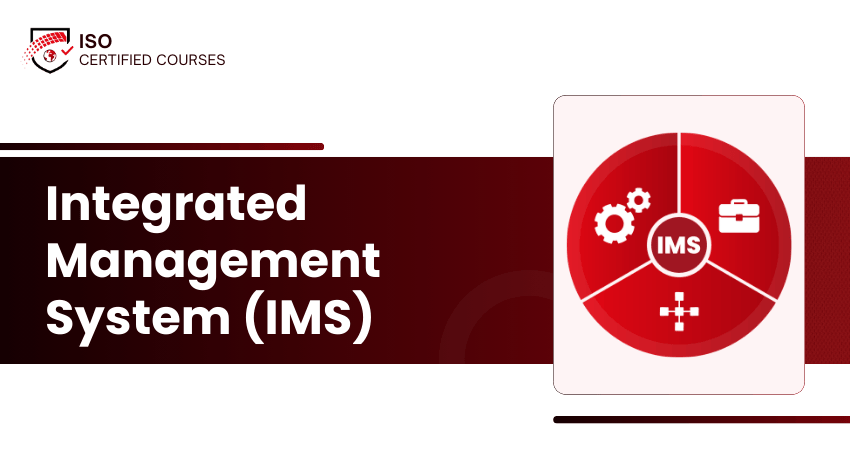
An Integrated Management System (IMS) is a single structured framework that connects various ISO standards into one system. It brings policies, procedures, records, and responsibilities together, so the organisation works in a coordinated way.
Rather than treating compliance areas independently, an IMS merges them to operate as one organisational system. Even more, an IMS does not replace individual standards. Instead, it integrates their requirements, so they are managed together
Components of the IMS
An IMS can include several standards depending on the organisation’s industry and operational risks. Below are the most commonly integrated systems:
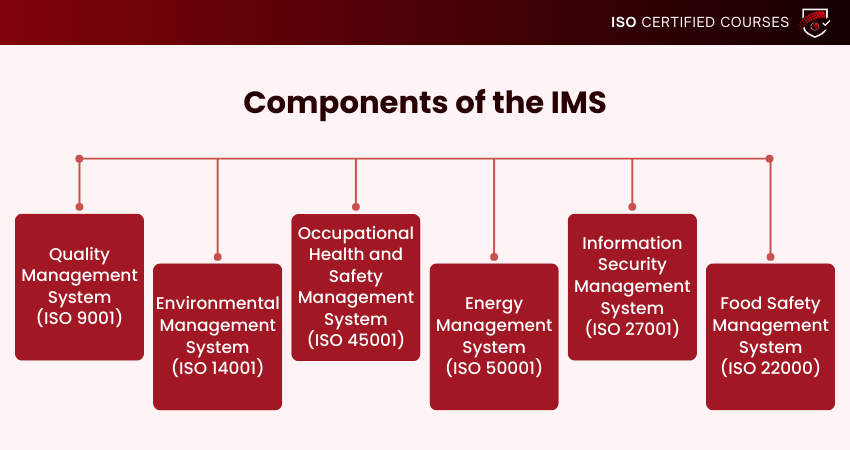
1) Quality Management System (ISO 9001)
The Quality Management System focuses on delivering products and services that meet customer expectations. It helps the organisation plan work, control processes, and improve performance. Under an IMS, quality becomes the backbone of every business operation. It helps ensure the organisation produces reliable outcomes while reducing errors, complaints, and rework.
Enhance your expertise in quality standards with ISO 9001 Training – Register today!
2) Environmental Management System (ISO 14001)
The Environmental Management System manages how business activities affect the environment. It identifies environmental aspects such as emissions, waste, resource usage, and pollution risks. In an IMS, environmental planning is part of everyday operations. When a company introduces a new process, it evaluates both operational efficiency and environmental impact.
Manage environmental responsibilities effectively with ISO 14001 Training – Join now!
3) Occupational Health and Safety Management System (ISO 45001)
ISO 45001 focuses on protecting workers from injuries, accidents, and workplace hazards. Instead of reacting to incidents, the system emphasises preventive risk management measures. In an IMS environment, safety becomes part of operational decision-making. Maintenance planning, procurement, and process design include hazard analysis and safety checks.
Redefine your workplace Health and Safety Management with ISO 45001 Training – Sign up soon!
4) Energy Management System (ISO 50001)
The Energy Management System (EnMS) controls energy usage across facilities, equipment, and processes. It reduces electricity consumption and operating costs through sustainable energy practices. In an IMS, energy monitoring works alongside production planning. It helps organisations identify energy inefficiencies and implement continuous improvements to optimise performance.
Improve your energy efficiency and sustainability practices with ISO 50001 Training – Start anytime!
5) Information Security Management System (ISO 27001)
An Information Security Management System (ISMS) protects organisational data such as customer information, contracts, and employee records from breaches, loss, or misuse. In an IMS, information security is not only an IT responsibility. Every department handles data, so security becomes part of overall risk management. With that, it helps organisations manage cyber threats alongside operational risks.
Protect and safeguard organisational information and data with ISO 27001 Training – Explore immediately!
6) Food Safety Management System (ISO 22000)
The Food Safety Management System applies mainly to food manufacturers, processors, and distributors. It ensures products are safe for consumption and prevents contamination. When integrated, food safety aligns with quality, safety, and operational controls. Hygiene practices, storage procedures, and traceability records are managed through shared processes.
Understand the real-world food safety system with ISO 22000 Training – Get started today!
Benefits of Integrated Management System
An Integrated Management System improves how an organisation operates on a daily basis by connecting several standards. Below are the benefits that a business can gain from IMS:
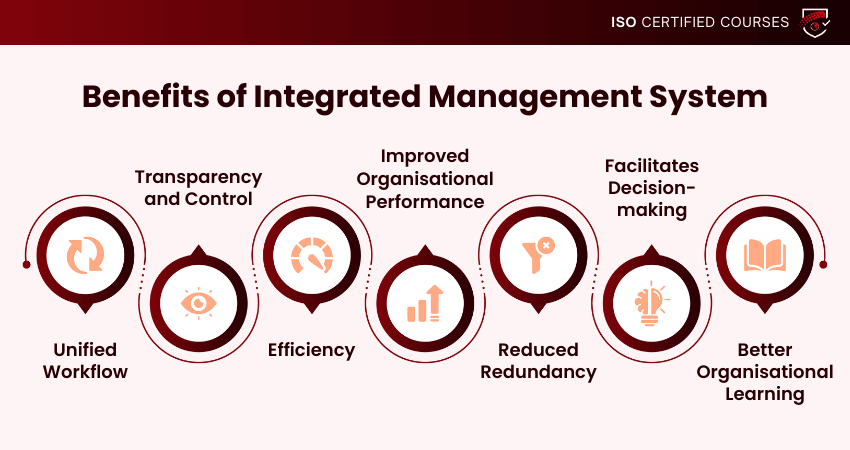
1) Unified Workflow
Employees follow one set of procedures instead of dealing with different manuals for each system. Tasks become easier to understand because instructions are standardised across departments. It also takes less time to check which process applies to their work.
2) Transparency and Control
With IMS, you can have a single view of business performance. Reports from different teams are combined into a single monitoring structure. This makes it easier to track compliance and identify problem areas early. Leaders also gain better control over business activities and corrective actions.
3) Efficiency
Shared processes remove repetitive activities such as duplicate audits, documentation, and reviews. Internal audits can assess multiple standards simultaneously, reducing administrative workload. Employees spend less effort maintaining separate records, improving time and resource utilisation.
4) Improved Organisational Performance
When departments collaborate, operational performance improves. It also enhances communication because teams follow common objectives and procedures. Problems are solved faster due to coordinated efforts. This leads to better productivity, reliability, and service quality.
5) Reduced Redundancy
Separate systems often require repeated documentation such as training records, policies, and inspections. An IMS consolidates them into one process, significantly reducing paperwork. This also lowers operational costs and simplifies record management.
6) Facilitates Decision-making
Managers can evaluate quality, safety, cost, and environmental impact, all at the same time. Decisions are made based on complete information instead of isolated reports. Risks are identified earlier and handled effectively. This supports smarter and faster business planning.
7) Better Organisational Learning
Issues found in one department are shared across the organisation. This helps other teams to learn from it, too. Employees become more aware of risks and improvement opportunities. Over time, this builds a culture of continuous improvement and knowledge sharing.
Build customer trust and service quality with ISO 10002 Quality Management Training – Join anytime!
How to Implement an Integrated Management System?
Implementing an Integrated Management System requires careful planning and coordination across the organisation. With a structured approach, you can successfully integrate multiple standards. So, let’s now check how to implement an IMS:
1) Initial Evaluation
The first step is to understand the organisation’s current situation. This means reviewing existing systems, processes, and performance. The goal is to find out strengths, weaknesses, risks, and areas that need improvement.
Organisations usually conduct a gap analysis to compare current practices with ISO requirements. They collect information, talk to key stakeholders, and define the scope of integration. This step creates a clear starting point and helps build a practical action plan.
2) IMS Design and Development
In this stage, the organisation designs the structure of the integrated system. It identifies common elements across different standards, such as document control, risk management, audits, and corrective actions. These shared processes become the foundation of the IMS.
An integrated policy is created to reflect commitments to quality, safety, environment, and other areas. Clear objectives and performance indicators are also set. This ensures that all management areas are aligned with the same goals.
3) Training and Internal Communication
Employees need to understand the new system and their role in it. Training sessions help them learn about updated procedures and responsibilities. Awareness programmes explain why integration is important and how it benefits the organisation.
Good communication builds support and involvement. When employees understand the purpose of the IMS, they are more likely to follow processes correctly. This creates a positive culture and smoother implementation.
4) System Implementation
This is the stage where the organisation puts the IMS into action. New or updated processes are applied across departments. Roles and responsibilities are clearly defined, so everyone knows their tasks and expectations.
Existing systems and documents are adjusted to match the integrated structure. Data management and reporting processes are combined to ensure smooth information flow. This step turns planning into operational reality.
5) Performance Monitoring and Review
After implementation, the organisation should check whether the system is working properly. Regular internal audits and performance checks help measure progress. This ensures the organisation meets its goals and standard requirements.
If problems are found, corrective actions are taken without delay. Management reviews the system regularly to identify improvement opportunities. Similarly, continuous monitoring keeps the IMS effective and up to date.
6) Certification and Compliance
Certification shows that the organisation’s IMS meets ISO standard requirements. You can get it through any certification body. They conduct audits, review your system, and check if it is working effectively against selected standards.
During the audit, auditors examine documents, interview employees, and review processes. If successful, the organisation receives certification. This improves credibility, builds customer trust, and strengthens its position in the market.
Conclusion
An Integrated Management System helps organisations manage multiple responsibilities through one standard approach. Instead of handling several requirements separately, the business operates with shared processes and common goals. For businesses aiming for sustainable growth and operational excellence, it has become a strategic management approach.
Implement ISO standards effectively in real business scenarios with ISO Training – Begin now!
Search Smarter
Quickly search through our blog content for what interests you
- ISO 9001 Principles: Quality Management Principles Explained
- ISO 9000 vs ISO 9001: Choosing the Right Quality Standard
- Key Differences Between ISO 9001 and 22000: Explained
- ISO 9001 Requirements: Key Elements for Quality Management
- ISO 45001 Implementation: Benefits and Step-by-Step Guide
- 17 Key Elements of ISO 14001 Environmental Management System
- ISO 17025 Principles: Explained in Detail
- ISO 14001 Checklist: Key Requirements for ISO 14001
- ISO 45001 Objectives: Definition, Plans to Achieve and Examples
- Difference Between OHSAS 18001 and ISO 45001: Detailed Comparison
- ISO 14001 and ISO 50001: What are the Differences?
- What is ISO 27001:2022? Clauses and Requirements Explained
- ISO 13485 Benefits Explained: What Manufacturers Must Know
- ISO 20000 vs ISO 27001: A Complete Comparison Guide 2026
- ISO 13485 vs ISO 9001: A Complete Comparison and Usage Guide 2026
- ISO 27001 vs. ISO 22301: Key Differences & Similarities Explained
- ISO 26000: A Guide to Social Responsibility Standards
No match found
Frequently Asked Questions
No FAQs available for this blog.