
























ISO 45001 Implementation: Benefits and Step-by-Step Guide
ISO 45001 Implementation is the process of adopting an OH&S Management System to improve workplace safety, manage risks, and ensure regulatory compliance. It involves numerous steps, ranging from leadership commitment and involvement to establishing an implementation team to carry out internal audits and management reviews.

Creating a safe and healthy workplace is no easy task. It goes beyond a legal obligation; it’s a commitment to the people who keep your organisation thriving. This is where the ISO 45001 comes in with a clear framework to reduce risks and build a culture of safety across every level. But what does it take to achieve a successful ISO 45001 Implementation?
This blog answers this question by taking you through every step of the ISO 45001 Implementation process. Read on to discover how you can turn risks into resilience and embrace the blueprint for a safer tomorrow.
Table of Contents
1) What is ISO 45001?
2) Step-by-Step Guide to ISO 45001 Implementation
3) Leadership Commitment and Involvement
4) Establishing an Implementation Team
5) Performing a Gap Analysis
6) Develop an Implementation Plan
7) Identifying Risks and Applying Controls
8) Documentation and Procedures
9) Conducting Training and Raising Awareness
10) Carrying out Internal Audits and Management Reviews
11) What are the Benefits of ISO 45001?
12) Conclusion
What is ISO 45001?
ISO 45001 is an international standard that provides a structured framework for establishing and improving an Occupational Health and Safety (OH&S) Management System. This system helps organisations improve workplace safety, identify risks and reduce incidents. It provides practical guidance and best practices to achieve the desired outcomes of an ideal OH&S system. This includes meeting compliance requirements and fulfilling organisational objectives.
The standard outlines several core requirements, including:
1) Developing, implementing, and maintaining a clear OH&S policy
2) Establishing a proactive, continuous process for hazard identification
3) Defining OH&S roles, responsibilities, and authorities within the organisation
4) Monitoring and measuring the system’s performance regularly
5) Ensuring compliance with legal and regulatory obligations

Step-by-Step Guide to ISO 45001 Implementation
From leadership commitment and involvement, internal audits and management reviews, these are the steps you must take to ensure a successful ISO 45001 Implementation:
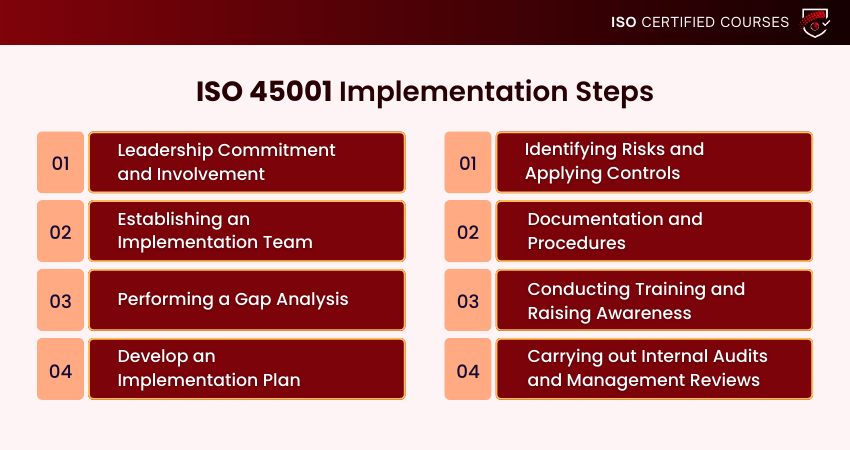
1) Leadership Commitment and Involvement
1) Leaders must set clear health and safety objectives. This will help guide ISO 45001 Implementation properly.
2) They must allocate the necessary resources for the effective execution of safety measures.
3) Safety shouldn’t just be an option; it must be integrated into the organisational culture as a core value.
4) Leaders must lead by example and show visible commitment to health and safety.
5) There must be effective communication across all levels to reinforce the safety priorities.
6) Leaders must participate in the review process. It will help them track the progress, mistakes and improvements.
7) A culture of shared responsibility must be encouraged so that everyone values safety.
8) Continuous improvement in health and safety practices should always be inspired and supported.
2) Establishing an Implementation Team
1) Establish a diverse and engaged implementation team.
2) Involve representatives from different departments for a cross-functional approach.
3) Ensure leadership participation to provide guidance and allocate resources.
4) Cultivate effective communication and collaboration within your team.
5) Define well-specified roles and responsibilities for all team members.
6) Hold regular meetings for progress updates and issue resolution.
7) Streamline the implementation process and build a safer work environment through teamwork.
3) Performing a Gap Analysis
1) Conduct a gap analysis to compare current OH&S practices with ISO 45001 requirements.
2) Identify gaps or areas of non-compliance that need to be addressed.
3) Evaluate compliance with legal and regulatory OH&S requirements.
4) Review documentation, permits, licences, and records for legal adherence.
5) Highlight non-compliance areas and include them in the action plan.
6) Prioritise identified gaps based on significance and potential impact.
7) Allocate your resources effectively to address the most critical areas first.
4) Develop an Implementation Plan
1) Develop a comprehensive implementation plan for ISO 45001.
2) Consider the organisational context when setting objectives and targets.
3) Align your objectives with the organisation's overarching goals.
4) Allocate the necessary resources for effective implementation.
5) Establish clearcut roles and responsibilities across the organisation.
6) Create policies and procedures that meet ISO 45001 requirements.
7) Implement effective communication and training programmes.
8) Set up monitoring mechanisms and controls to ensure compliance.
9) Enable continuous improvement through regular review and updates.
Safety begins with knowledge. Build your foundation with our ISO 45001 Foundation Training - Sign up now!
5) Identifying Risks and Applying Controls
1) Risk assessment and control are key elements of ISO 45001 Implementation.
2) Begin by systematically identifying potential workplace hazards.
3) Hazards may include physical, ergonomic, psychosocial, or other risks to employee health and safety.
4) Assess each hazard for likelihood and potential severity of harm.
5) Use methods such as risk matrices or qualitative assessments to evaluate risk levels.
6) Implement strong control measures to eliminate or reduce risks.
Follow the ISO 45001 hierarchy of controls as follows:
a) Elimination: Remove the hazards completely where possible.
b) Substitution: Replace hazardous materials or processes with safer alternatives.
c) Engineering Controls: Apply physical solutions like guards or ventilation.
d) Administrative Controls: Establish safe procedures, training, and clear instructions.
e) Personal Protective Equipment (PPE): Provide protective gear when other measures are insufficient.
6) Documentation and Procedures
1) Effective documentation and procedures are vital for ISO 45001 Implementation.
2) The Occupational Health and Safety (OH&S) Manual outlines organisational commitment and system overview.
3) Standard Operating Procedures (SOPs) define processes for hazard identification, risk assessment, incident reporting, emergency response, and PPE use.
4) Risk assessment and control procedures describe steps for identifying hazards, evaluating risks, and applying controls.
5) The ISO 45001 Legal Register ensures compliance with legal and regulatory requirements.
6) Incident reporting and investigation procedures support timely reporting, detailed analysis, and corrective actions.
7) An emergency response plan provides clear guidelines and coordination for handling emergencies.
8) Clear documentation enables employees to understand responsibilities, maintain safe practices, and support continuous improvement.
7) Conducting Training and Raising Awareness
1) Training and awareness equip employees with knowledge and skills for a safe workplace.
2) Conduct a training needs assessment to identify specific requirements.
3) Develop a programme covering hazard identification, risk assessment, emergency procedures, PPE use, and compliance.
4) Choose suitable delivery methods and encourage employee engagement.
5) You must provide ongoing training and refresher courses to maintain and update knowledge.
6) Run awareness campaigns using diverse communication channels.
7) Continuously evaluate training and gather feedback for improvement.
8) Prioritising training and awareness cultivates a strong safety culture and supports ISO 45001 Implementation.
8) Carrying out Internal Audits and Management Reviews
1) Conduct internal audits regularly to check compliance with ISO 45001 requirements.
2) Use audits to identify improvement areas and initiate corrective actions.
3) Hold management reviews at planned intervals to evaluate system performance.
4) Review incident data, performance indicators, and compliance during management reviews.
5) Set new objectives for continuous improvement based on review outcomes.
6) Document audit findings, review results, and corrective actions for transparency.
7) Ensure accountability through proper reporting and record-keeping.
8) Foster a proactive safety culture that prioritises employee well-being.
9) Create a feedback loop for informed decision-making and resource allocation.
ISO 45001 is your gateway to a resilient and safe workplace. Sign up for our varied ISO 45001 Courses now!
What are the Benefits of ISO 45001?
ISO 45001 helps organisations improve workplace practices, manage health and safety risks and protect workers in the process. Here are its main benefits:
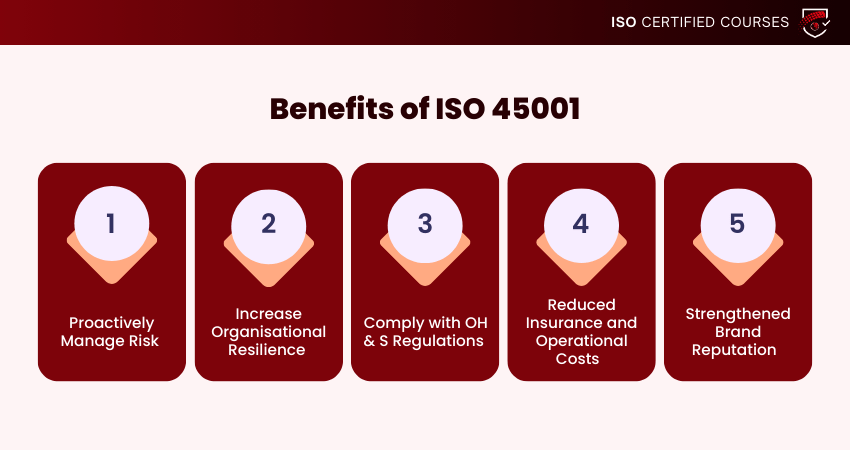
1) Proactively Manage Risk
ISO 45001 encourages organisations to address risks before they cause any harm. This reduces the chances of workplace accidents and ensures the response plans are ready if incidents pop up.
2) Increase Organisational Resilience
Through ISO 45001, businesses can better prepare for emergencies. This widely used framework promotes continuous improvement, which makes health and safety systems stronger over time.
3) Comply with OH&S Regulations
ISO 45001 helps diverse organisations stay compliant with health and safety laws. These include the UK Health and Safety at Work Act 1974 or the US Occupational Safety and Health Act of 1970.
4) Reduced Insurance and Operational Costs
Organisations that show a strong commitment to safety can enjoy much lower premiums. By actively managing risks and elevating the safety standards, businesses can save substantial money on insurance.
5) Strengthened Brand Reputation
Being ISO 45001 certified brings the spotlight to you for your dedication to safety and employee well-being. This builds trust with staff, boosts morale and creates a positive image with customers and investors alike.
Conclusion
ISO 45001 is a proven pathway to a safer and stronger organisation. By following this step-by-step ISO 45001 Implementation strategy as outlined in this blog, you’re not only meeting standards but nurturing a culture where safety is king. With commitment and continuous improvement, your workplace can become a space where people feel protected and empowered to succeed together.
Become the Watchdog of Workplace Safety with our comprehensive ISO 45001 Internal Auditor Training – Register now and set the stage for safer workplaces!
Search Smarter
Quickly search through our blog content for what interests you
- ISO 9001 Principles: Quality Management Principles Explained
- ISO 9000 vs ISO 9001: Choosing the Right Quality Standard
- Key Differences Between ISO 9001 and 22000: Explained
- ISO 9001 Requirements: Key Elements for Quality Management
- 17 Key Elements of ISO 14001 Environmental Management System
- ISO 17025 Principles: Explained in Detail
- ISO 14001 Checklist: Key Requirements for ISO 14001
- ISO 45001 Objectives: Definition, Plans to Achieve and Examples
- Difference Between OHSAS 18001 and ISO 45001: Detailed Comparison
- ISO 14001 and ISO 50001: What are the Differences?
- What is ISO 27001:2022? Clauses and Requirements Explained
- What is an Integrated Management System (IMS) and its Components?
- ISO 13485 Benefits Explained: What Manufacturers Must Know
- ISO 20000 vs ISO 27001: A Complete Comparison Guide 2026
- ISO 13485 vs ISO 9001: A Complete Comparison and Usage Guide 2026
- ISO 27001 vs. ISO 22301: Key Differences & Similarities Explained
- ISO 26000: A Guide to Social Responsibility Standards
No match found
Frequently Asked Questions
No FAQs available for this blog.