



ISO 20000 vs ISO 27001: A Complete Comparison Guide 2026
ISO 20000 focuses on IT Service Management for service delivery, while ISO 27001 focuses on Information Security Management to protect organisational data. Both are internationally recognised ISO standards that improve operational effectiveness and build trust. Together, they ensure IT services are reliable, efficient, and secure.

Have you ever faced a system outage that halted productivity or worried about how a data breach could damage your reputation overnight? These real-world challenges make understanding ISO 20000 vs ISO 27001 more relevant than ever. Organisations today are expected to deliver flawless IT services while also protecting sensitive information from growing cyber threats, and balancing both is not always easy.
When exploring ISO 20000 vs ISO 27001, ask yourself: do you need stronger service performance, tighter data security, or both? One improves IT service delivery and satisfaction, while the other strengthens information protection and risk control to build lasting trust. Let’s explore which one is right for you.
What is ISO 20000?
ISO 20000 is the international standard for IT Service Management (ITSM). Published by the International Organization for Standardization (ISO), it provides a structured framework to plan, deliver, monitor, and improve IT services through a formal Service Management System (SMS). The standard ensures IT services are reliable, consistent, and aligned with business needs, and it is fully auditable and certifiable.
ISO 20000 uses a service-based, process-driven approach to improve service quality and performance. It supports continual improvement and is commonly aligned with ITIL best practices. A Lead Auditor assesses whether IT service practices meet ISO 20000 requirements and guides organisations towards certification.
Key Points:
1) Scope:
IT Service Management System (SMS)
2) Objective:
Deliver reliable, high-quality IT services
3) Approach:
Structured and process-focused
4) Certification:
Internationally recognised and auditable
5) Benefit:
Enhances service efficiency and customer confidence
What is ISO 27001?
ISO 27001 is the International Standard for Information Security Management Systems (ISMS). Published by the International Organization for Standardization (ISO), it provides a structured framework to effectively protect sensitive data, manage security risks, and ensure the confidentiality, integrity, and availability of information. It applies to organisations of any size or industry worldwide.
ISO 27001 follows a risk-based approach to identify threats and implement appropriate security controls. It is an auditable and certifiable standard that demonstrates strong information security practices and stakeholder assurance. It also promotes continual improvement, ensuring security measures evolve alongside emerging risks and organisational changes.
Key Points:
1) Scope:
Information Security Management System (ISMS)
2) Objective:
Protect confidentiality, integrity, and availability
3) Approach:
Risk management-driven
4) Certification:
Internationally recognised and auditable
5) Benefit:
Strengthens data protection and organisational trust
ISO 20000 vs ISO 27001: Key Differences
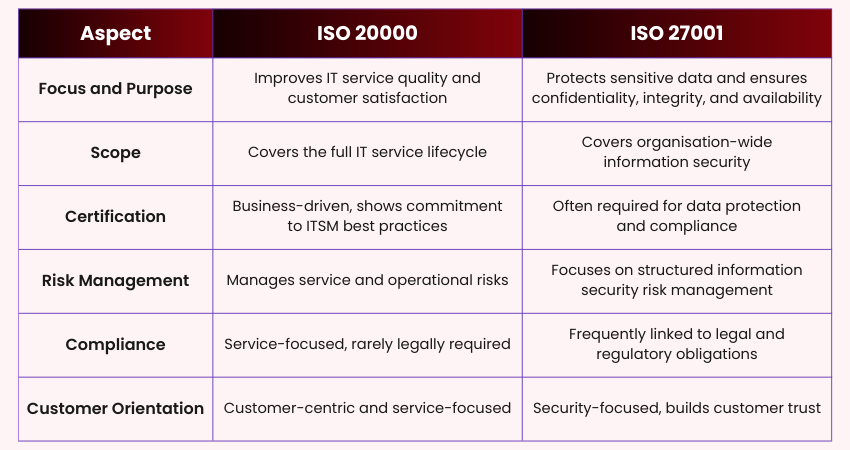
While both improve governance, ISO 20000 and ISO 27001 have different priorities. ISO 20000 focuses on IT Service Management, while ISO 27001 centres on information security. The sections below highlight the key differences between ISO 20000 vs 27001:
1) Focus and Objectives
ISO 20000 focuses on IT Service Management (ITSM). Its objective is to ensure IT services are planned, delivered, and continuously improved to meet business and customer expectations. The emphasis is on service quality, operational efficiency, and customer satisfaction.
ISO 27001 focuses on Information Security Management (ISMS). Its objective is to protect sensitive information by maintaining confidentiality, integrity, and availability. It prioritises identifying security risks and implementing appropriate controls to manage them.
2) Scope
The scope of ISO 20000 covers the complete lifecycle of IT services, including service design, transition, delivery, support, and continual improvement. It is primarily centred on IT operations and service processes.
The scope of ISO 27001 is broader and applies to the entire organisation’s information assets. It covers data in all forms, including digital records, physical documents, systems, people, and infrastructure.
3) Certification
Both standards are auditable and certifiable, but their focus differs. ISO 20000 Certification verifies effective IT service delivery through a structured Service Management System and consistent performance measurement.
ISO 27001 Certification confirms that an organisation’s Information Security Management System systematically identifies, assesses, and manages security risks, ensuring sensitive information is protected through documented controls and structured governance.
Master ISO 27001 auditing skills - join the
ISO 27001 Lead Auditor Training
now.
4) Risk Management Approach
Risk management supports both standards, but with different priorities. ISO 20000 manages operational risks affecting service continuity, performance, and reliability to ensure stable and consistent IT service delivery.
ISO 27001 places risk management at its core, requiring formal risk assessments to identify threats, evaluate vulnerabilities, and implement proper security controls to protect organisational information assets.
5) Compliance Requirements
ISO 20000 compliance focuses on aligning IT service processes with best practices, service agreements, and customer expectations, primarily driven by operational improvement and service quality objectives.
ISO 27001 compliance often aligns with legal, regulatory, and contractual obligations, particularly for organisations handling sensitive data, supporting adherence to privacy and data protection requirements.
6) Customer Orientation
ISO 20000 enhances customer satisfaction by improving service quality, defining clear service levels, and monitoring performance. This ensures IT services remain consistent, reliable, and aligned with business expectations, delivering a stronger overall customer experience.
ISO 27001 builds customer trust by protecting confidential information and reducing security risks through structured controls. By safeguarding sensitive data, it strengthens confidence in the organisation’s commitment to information security and responsible data management.
Gain essential ISO 20000 expertise to elevate service quality and success through the
ISO 20000 Training
– Register today!
ISO 27001 vs ISO 20000: Key Similarities
Despite different focus areas, ISO 20000 and ISO 27001 follow a similar management system structure and continuous improvement approach. Both share principles such as risk-based thinking and documented processes. The following sections highlight their key similarities.
1) Management System Framework
Both ISO 20000 and ISO 27001 follow a structured management system model issued by the International Organization for Standardization. Each requires organisations to establish formal policies, defined objectives, documented procedures, and controlled processes to ensure consistency and accountability.
2) Process-based Approach
Both standards promote a structured and clearly defined process-driven methodology rather than informal practices. Organisations must clearly define roles, responsibilities, workflows, and performance measures. This disciplined approach strengthens operational control, accountability, and overall efficiency across the organisation.
3) Risk-Based Thinking
Risk management is fundamentally embedded in both frameworks. ISO 27001 focuses on identifying and treating information security risks, while ISO 20000 addresses risks affecting IT service delivery and continuity. In both cases, risks must be assessed, documented, and managed systematically through defined controls.
4) Continuous Improvement
Both standards follow the well-established Plan-Do-Check-Act cycle, encouraging ongoing monitoring and refinement. Organisations are required to conduct internal audits, review performance metrics, and implement corrective actions to improve system effectiveness and long-term sustainability.
5) Audit and Certification
ISO 27001 and ISO 20000 are both formally auditable and internationally certifiable standards. They require internal reviews, documented evidence of compliance, and external audits by accredited certification bodies. Certification demonstrates adherence to recognised global best practices and governance standards.
6) Leadership and Governance
Strong and active leadership involvement is mandatory under both standards. Senior management must provide clear strategic direction, allocate adequate resources, and actively support continual improvement initiatives across the organisation to ensure long-term organisational success, stability, and accountability.
7) Global Recognition
Both certifications are globally recognised and significantly enhance organisational credibility and competitive positioning in the marketplace. They demonstrate structured governance, professional management practices, and a strong commitment to quality, regulatory compliance, and effective risk control across operations.
ISO 20000 vs ISO 27001: Which Should You Choose?
Choosing between ISO 20000 and ISO 27001 depends on your organisation’s main priority. If your goal is to improve IT service quality, ensure consistent delivery, and meet Service Level Agreements, ISO 20000 is the better choice. It helps standardise service processes and enhance customer satisfaction through structured IT Service Management.
If your focus is on protecting sensitive data, reducing security risks, and meeting regulatory requirements, ISO 27001 is more suitable. It provides a risk-based framework for safeguarding information and strengthening security governance. Many organisations implement both standards together to achieve reliable IT services and strong data protection.
Conclusion
Choosing between ISO 20000 vs ISO 27001 is more than a certification decision. It shapes how your organisation delivers services and protects information. Whether you focus on service quality, data security, or both, aligning with the right standard strengthens trust, resilience, and long-term business success.
Learn to protect critical data and lead information security confidently through the
ISO 27001 Training
– Join now!
Search Smarter
Quickly search through our blog content for what interests you
- ISO 9001 Principles: Quality Management Principles Explained
- ISO 9000 vs ISO 9001: Choosing the Right Quality Standard
- Key Differences Between ISO 9001 and 22000: Explained
- ISO 9001 Requirements: Key Elements for Quality Management
- ISO 45001 Implementation: Benefits and Step-by-Step Guide
- 17 Key Elements of ISO 14001 Environmental Management System
- ISO 17025 Principles: Explained in Detail
- ISO 14001 Checklist: Key Requirements for ISO 14001
- ISO 45001 Objectives: Definition, Plans to Achieve and Examples
- Difference Between OHSAS 18001 and ISO 45001: Detailed Comparison
- ISO 14001 and ISO 50001: What are the Differences?
- What is ISO 27001:2022? Clauses and Requirements Explained
- What is an Integrated Management System (IMS) and its Components?
- ISO 13485 Benefits Explained: What Manufacturers Must Know
- ISO 13485 vs ISO 9001: A Complete Comparison and Usage Guide 2026
- ISO 27001 vs. ISO 22301: Key Differences & Similarities Explained
- ISO 26000: A Guide to Social Responsibility Standards
No match found
Frequently Asked Questions
No FAQs available for this blog.