



What is Competency Management? Benefits, Tips and Best Practices
Competency Management identifies, maps, assesses, and develops employee skills, knowledge, and behaviours to improve performance and meet organisational goals. It helps organisations recognise skill gaps and plan targeted development. This boosts productivity, supports growth, and ensures employees align with business needs.

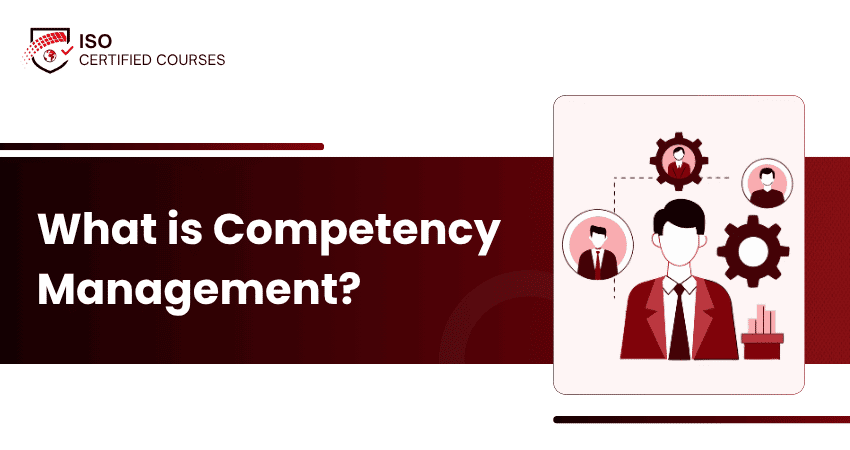
Have you ever felt unsure whether your team truly has the right skills to meet business goals? Many organisations struggle with hidden skill gaps, unclear expectations, and inconsistent performance. This is where Competency Management makes a real difference by bringing structure, clarity, and direction to how skills are defined and developed.
Rather than relying on guesswork, Competency Management helps organisations identify, assess, and build the right capabilities for success. It aligns individual growth with organisational goals, boosting productivity and creating future-ready teams. In this blog, you will explore its benefits, process, tips, and best practices to apply it effectively.
What is Competency Management?
Competency Management is a structured approach used by organisations to identify, assess, and strengthen the skills, knowledge, and behaviours required for effective performance. It focuses on aligning individual capabilities with organisational goals to improve overall performance.
Rather than relying on assumptions, organisations use competency frameworks to define expectations clearly. This helps employees understand what is required in their roles while enabling managers to measure performance objectively and support continuous improvement across teams.

Why is Competency Management Important?
Competency Management plays a vital role in ensuring that employees have the right skills to meet evolving business demands. It helps organisations stay competitive by building a workforce that is capable, adaptable, and aligned with long-term objectives.
Competency Management also improves decision-making in hiring, training, and performance evaluation. By identifying skill gaps early, organisations can take proactive steps to address them, ensuring consistent growth, higher productivity, and improved employee satisfaction.
What are the Benefits of Competency Management?
Understanding the benefits of Competency Management helps organisations recognise its value beyond basic skill tracking. It supports both individual growth and organisational success by creating a structured and measurable approach to workforce development. By aligning skills with business needs, it enables organisations to build a more capable, agile, and future-ready workforce.
1) Improved Employee Performance and Productivity
Competency Management ensures that employees clearly understand their roles and expectations. When individuals know the exact skills and behaviours required, they can focus on improving their performance, leading to increased productivity and better outcomes.
Competency Management also allows managers to provide targeted feedback and support. By addressing specific skill gaps, employees can work more efficiently, reduce errors, and contribute more effectively to organisational goals, creating a high-performing workforce.
2) Effective Talent Acquisition and Retention
With clearly defined competencies, organisations can hire candidates who match job requirements more accurately. This reduces hiring mistakes and ensures that new employees are better prepared to perform their roles from the beginning.
Employees are more likely to stay with organisations that invest in their growth. Competency Management provides clear career paths and development opportunities, improving job satisfaction, and reducing turnover over time.
3) Focused Employee Development and Training
Competency Management helps organisations design training programmes based on actual skill gaps rather than assumptions. This ensures that employees receive relevant and effective learning opportunities suitable to their specific requirements and roles.
It also promotes continuous learning by encouraging employees to improve their competencies over time. This targeted approach not only enhances individual performance but also improves the overall capability of the organisation in a structured way.
4) Enhanced Alignment with Organisational Goals
By linking competencies to organisational objectives, employees can understand how their work contributes to the bigger picture. This alignment ensures that everyone is working towards common goals, improving coordination and efficiency across teams.
It also supports strategic planning by ensuring that the workforce has the skills needed for future growth. This helps organisations adapt to changes more effectively while maintaining focus on long-term success and sustainability.
5) Improved Succession Planning
Competency Management helps identify high-potential employees who can take on future leadership roles. By evaluating competencies regularly, organisations can prepare employees for advancement through targeted development and mentoring programmes.
This proactive approach reduces the risk of leadership gaps. It ensures business continuity by developing a strong leadership pipeline and supporting long-term organisational stability and growth.
Gain practical audit skills to assess inspection bodies confidently and effectively with the ISO 17020 Internal Auditor Training – Join soon!
How to Build a Competency Management Process?
Building a Competency Management process requires a structured, step-by-step approach. Each stage plays a crucial role in ensuring that competencies are clearly defined, accurately measured, and continuously developed across the organisation. When implemented effectively, this process creates a strong foundation for performance, growth, and long-term success.
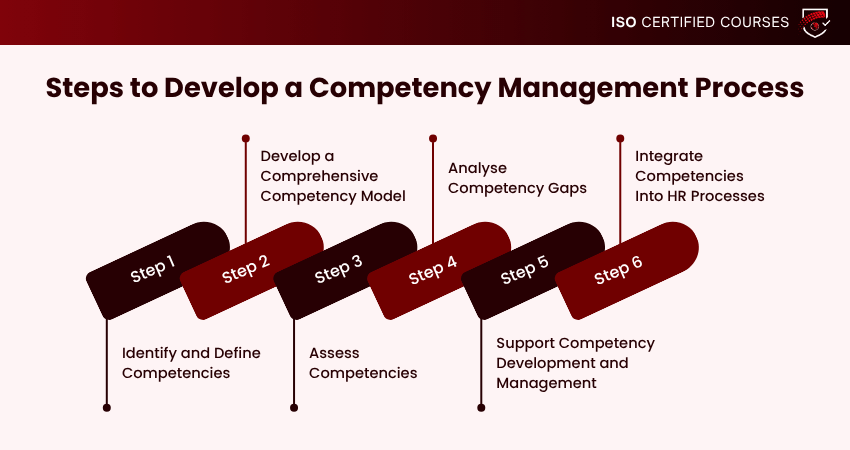
Step 1: Identify and Define Competencies
The first step involves identifying the key skills, knowledge, and behaviours required for each role. These competencies should be clearly defined to ensure consistency and alignment with organisational expectations and objectives.
It is important to involve both managers and employees in this process. Their input helps create practical and realistic competency definitions that accurately reflect job requirements and support effective performance management.
Step 2: Develop a Comprehensive Competency Model
Once competencies are defined, organisations need to create a structured competency model. This model acts as a framework that outlines all required competencies across different roles and levels within the organisation.
A well-designed model provides clarity and consistency. It standardises expectations, making it easier to evaluate performance, plan training, and align workforce capabilities with business strategies.
Step 3: Assess Competencies
After developing the model, organisations must assess employees’ current competency levels. This can be done through various methods, such as self-assessments, manager evaluations, and feedback from peers or stakeholders.
Regular assessments provide valuable insights into employee strengths and areas for improvement. This information is essential for making informed decisions about training, development, and performance management within the organisation.
Step 4: Analyse Competency Gaps
The next step is to identify the gap between required and existing competencies. This analysis helps organisations understand where employees need improvement and what actions are required to bridge these gaps effectively.
By focusing on specific gaps, organisations can prioritise development efforts. This ensures resources are used efficiently, leading to better outcomes and improved employee performance across all levels of the organisation.
Step 5: Support Competency Development and Management
Once gaps are identified, organisations must provide the necessary support for development. Competency Management includes training programmes, mentoring, coaching, and other learning opportunities tailored to individual needs.
Continuous development is key to long-term success. By regularly updating skills and competencies, organisations can ensure that employees remain capable and adaptable in a constantly changing business environment.
Step 6: Integrate Competencies Into HR Processes
To maximise effectiveness, competencies should be integrated into all HR processes. This includes recruitment, onboarding, performance reviews, and career development planning within the organisation.
Integration ensures consistency and alignment across all functions. It also helps create a unified approach to talent management, making it easier to track progress and achieve organisational goals effectively.
Tips for Effective Competency Management
To make Competency Management work in daily operations, organisations should focus on practical actions that improve consistency and employee engagement. These tips help teams apply competency frameworks effectively in real-time:
a) Conduct Regular and Objective Assessments:
Assess employee skills frequently using self-reviews, manager feedback, and peer evaluations. Competency Management ensures a clear understanding of current capabilities and helps identify gaps early for timely improvement.
b) Implement Continuous Feedback Loops:
Provide ongoing feedback instead of relying only on annual reviews. Regular feedback helps employees adjust quickly, improve performance, and stay aligned with role expectations.
c) Encourage a Learning-Oriented Culture:
Promote continuous learning through training, mentoring, and knowledge sharing. This keeps employees engaged and ensures they are always developing relevant skills.
d) Create Individualised Development Plans:
Design personalised growth plans based on specific skill gaps. Tailored development ensures employees receive the right support to improve performance effectively.
e) Involve Employees in the Process:
Engage employees in assessing their competencies and setting development goals. This increases ownership, motivation, and overall effectiveness of the Competency Management process.
Gain expertise to lead audits and ensure inspection compliance through the ISO 17020 Lead Auditor Training – Register today!
Best Practices to Optimise Competency Management
To ensure long-term success, organisations must move beyond basic implementation and focus on optimisation. Applying the right strategies helps improve efficiency, consistency, and overall impact. Here are the best practices to optimise Competency Management:
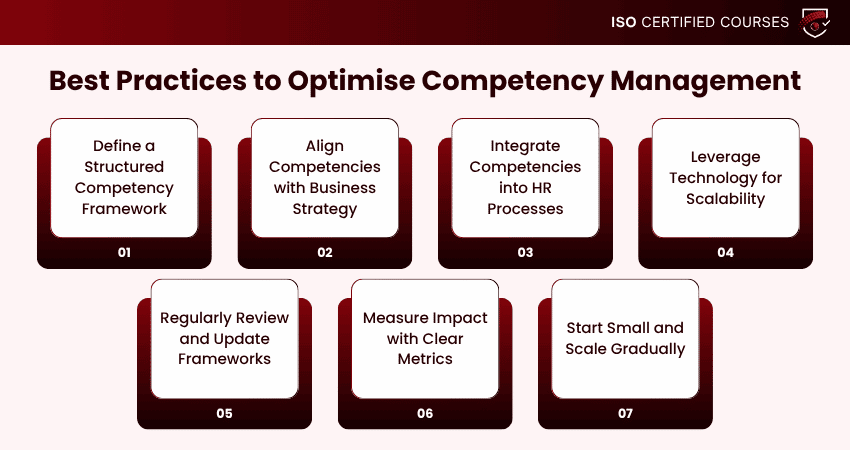
a) Define a Structured Competency Framework:
Develop a clear framework that outlines core, technical, and behavioural competencies for each role. This provides a strong foundation for all Competency Management activities.
b) Align Competencies with Business Strategy:
Ensure that all competencies directly support organisational goals. This alignment helps employees contribute effectively to business growth and long-term success.
c) Integrate Competencies into HR Processes:
Embed competency frameworks into recruitment, onboarding, performance management, and succession planning to ensure consistency across all talent management functions.
d) Leverage Technology for Scalability:
Use Competency Management tools to track skills, analyse gaps, and monitor progress. Technology improves efficiency, accuracy, and decision-making at scale.
e) Regularly Review and Update Frameworks:
Continuously update competency models to reflect changing business needs. This ensures that competencies remain relevant and aligned with organisational priorities.
f) Measure Impact with Clear Metrics:
Track key performance indicators such as productivity, skill improvement, and time-to-competency. Measuring results helps evaluate effectiveness and refine strategies.
g) Start Small and Scale Gradually:
Begin with pilot initiatives to test Competency Management processes. Early successes build confidence and support wider implementation across the organisation.
Conclusion
Competency Management helps organisations build a skilled, adaptable, and high-performing workforce. By defining clear competencies, assessing gaps, and supporting continuous development, businesses can improve performance, align employees with goals, and drive long-term success through a structured and strategic approach.
Achieve inspection excellence and compliance with the ISO 17020 Training – Register now!
Search Smarter
Quickly search through our blog content for what interests you
- Top ISO 9001 Internal Audit Questions and Answers in 2026
- ISO 27005 vs ISO 31000: How to Choose the Right Risk Framework
- Challenges of ISO 14001 and How to Overcome Them
- Top 14 Benefits of ISO 45001 Certification
- What are the ISO 27001 Requirements: A Complete 2026 Guide
- 12 Benefits of ISO 27001 Certification for Business
- ISO 27001 vs ISO 27002: Key Difference and Uses Cases
- ISO 17025 vs ISO 9001: Key Differences and Similarities
- ISO 45001 Requirements for Occupational Health & Safety
- ISO 9001, 14001, and 45001: Key Differences and Similarities
- ISO 27001 vs SOC 2: Understanding Key Differences
- ISO 17025 Requirements: Explained in Detail
- What is ISO 27001 Gap Analysis? A Complete Overview
- ISO 17025: An Overview of Laboratory Accreditation
- What is ISO 27001: An Overview of the Information Security Standard
- ISO 27001 Controls from Annex A: What Changed in ISO 27001:2022?
- What is ISO 50001: Meaning, Requirements & Clauses Explained
- Top 10 Benefits of ISO 50001: A Detailed Explanation
- What is a Quality Management System (QMS): A Comprehensive Overview
- ISO 22000: Food Safety Management System Explained
- What is the Statement of Applicability (SoA) in ISO/IEC 27001?
- What is ISO 31000? The Risk Management Standard Explained
- What Is ISO 13485? Understanding Its 8 Key Sections
- ISO 56000: A Comprehensive Guide to Innovation Management
- What is ISO 14064? Components, Execution, and Benefits Explained
- Carbon Footprint: Definition, Types, and How to Calculate It
- ISO 22301: Requirements, Benefits and How to Implement It?
- ISO 9001 vs ISO 9002: Key Differences You Should Know
- Carbon Accounting: Meaning, Benefits, and Challenges
- Ecological Footprint: Meaning, Importance, and Purpose
- Compliance Management System: Components and How to Implement
- ISO 9001 and 27001: Quality Management vs Information Security Management
- ISO 27001 Annex A Controls: Everything You Need to Know
No match found
Frequently Asked Questions
What are the 5 C's of Competency?
The 5 C’s of Competency are Competence, Communication, Conflict management, Confidence, and Conscience. They help individuals perform well, communicate clearly, handle challenges, build trust, and make ethical decisions for team and organisational success.
What are the Key Components of a Competency Framework?
A competency framework includes core values, competencies, technical skills, leadership skills, and behavioural indicators. These define required abilities and are mapped to levels, helping guide recruitment, performance management, and employee development aligned with organisational goals.
What is a Competency Management System?
A Competency Management System (CMS or CompMS) is a tool or platform used to track, assess, and develop employee competencies. It helps organisations manage workforce skills efficiently while supporting performance management and continuous learning initiatives.