
























ISO 9001 vs ISO 9002: Key Differences You Should Know
ISO 9001 sets requirements for a full Quality Management System while ISO 9002 covered production and installation but was later merged into ISO 9001. ISO 9001 covers design, development, production, installation, and servicing. ISO 9002 was more limited, focusing only on production and installation, excluding design and development.

Standards may look similar on paper, but when it comes to ISO 9001 and ISO 9002, the differences tell a bigger story. Both were built to bolster Quality Management, yet each served a distinct purpose in shaping how organisations deliver excellence. While ISO 9001 focused on broad quality assurance processes, ISO 9002 homed in on production and installation.
While both belong to the same family, their purpose and relevance have evolved over time. In this blog, we break down these key differences between ISO 9001 and ISO 9002 clearly to help you understand which standard truly fits your quality journey.
What is ISO 9001?
ISO 9001 is an international standard that outlines the requirements for a Quality Management System (QMS). It helps organisations understand customer needs and improve processes accordingly. The standard focuses on enhancing customer satisfaction while reducing costs without affecting quality. The latest major revision was published in 2015, and it remains one of the most widely recognised standards worldwide.

What is ISO 9002?
ISO 9002 is part of the ISO 9000 family and provides a framework for quality assurance in production, installation, and servicing. The key ISO 9001 vs ISO 9002 distinction is that while it shares many guidelines with ISO 9001, it does not cover the design and development of new products. It is mainly applicable to organisations focused on consistent production and service delivery processes.
Difference Between ISO 9001 and ISO 9002
Here are the key differences between ISO 9001 and ISO 9002:
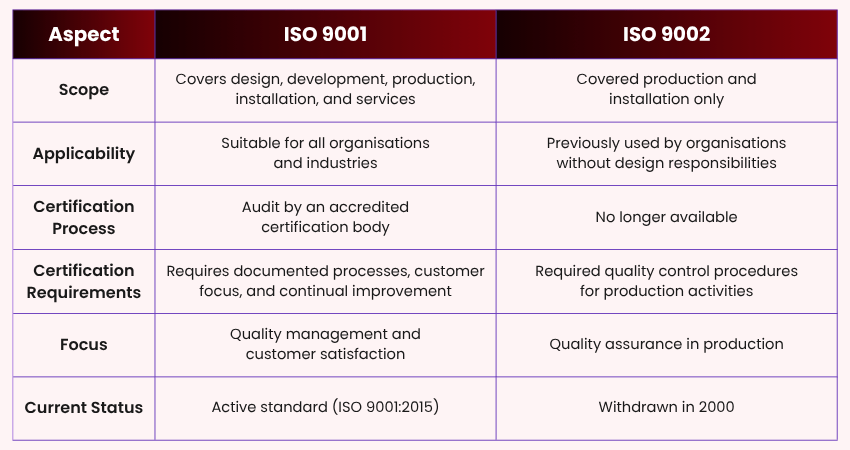
Let’s delve deeper into the ISO 9002 vs ISO 9001 differences:
1) Scope
ISO 9001 covers all aspects of a Quality Management System (QMS), including design, development, production, installation, and servicing. In contrast, ISO 9002 was limited to production, installation, and servicing, excluding design and development processes. This makes ISO 9001 more comprehensive and adaptable across various industries. It ensures organisations can manage the entire product lifecycle effectively.
2) Applicability
ISO 9001 is suitable for organisations aiming to improve customer satisfaction and meet regulatory requirements. ISO 9002 was intended for organisations involved only in production and servicing activities. ISO 9001 is widely adopted across sectors due to its flexibility and relevance. ISO 9002 was more niche and suited to specific operational setups.
3) Certification Process
ISO 9001 requires a comprehensive audit that includes evaluation of design and development processes. ISO 9002 previously involved a more limited audit focused mainly on manufacturing and installation, and it is now obsolete. The ISO 9001 audit ensures a deeper evaluation of organisational processes and controls. ISO 9002 audits were simpler but less thorough in scope.
4) Certification Requirements
ISO 9001 emphasises customer focus, leadership, process approach, and risk-based thinking. ISO 9002 focused primarily on maintaining consistent product quality in manufacturing and installation. ISO 9001 encourages continuous improvement and proactive risk management. ISO 9002 lacked emphasis on strategic Quality Management principles.
Take charge of excellence and master the art of great QMS with our ISO 9001 Lead Implementer Training - Sign up today!
5) Focus
ISO 9001 demonstrates an organisation’s ability to manage complete, end-to-end processes. ISO 9002 focused only on ensuring consistency in production and service delivery and is no longer in use. This makes ISO 9001 ideal for organisations aiming for long-term quality excellence. ISO 9002 was more operational and limited in its approach.
6) Current Status and Updates
ISO 9001 is actively used and regularly updated, with its latest revision in 2015. ISO 9002 was last updated in 1994 and has since been withdrawn and replaced by ISO 9001. ISO 9001 continues to evolve to meet modern business and quality standards. ISO 9002 is now outdated and no longer applicable in current quality frameworks.
Why Did ISO 9001 Replace ISO 9002?
ISO 9001 has remained widely adopted due to its regular updates and ability to align with evolving Quality Management practices. The release of ISO 9001:2000 merged ISO 9001, ISO 9002, and ISO 9003 into a single, unified standard. As a result, ISO 9002 gradually lost its relevance. Later, the ISO 9001:2015 revision introduced a strong process-based approach, making ISO 9002 fully obsolete.
It was formally withdrawn and absorbed into ISO 9001, which became the comprehensive standard for Quality Management Systems. The 2015 version also allows organisations to exclude non-applicable requirements, making implementation more flexible. Consolidating multiple standards into one simplified framework helped reduce complexity and unnecessary terminology for organisations worldwide.
Build stronger systems and sharper skills with
ISO 9001 Internal Auditor Training
– Register today!
What Impact Did the 2015 Revision Have on ISO 9001?
ISO 9001:2015 is now one of the most widely adopted ISO standards used for Quality Management Systems. The key impacts include:
1) Simplified Documentation:
The revision reduced the need for extensive documentation, offering organisations greater flexibility and encouraging a stronger focus on understanding internal and external business contexts.
2) Proactive Approach:
It promotes forward-thinking by encouraging organisations to plan processes and manage interactions more effectively rather than reacting to issues after they occur.
3) Risk-based Thinking:
The standard integrates risk-based thinking, enabling organisations to implement preventive measures and minimise potential risks and negative outcomes.
4) PDCA Cycle Integration:
The inclusion of the Plan-Do-Check-Act (PDCA) cycle ensures processes are well-resourced, monitored, and continuously improved.
5) High-level Structure (Annex SL):
The adoption of Annex SL provides a unified framework, making it easier to integrate ISO 9001 with other standards such as ISO 27001, ISO 14001, and ISO 45001.
How Can You Obtain ISO 9001 and ISO 9002 Certification?
ISO 9002 does not offer a separate certification, as it only formed part of earlier ISO 9001 guidelines and is now obsolete. Here's the ISO 9001 Certification process:
1) Begin by reviewing the standard and its Quality Management principles to gain a clear understanding of expectations.
2) Assess your current processes against ISO 9001 requirements to identify those areas that need improvement.
3) Implement a proper Quality Management System that aligns with ISO 9001 standards.
4) Train employees on ISO 9001 requirements to ensure they understand their roles within the QMS.
5) Submit your application along with the necessary documentation for certification.
6) Conduct an internal audit to make sure that there's compliance with ISO 9001 requirements within the organisation.
7) Upon successful completion of audits, the ISO 9001 Certification is granted.
Conclusion
In the field of Quality Management, ISO 9001 is the current internationally recognised standard, while ISO 9002 remains part of its historical development. Understanding the core difference between ISO 9001 and ISO 9002 clarifies their roles and shows how Quality Management practices have evolved. Implementing ISO 9001 enables organisations to establish structured, adaptable, and customer-focused Quality Management Systems.
Lead the perfect blend of quality and consistency in our range of
ISO 9001 Courses
– Register today!
Search Smarter
Quickly search through our blog content for what interests you
- Top ISO 9001 Internal Audit Questions and Answers in 2026
- ISO 27005 vs ISO 31000: How to Choose the Right Risk Framework
- Challenges of ISO 14001 and How to Overcome Them
- Top 14 Benefits of ISO 45001 Certification
- What are the ISO 27001 Requirements: A Complete 2026 Guide
- 12 Benefits of ISO 27001 Certification for Business
- ISO 27001 vs ISO 27002: Key Difference and Uses Cases
- ISO 17025 vs ISO 9001: Key Differences and Similarities
- ISO 45001 Requirements for Occupational Health & Safety
- ISO 9001, 14001, and 45001: Key Differences and Similarities
- ISO 27001 vs SOC 2: Understanding Key Differences
- ISO 17025 Requirements: Explained in Detail
- What is ISO 27001 Gap Analysis? A Complete Overview
- ISO 17025: An Overview of Laboratory Accreditation
- What is ISO 27001: An Overview of the Information Security Standard
- ISO 27001 Controls from Annex A: What Changed in ISO 27001:2022?
- What is ISO 50001: Meaning, Requirements & Clauses Explained
- Top 10 Benefits of ISO 50001: A Detailed Explanation
- What is a Quality Management System (QMS): A Comprehensive Overview
- ISO 22000: Food Safety Management System Explained
- What is the Statement of Applicability (SoA) in ISO/IEC 27001?
- What is ISO 31000? The Risk Management Standard Explained
- What Is ISO 13485? Understanding Its 8 Key Sections
- ISO 56000: A Comprehensive Guide to Innovation Management
- What is ISO 14064? Components, Execution, and Benefits Explained
- Carbon Footprint: Definition, Types, and How to Calculate It
- ISO 22301: Requirements, Benefits and How to Implement It?
- Carbon Accounting: Meaning, Benefits, and Challenges
- Ecological Footprint: Meaning, Importance, and Purpose
- Compliance Management System: Components and How to Implement
- What is Competency Management? Benefits, Tips and Best Practices
- ISO 9001 and 27001: Quality Management vs Information Security Management
- ISO 27001 Annex A Controls: Everything You Need to Know
- ISO 27001 Audit: A Complete Guide to the Audit Process
- ISO 9001 vs ISO 14001: Key Differences and Similarities
No match found
Frequently Asked Questions
What are the Seven Core Principles of ISO 9001?
The seven principles of Quality Management related to ISO 9001 are:
1) Customer Focus
2) Engagement of People
3) Leadership
4) Process Approach
5) Improvement
6) Evidence-based Decision Making
7) Relationship Management
These principles guide organisations in ensuring consistent quality and cementing customer satisfaction.
What is the ISO 9001:2015 with 2024 Amendment?
ISO 9001:2015 includes updates that address climate change considerations within the organisational context. It ensures businesses evaluate how external environmental factors impact their Quality Management System while maintaining the core structure of the 2015 version.
Which Version of ISO 9001 is Currently in Use?
The currently used version is ISO 9001:2015, along with its latest amendment updates. It remains the globally recognised standard for Quality Management Systems, widely adopted across industries for ensuring consistent quality and continuous improvement.