



12 Benefits of ISO 27001 Certification for Business
ISO 27001 is an international standard for managing an Information Security Management System. The Benefits of ISO 27001 include stronger data security, reduced risks, regulatory compliance, customer trust, and improved information management processes. Over time, this leads to better control and consistency in how data is handled.

How secure is your business information right now, and could you prove it to customers or regulators if asked? In our present world, protecting sensitive information is no longer just a technical concern but a core business responsibility.
ISO 27001 addresses this by providing an internationally recognised framework for managing Information Security risks, building trust, and meeting recognised requirements. This blog explains what ISO 27001 is, its key benefits, and how organisations can achieve ISO 27001 Certification.
What is ISO 27001?
ISO 27001 is an international standard that outlines how organisations can establish, implement, maintain, and continually improve an Information Security Management System (ISMS). An ISMS is a structured approach to managing sensitive information, so it remains confidential, accurate, and available, while being protected from potential risks.
ISO 27001 takes a holistic approach to Information Security by covering people, processes, and technology. This includes security policies, risk assessment and treatment, employee awareness, incident response, supplier security controls, and ongoing monitoring and review. The objective is to manage information security risks in a consistent, practical, and well-governed manner.
What are the Benefits of ISO 27001?
ISO 27001 is often seen as a security standard, but it also delivers strong business value. Below are the important Benefits of ISO 27001 that show why many organisations choose it:
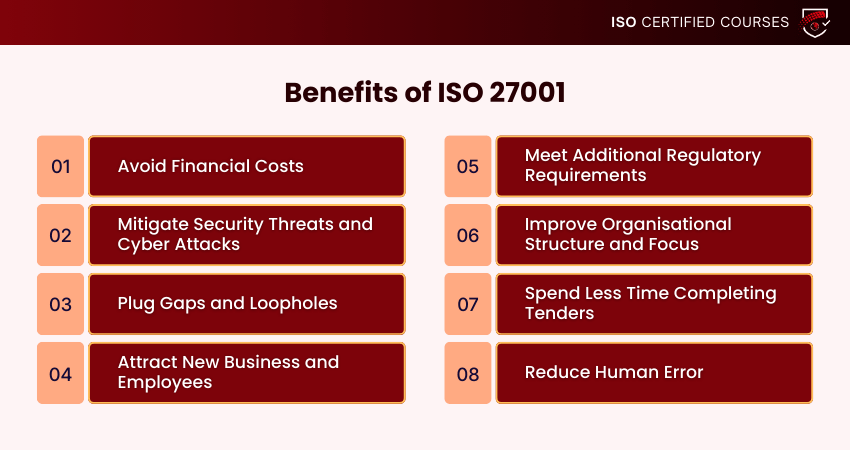
1) Avoid Financial Costs Associated With Data Breaches
Data breaches can cause heavy financial losses like fines, legal fees, system recovery costs, and lost business. ISO 27001 helps organisations prevent these incidents by identifying risks early and following controls in place before problems occur.
1) Conduct regular risk assessments to identify weak areas
2) Apply strong access controls to sensitive information
3) Maintain secure backups and test them regularly
4) Create and practise an incident response plan
5) Monitor systems for unusual or suspicious activity
2) Mitigate Security Threats and Cyber Attacks
Cyber threats change all the time. Hackers use new methods to steal data, disrupt systems, or demand ransom payments. To avoid this, ISO 27001 helps organisations stay prepared by doing ongoing monitoring, regular reviews, and updates to security controls.
1) Keep software and systems updated with security patches
2) Use firewalls, antivirus tools, and intrusion detection systems
3) Review security risks whenever systems or processes change
4) Limit access based on job roles and responsibilities
5) Monitor logs and alerts for early threat detection
3) Plug Gaps and Loopholes in Your Existing Security System
Many businesses already have some security practices. These may include passwords, firewalls, or antivirus software. However, these controls may be inconsistent, undocumented, or outdated. ISO 27001 highlights gaps such as weak passwords, unclear responsibilities, or unsecured third-party access. Closing these gaps strengthens overall security.
1) Perform a full gap analysis against ISO 27001 requirements
2) Review access rights regularly and remove unnecessary access
3) Secure third-party and supplier connections
4) Document all security policies and procedures clearly
5) Test controls to confirm that they work as intended
Build confidence in evaluating Information Security controls with our
ISO 27001 Internal Auditor Training
– Register today!
4) Attract New Business and Employees
Trust plays a huge role in business decisions. Customers want to know that their data will be kept safe. So, to protect that trust and earn new people, ISO 27001 acts as proof of strong security practices, making the organisation more attractive to clients and potential employees.
1) Communicate security commitment during recruitment
2) Train employees to understand and support security values
3) Maintain ISO 27001 best practices through continual improvement
4) Promote a strong security culture to improve confidence
5) Share security policies and practices transparently with clients
5) Meet Additional Regulatory Requirements
Many laws and industry regulations require organisations to protect sensitive and personal data. ISO 27001 supports compliance by aligning closely with many legal requirements. It helps organisations protect personal data, manage access, and keep records of security activities.
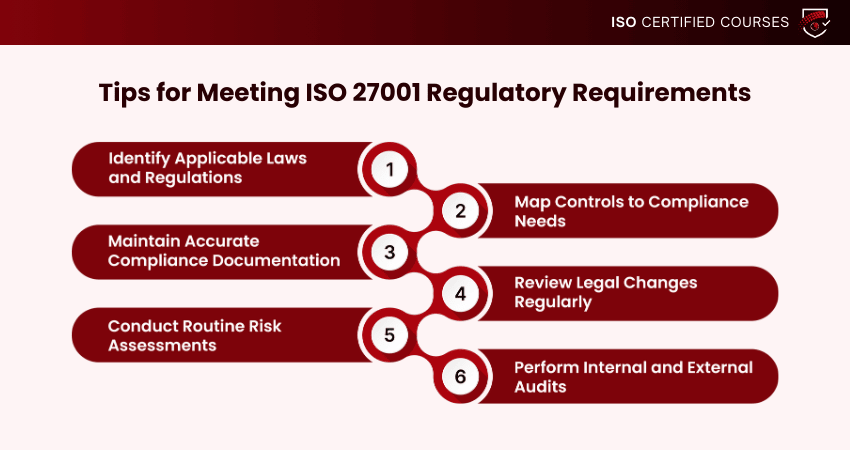
1) Map legal and regulatory requirements to ISO 27001 controls
2) Keep clear documentation for audits and inspections
3) Review compliance requirements regularly
4) Train employees on data protection responsibilities
5) Carry out internal audits to check ongoing compliance
6) Improve Organisational Structure and Focus
ISO 27001 clarifies roles, responsibilities, and accountability across the organisation. Due to this, Information Security becomes a shared responsibility rather than being limited to IT teams, improving coordination and focus.
1) Assign clear ownership for information assets
2) Define roles and responsibilities in security policies
3) Involve leadership in security planning and reviews
4) Align security objectives with business goals
5) Communicate policies clearly across all departments
7) Spend Less Time Completing Tenders
Many clients require proof of security before their contract approval. Obtaining the ISO 27001 Certification reduces the need to complete lengthy security questionnaires, saving time and effort during tender processes.
1) Respond to tenders faster and focus more on delivering value
2) Maintain up-to-date security documentation
3) Prepare standard responses from clients and stakeholders
4) Train sales teams on how to explain certification value
5) Keep audit reports organised and accessible
8) Reduce Human Error
Human errors are a common cause of security incidents. Simple mistakes such as clicking on phishing emails or sharing information incorrectly can lead to serious problems. You can reduce this risk with ISO 27001 by promoting awareness, training, and clear procedures that guide employee behaviour and decision-making.
1) Provide regular security awareness training
2) Create clear and simple security procedures
3) Encourage reporting of mistakes without fear
4) Use strong passwords and access policies
5) Test employee awareness through exercises or simulations
9) Follow a Risk-based Approach
ISO 27001 focuses on managing risks rather than applying fixed rules. Organisations identify what could go wrong and decide how to control those risks. This helps organisations use resources wisely. High-risk areas receive more attention, while lower-risk areas are managed appropriately.
1) Identify and document all Information Security risks
2) Know the likelihood and impact of each risk
3) Apply controls based on risk level
4) Review risks regularly as the business changes
5) Involve management in risk decisions
10) Gain Higher Levels of Trust
Trust is an important aspect for strong customer and partner relationships. You can achieve this through ISO 27001 by giving independent assurance that security controls are in place and working effectively. Higher trust leads to increased customer loyalty.
1) Be transparent about security policies and practices
2) Maintain strong incident response and communication plans
3) Review controls regularly to ensure effectiveness
4) Use audits to demonstrate ongoing commitment
5) Communicate security improvements and updates clearly
11) Increase Security Awareness
ISO 27001 encourages continuous awareness of Information Security across the organisation. This ensures employees remain alert to risks and follow best practices in daily work. This means that security remains part of the organisational mindset rather than an afterthought.
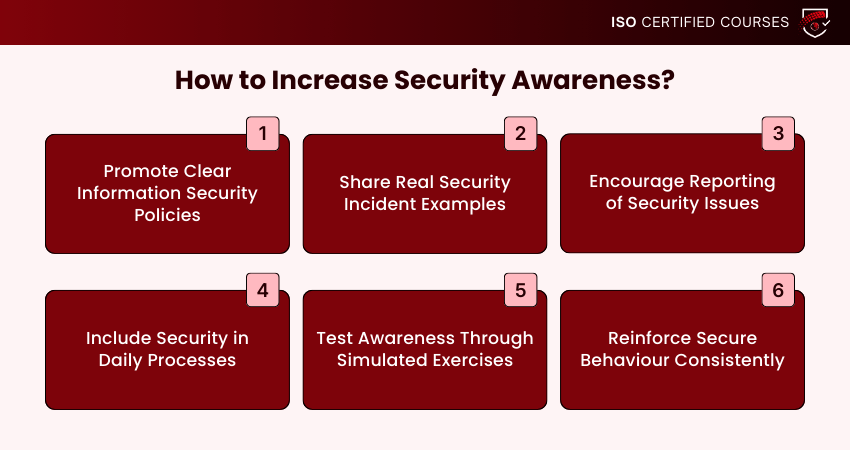
1) Run regular training and awareness sessions
2) Share updates on security risks and incidents
3) Include security topics in team meetings
4) Promote a culture of responsibility and vigilance
5) Review awareness programmes regularly
12) Retain Existing Customers
Nurturing a strong relationship with existing customers is one of the easiest yet time-consuming tasks. You need to retain them for the long run without breaking their trust in you. ISO 27001 helps organisations meet these expectations consistently, reducing the risk of incidents that might damage relationships.
1) Demonstrate security commitment during client reviews
2) Meet contractual security obligations consistently
3) Respond quickly and transparently to security issues
4) Continuously improve security controls
5) Maintain certification to show long-term reliability
Build end-to-end implementation expertise with our
ISO 27001 Lead Implementer Training
– Sign up soon!
How to Become ISO 27001 Certified?
Becoming ISO 27001 certified is not just about getting a certificate. It shows that your organisation is serious about keeping information safe. It also helps improve trust with customers, partners, and regulators. Here's how you can get ISO 27001 certified:
1) Set up Your Information Security Management System (ISMS)
The first step is to establish, implement, and document an Information Security Management System that suits the organisation’s size, scope, and risk environment. This includes policies, procedures, risk assessments, and security controls that define how information is protected.
At this stage, organisations identify information security risks, select appropriate controls, train employees, and assign clear roles and responsibilities. The ISMS forms the foundation for managing Information Security across the organisation.
2) Get Your ISMS Reviewed by an Independent Auditor
Before seeking certification, the ISMS must be internally reviewed through an internal audit and management review. This step checks whether the ISMS conforms to ISO 27001 requirements and is effectively implemented.
These reviews identify gaps, nonconformities, and improvement opportunities, allowing organisations to address issues before the external certification audit.
3) Successfully Pass the ISO 27001 Audit
The final step is the certification audit supervised by an accredited external certification body. The auditors evaluate the ISMS documentation and verify how effectively the controls operate in practice.
If the organisation meets the requirements, ISO 27001 Certification is awarded. This confirms that Information Security practices align with international standards and are subject to continual review and improvement.
Conclusion
ISO 27001 is a strategic investment that strengthens security, builds trust, and supports sustainable business growth. By adopting a structured, risk-based approach to Information Security, organisations can attain the Benefits of ISO 27001 and reduce the likelihood of costly security incidents. In a world where information is one of the most valuable business assets, protecting it properly brings a cutting edge to your organisation.
Learn how to achieve and maintain ISO 27001 compliance with our
ISO 27001 Training
– Start now!
Search Smarter
Quickly search through our blog content for what interests you
- Top ISO 9001 Internal Audit Questions and Answers in 2026
- ISO 27005 vs ISO 31000: How to Choose the Right Risk Framework
- Challenges of ISO 14001 and How to Overcome Them
- Top 14 Benefits of ISO 45001 Certification
- What are the ISO 27001 Requirements: A Complete 2026 Guide
- ISO 27001 vs ISO 27002: Key Difference and Uses Cases
- ISO 17025 vs ISO 9001: Key Differences and Similarities
- ISO 45001 Requirements for Occupational Health & Safety
- ISO 9001, 14001, and 45001: Key Differences and Similarities
- ISO 27001 vs SOC 2: Understanding Key Differences
- ISO 17025 Requirements: Explained in Detail
- What is ISO 27001 Gap Analysis? A Complete Overview
- ISO 17025: An Overview of Laboratory Accreditation
- What is ISO 27001: An Overview of the Information Security Standard
- ISO 27001 Controls from Annex A: What Changed in ISO 27001:2022?
- What is ISO 50001: Meaning, Requirements & Clauses Explained
- Top 10 Benefits of ISO 50001: A Detailed Explanation
- What is a Quality Management System (QMS): A Comprehensive Overview
- ISO 22000: Food Safety Management System Explained
- What is the Statement of Applicability (SoA) in ISO/IEC 27001?
- What is ISO 31000? The Risk Management Standard Explained
- What Is ISO 13485? Understanding Its 8 Key Sections
- ISO 56000: A Comprehensive Guide to Innovation Management
- What is ISO 14064? Components, Execution, and Benefits Explained
- Carbon Footprint: Definition, Types, and How to Calculate It
- ISO 22301: Requirements, Benefits and How to Implement It?
- ISO 9001 vs ISO 9002: Key Differences You Should Know
- Carbon Accounting: Meaning, Benefits, and Challenges
- Ecological Footprint: Meaning, Importance, and Purpose
- Compliance Management System: Components and How to Implement
- What is Competency Management? Benefits, Tips and Best Practices
- ISO 9001 and 27001: Quality Management vs Information Security Management
- ISO 27001 Annex A Controls: Everything You Need to Know
No match found
Frequently Asked Questions
What is ISO 27001 in a Nutshell?
ISO 27001 is a voluntary international standard for establishing, implementing, maintaining, and continually improving an Information Security Management System (ISMS).
What are the Four Themes of ISO 27001?
The four themes of ISO 27001 are
1) Organisational (Governance, policies)
2) People (Training, HR security)
3) Physical (Facilities and equipment protection)
4) Technological (IT systems and cybersecurity controls)
What are the Three Key Principles of ISO 27001?
The three key principles of ISO 27001 are confidentiality, integrity, and availability. These principles ensure that information is only accessible to authorised users, remains accurate and complete, and is available when needed to support business operations.