
























What is ISO 31000? The Risk Management Standard Explained
ISO 31000 is an international standard that provides principles and guidance to help organisations identify, assess, manage and monitor risks effectively. It defines eight key risk-related terms to ensure consistent understanding across organisations. ISO 31000 is applicable to any organisation, regardless of size or sector.

In a world where uncertainty is the only constant, ISO 31000 has proven itself to be a reliable guiding light. More than just a standard, it is a mindset that empowers teams to anticipate challenges, seize every opportunity and build resilience from the inside out.
As the globally recognised Risk Management standard, it offers a flexible approach to managing risk. Rather than eliminating risk entirely, it helps organisations understand it, respond intelligently and build resilience. In this blog, we break down ISO 31000 in simple, practical terms. So read on!
What is the Purpose of ISO 31000?
Risk Management plays a critical role in every organisation, as it helps identify and manage uncertainties that could affect business objectives. These risks may stem from cyber security threats, operational challenges or broader internal and external factors impacting continuity and performance.
ISO 31000 establishes a comprehensive framework for recognising, managing, and monitoring risk across an organisation. It addresses a wide range of risk types, including strategic, cyber security, financial, compliance and operational risks.
What is the Scope of ISO 31000?
ISO 31000 offers guidance for managing the wide range of risks an organisation may encounter. It is intentionally broad and adaptable, allowing organisations of different sizes, sectors and industries to apply the framework in line with their specific context, objectives and risk appetite.
As an international benchmark for structured Risk Management, ISO 31000 supports the development of consistent and effective risk practices. However, it is a guidance standard rather than a certifiable one. This means organisations cannot be formally audited or certified against it.
ISO 31000 Structure
ISO 31000 is structured around three core elements that work together to support effective Risk Management across an organisation: principles, framework, and process.
The principles define the characteristics of effective Risk Management, such as being integrated, structured, inclusive, and continuously improved. The framework helps organisations embed Risk Management into governance, leadership, strategy, and culture. The process provides a systematic approach to identifying, analysing, evaluating, treating, monitoring, and reviewing risk, supported by communication and consultation.
Together, these elements ensure Risk Management is consistent, adaptable, and aligned with organisational objectives.
Become a Lead Implementer to design, build, and embed Risk Management excellence. Sign up for
ISO 31000 Lead Implementer Training
now!
ISO 31000 Risk Management Framework
The ISO 31000 Risk Management framework is designed to be flexible, allowing organisations to apply it in line with their structure, objectives, and approach to Risk Management. Rather than following document sections, the framework focuses on how Risk Management is embedded, governed, and continually improved across the organisation.
The framework is built around six core elements:
1) Leadership and Commitment:
Senior management provides direction and support to ensure Risk Management aligns with organisational objectives and culture.
2) Integration:
Risk Management is embedded into governance, strategy, planning, and operational processes.
3) Design:
The framework is tailored to the organisation’s context, risk profile, and strategic priorities.
4) Implementation:
Risk Management practices are applied through defined roles, responsibilities, communication, and reporting mechanisms.
5) Evaluation:
The effectiveness of the framework is regularly reviewed to identify strengths and areas for improvement.
6) Improvement:
The framework is continually enhanced to remain effective as risks and organisational conditions change.
ISO 31000 Risk Management Principles
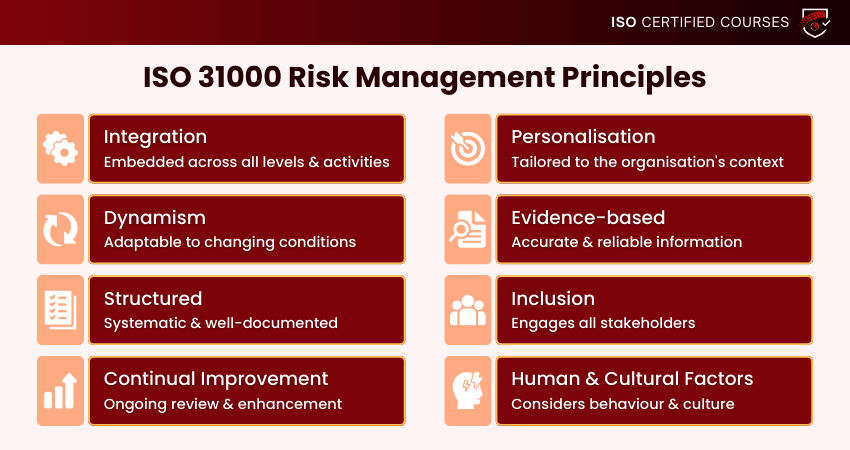
Here are the eight key principles pertaining to ISO 31000 Risk Management:
1) Integration
Risk Management is embedded across all organisational activities and decision-making levels. This ensures risks are considered alongside objectives, performance, and strategic planning.
2) Structured and Comprehensive
Risk Management follows a systematic, well-documented approach that supports strong governance. A consistent structure improves transparency, accountability and comparability of risk decisions.
3) Customised
Risk Management practices are tailored to suit the organisation’s context, objectives, and risk profile. This allows the approach to remain relevant to industry demands, size, and organisational complexity.
4) Inclusion
Relevant stakeholders are actively involved and informed throughout the Risk Management process. Inclusive participation improves risk awareness, communication, and quality of decision-making.
5) Dynamism
Risk Management remains responsive and adaptable to changes in internal and external environments. This helps organisations anticipate emerging risks and respond effectively to uncertainty.
6) Continual Improvement
Organisations regularly review and improve their Risk Management practices. Ongoing improvement ensures the framework remains effective as business conditions evolve.
7) Best Available Information
Risk-related decisions are based on accurate, timely and reliable information. Using quality data strengthens confidence in assessments and supports informed judgment.
8) Human and Cultural Factors
The influence of human behaviour and organisational culture on risk is recognised and addressed. Understanding these factors supports realistic risk assessments and effective risk controls.
Own the audit room and command decisions with ISO 31000 expertise. Sign up for
ISO 31000 Lead Auditor Training
now!
ISO 31000 Risk Management Process
The ISO 31000 Risk Management process is structured around six key elements that work together to make sure that risks are managed consistently:
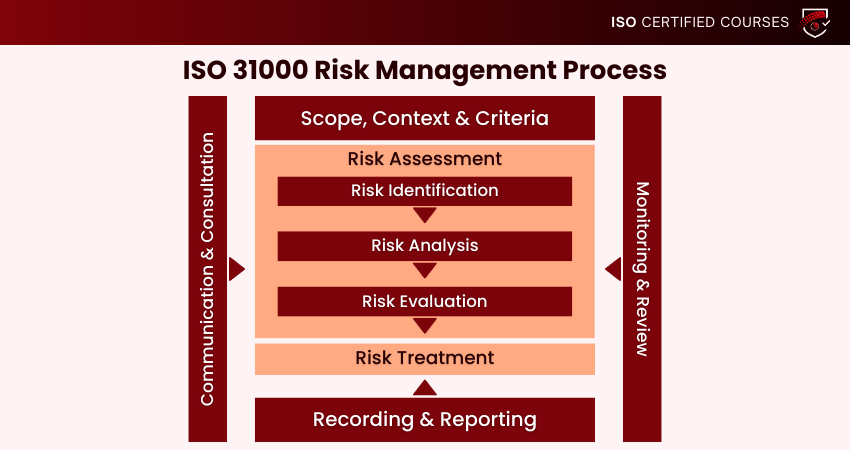
1) Ongoing Communication and Consultation
This takes place throughout the entire process, helping ensure all relevant stakeholders understand the risks, their responsibilities, and the actions required. Diverse perspectives, expertise and scenarios are considered at every stage to support informed decision-making.
2) Defining Scope, Context, and Risk Criteria
These establish the foundation of Risk Management by defining objectives, identifying internal and external influences and determining the organisation’s risk tolerance. This ensures risks are assessed in line with organisational priorities.
3) Conducting Risk Assessment
Risk Assessment consists of three interrelated steps: identifying potential risks, including both threats and opportunities, analysing their likelihood and consequences, and evaluating them against defined risk criteria. This enables organisations to focus on risks that matter most.
a) Risk Identification
This involves recognising potential events, situations, or sources of risk that could affect objectives, including both threats and opportunities.
b) Risk Analysis
Identified risks are analysed to understand their likelihood, consequences, and existing controls. This supports an informed understanding of risk exposure.
c) Risk Evaluation
Analysed risks are compared against risk criteria to determine priorities and decide which risks require treatment.
4) Risk Treatment Measures
These focus on selecting and applying appropriate measures to address identified risks. Where possible, risks are eliminated; otherwise, they are reduced, accepted or shared to an acceptable level.
5) Continuous Monitoring and Review
This helps ensure that risk controls remain effective and relevant over time. Performance is regularly assessed against expected outcomes to identify gaps, changes or the need for improvement.
6) Documenting and Reporting Risk Activities
These require the entire Risk Management process to be documented and communicated to stakeholders. Records such as incidents, non-compliance, system failures, observations and near misses support accountability and continuous improvement of Risk Management practices.
Audit risk the ISO 31000 way and become the voice of assurance. Sign up for
ISO 31000 Internal Auditor Training
now!
Pros and Cons of ISO 31000 Standard
Here are the benefits of ISO 31000:
1) Proven Effectiveness:
ISO 31000 is an internationally recognised standard that has been widely adopted and tested across industries.
2) Standardised Risk Management:
It provides a consistent framework for identifying risks, setting criteria, and applying appropriate treatments.
3) Stronger Risk-aware Culture:
Embedding Risk Management into daily activities encourages employees to proactively identify and manage risks.
4) Improved Financial Performance:
Reducing avoidable risks lowers the likelihood of losses and supports more stable business outcomes.
5) Integration With Existing Systems:
ISO 31000 aligns with other ISO standards, allowing easy integration into current management frameworks.
6) Proactive Decision-making:
The framework supports a shift from reactive responses to forward-looking risk mitigation.
7) Enhanced Investor Confidence:
Demonstrating effective Risk Management can make organisations more attractive to banks and investors.
But ISO 31000 is not without some substantial challenges. The key ones include:
1) Ongoing Commitment Required:
Effective implementation demands continuous effort, expertise, and regular updates.
2) Risk of False Assurance:
Even with robust processes, not all risks can be identified or controlled.
3) Potential Over-cautiousness:
Excessive focus on risk avoidance may restrict innovation and limit growth opportunities.
Conclusion
ISO 31000 turns any shred of uncertainty into future-ready insight. It does not promise a risk-free organisation, but it equips leaders with clarity and confidence when navigating complexity. Thanks to ISO 31000, by embedding risk awareness into everyday decisions, organisations can build resilience, protect value and stay ready for change in an unpredictable business landscape.
Want to learn how to turn any risk into a roadmap towards success?
ISO 31000 Courses
will help you out - Register now!
Search Smarter
Quickly search through our blog content for what interests you
- Top ISO 9001 Internal Audit Questions and Answers in 2026
- ISO 27005 vs ISO 31000: How to Choose the Right Risk Framework
- Challenges of ISO 14001 and How to Overcome Them
- Top 14 Benefits of ISO 45001 Certification
- What are the ISO 27001 Requirements: A Complete 2026 Guide
- 12 Benefits of ISO 27001 Certification for Business
- ISO 27001 vs ISO 27002: Key Difference and Uses Cases
- ISO 17025 vs ISO 9001: Key Differences and Similarities
- ISO 45001 Requirements for Occupational Health & Safety
- ISO 9001, 14001, and 45001: Key Differences and Similarities
- ISO 27001 vs SOC 2: Understanding Key Differences
- ISO 17025 Requirements: Explained in Detail
- What is ISO 27001 Gap Analysis? A Complete Overview
- ISO 17025: An Overview of Laboratory Accreditation
- What is ISO 27001: An Overview of the Information Security Standard
- ISO 27001 Controls from Annex A: What Changed in ISO 27001:2022?
- What is ISO 50001: Meaning, Requirements & Clauses Explained
- Top 10 Benefits of ISO 50001: A Detailed Explanation
- What is a Quality Management System (QMS): A Comprehensive Overview
- ISO 22000: Food Safety Management System Explained
- What is the Statement of Applicability (SoA) in ISO/IEC 27001?
- What Is ISO 13485? Understanding Its 8 Key Sections
- ISO 56000: A Comprehensive Guide to Innovation Management
- What is ISO 14064? Components, Execution, and Benefits Explained
- Carbon Footprint: Definition, Types, and How to Calculate It
- ISO 22301: Requirements, Benefits and How to Implement It?
- ISO 9001 vs ISO 9002: Key Differences You Should Know
- Carbon Accounting: Meaning, Benefits, and Challenges
- Ecological Footprint: Meaning, Importance, and Purpose
- Compliance Management System: Components and How to Implement
- What is Competency Management? Benefits, Tips and Best Practices
- ISO 9001 and 27001: Quality Management vs Information Security Management
- ISO 27001 Annex A Controls: Everything You Need to Know
- ISO 27001 Audit: A Complete Guide to the Audit Process
- ISO 9001 vs ISO 14001: Key Differences and Similarities
No match found
Frequently Asked Questions
No FAQs available for this blog.