





















ISO 17025 vs ISO 9001: Key Differences and Similarities
ISO 17025 focuses on technical competence and reliable testing results for laboratories, while ISO 9001 focuses on managing processes and improving quality. The standards serve different purposes but share common quality management principles. Choosing the right one depends on the organisation’s role, its services and regulatory requirements.

Accuracy and quality may sound similar, but in real-world operations, ISO 17025 vs ISO 9001 highlights a clear distinction between the two. One focuses on producing precise, reliable testing and calibration results, while the other is about delivering consistent performance and meeting customer expectations through structured management practices.
When organisations fail to understand this difference, they often select international standards that do not fully support their operational needs. This can affect regulatory alignment, credibility, and long-term success. That is why this blog explains ISO 17025 vs ISO 9001, outlining their similarities and differences to help you choose the standard that best fits your organisation’s role and goals. Let’s get started.
What is ISO 17025?
ISO 17025 is an international standard specifically designed for testing and calibration laboratories. This standard ensures that laboratories are capable of producing valid, accurate, and reliable test and calibration results. It covers not only how a lab manages its processes, but also how it handles equipment, staff competence, testing methods, measurement uncertainty, and traceability.
What is ISO 9001?
ISO 9001 is the most widely used standard for Quality Management Systems (QMS). Its purpose is to help organisations consistently meet customer and applicable regulatory requirements and improve customer satisfaction. Rather than focusing on technical testing or measurement accuracy, it concentrates on how a business manages its processes, risks, people, and continual improvement.
Key Differences Between ISO 17025 and ISO 9001
Although both standards are related to quality, their scope and intent differ significantly. Let's check how ISO 17025 and ISO 9001 differ from each other: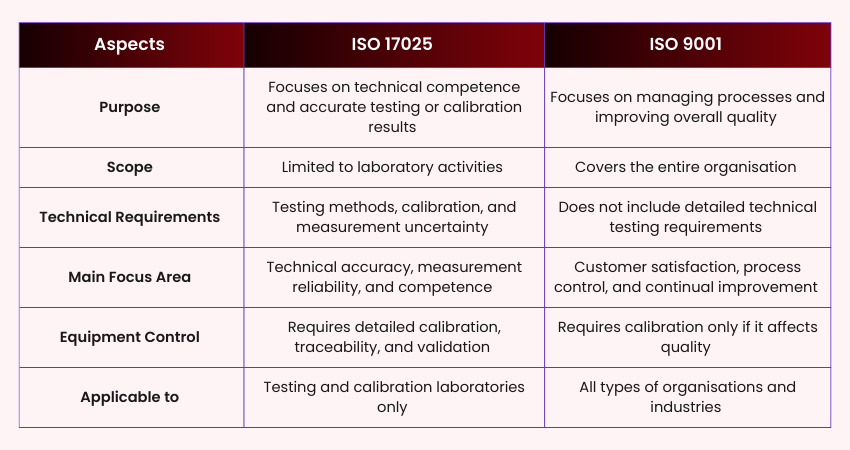
1) Purpose
ISO 9001 is designed to meet customer requirements by strengthening an organisation’s Quality Management and overall processes. ISO 17025, on the other hand, focuses on ensuring technical competence and the ability to produce valid and reliable testing and calibration results.
2) Scope
ISO 9001 applies to organisations of all types and industries, covering the entire Quality Management System across the business. ISO 17025 has a much narrower scope and applies only to testing and calibration laboratories.
3) Technical Requirements
ISO 17025 includes detailed technical requirements related to testing and calibration methods, equipment control, measurement uncertainty, and staff competence. These technical elements are not covered in ISO 9001, which focuses more on process consistency than technical accuracy.
4) Focus Areas
ISO 9001 emphasises leadership, process control, Risk Management, and meeting customer needs. However, ISO 17025 concentrates on laboratory competence, validated methods, traceability of measurements, and the reliability of test results.
5) Impartiality and Confidentiality
ISO 17025 places strong importance on impartiality and confidentiality to ensure unbiased and secure laboratory operations. These aspects are addressed indirectly in ISO 9001 through controls over documented information and customer data, but not as explicit requirements.
6) Recognition
ISO 17025 accreditation proves technical competence and is internationally recognised for the acceptance of test and calibration results. ISO 9001 Certification demonstrates an organisation’s commitment to quality and continuous improvement.
7) Customer and Regulatory Expectations
ISO 17025 is often required by industries, regulators, and authorities that depend on accurate and reliable testing results. On the other hand, ISO 9001 is commonly requested by general clients, suppliers, and regulators as a general quality management benchmark.
Strengthen your laboratory compliance with our ISO 17025 Internal Auditor Training – Register today!
Key Similarities Between ISO 17025 and ISO 9001
Although ISO 17025 vs ISO 9001 are designed for different purposes, they share several core principles that contribute to strong quality systems. These similarities make both standards valuable tools for organisations aiming to improve consistency, reliability, and customer satisfaction. Those similarities are:
1) Customer Focus
In ISO 17025 vs ISO 9001, both standards focus on meeting customer requirements and improving satisfaction through reliable results and consistent products or services.
2) Continuous Improvement
Both ISO 17025 and ISO 9001 promote regular reviews and ongoing improvements to enhance quality and performance.
3) Management Responsibility and Leadership
Both require senior leaders to show commitment, set quality policies, and support the Quality Management System.
4)Document and Record Control
Each standard requires controlled documented information, including procedures and records, to ensure consistency, traceability, and the ability to demonstrate fulfilment of requirements.
5) Competence and Training
Both standards emphasise staff competence and training to support reliable operations and consistent quality outcomes.
Support continuous quality improvement with our ISO 9001 Internal Auditor Training – Join immediately!
Benefits of ISO 17025 Accreditation
ISO 17025 offers significant benefits for laboratories. Those are listed below:
1) Builds strong technical credibility with customers, regulators, and partners
2) Ensures accurate and reliable testing and calibration results
3) Reduces errors through strict control of methods, equipment, and staff competence
4) Improves acceptance of test and calibration results by regulators and authorities
5) Enhances operational efficiency and confidence in daily laboratory activities
Benefits of ISO 9001 Certification
ISO 9001 offers broad benefits for organisations across all sectors. Some of the benefits include:
1) Improves customer satisfaction through consistent quality delivery
2) Increases operational efficiency by identifying risks and inefficiencies
3) Reduces waste and improves workflow management
4) Supports continual improvement and long-term business growth
5) Helps organisations adapt to changing customer and market needs
Which Standard Should You Choose?
Choosing between ISO 17025 and ISO 9001 depends entirely on your organisation’s role and objectives. If your organisation performs testing or calibration activities and issues measurement results, ISO 17025 is essential. It proves technical competence and ensures your results are reliable and internationally recognised.
If your organisation focuses on delivering products or services, managing customer relationships, or improving internal processes, ISO 9001 is the better choice.
Conclusion
ISO 17025 vs ISO 9001 are unique in their Quality Management, and they serve very different purposes. ISO 17025 is about trust in test results and technical competence, while ISO 9001 is about consistent quality and customer satisfaction. Whether you choose one or both, implementing the right standard can significantly improve credibility, efficiency, and long-term success.
Achieve and maintain laboratory excellence with our ISO 17025 Training – Begin your journey!
Search Smarter
Quickly search through our blog content for what interests you
- Top ISO 9001 Internal Audit Questions and Answers in 2026
- ISO 27005 vs ISO 31000: How to Choose the Right Risk Framework
- Challenges of ISO 14001 and How to Overcome Them
- Top 14 Benefits of ISO 45001 Certification
- What are the ISO 27001 Requirements: A Complete 2026 Guide
- 12 Benefits of ISO 27001 Certification for Business
- ISO 27001 vs ISO 27002: Key Difference and Uses Cases
- ISO 45001 Requirements for Occupational Health & Safety
- ISO 9001, 14001, and 45001: Key Differences and Similarities
- ISO 27001 vs SOC 2: Understanding Key Differences
- ISO 17025 Requirements: Explained in Detail
- What is ISO 27001 Gap Analysis? A Complete Overview
- ISO 17025: An Overview of Laboratory Accreditation
- What is ISO 27001: An Overview of the Information Security Standard
- ISO 27001 Controls from Annex A: What Changed in ISO 27001:2022?
- What is ISO 50001: Meaning, Requirements & Clauses Explained
- Top 10 Benefits of ISO 50001: A Detailed Explanation
- What is a Quality Management System (QMS): A Comprehensive Overview
- ISO 22000: Food Safety Management System Explained
- What is the Statement of Applicability (SoA) in ISO/IEC 27001?
- What is ISO 31000? The Risk Management Standard Explained
- What Is ISO 13485? Understanding Its 8 Key Sections
- ISO 56000: A Comprehensive Guide to Innovation Management
- What is ISO 14064? Components, Execution, and Benefits Explained
- Carbon Footprint: Definition, Types, and How to Calculate It
- ISO 22301: Requirements, Benefits and How to Implement It?
- ISO 9001 vs ISO 9002: Key Differences You Should Know
- Carbon Accounting: Meaning, Benefits, and Challenges
- Ecological Footprint: Meaning, Importance, and Purpose
- Compliance Management System: Components and How to Implement
- What is Competency Management? Benefits, Tips and Best Practices
- ISO 9001 and 27001: Quality Management vs Information Security Management
- ISO 27001 Annex A Controls: Everything You Need to Know
- ISO 27001 Audit: A Complete Guide to the Audit Process
No match found
Frequently Asked Questions
No FAQs available for this blog.