
























Carbon Accounting: Meaning, Benefits, and Challenges
Carbon Accounting is the process of measuring and tracking Greenhouse Gas (GHG) emissions produced by an organisation, to calculate its total carbon footprint. It helps organisations understand their environmental impact and identify areas for emission reduction. It also supports regulatory reporting and sustainability goals.

Running a business today is not just about meeting targets and driving growth. It also involves understanding the impact your daily operations have on the environment. From energy use in offices to emissions across supply chains, many organisations struggle to see the full picture. This is where Carbon Accounting becomes useful, helping businesses clearly understand where their emissions come from and what they can do about them.
Rather than being overly technical, Carbon Accounting turns everyday data into meaningful action. To better understand its practical value, in this blog, we will explore how it works and why it is becoming important for modern businesses. Let’s explore further.
What is Carbon Accounting?
Carbon Accounting is the process of measuring, tracking, and reporting the amount of greenhouse gas emissions produced directly or indirectly by an organisation. These emissions are usually expressed in terms of carbon dioxide equivalent (CO₂e), which enables the comparison of different gases using a standardised scale.
It helps businesses understand their environmental impact and provides the data needed to create strategies for reducing emissions. This process is widely used by companies, governments, and institutions to support sustainability initiatives and meet regulatory requirements.
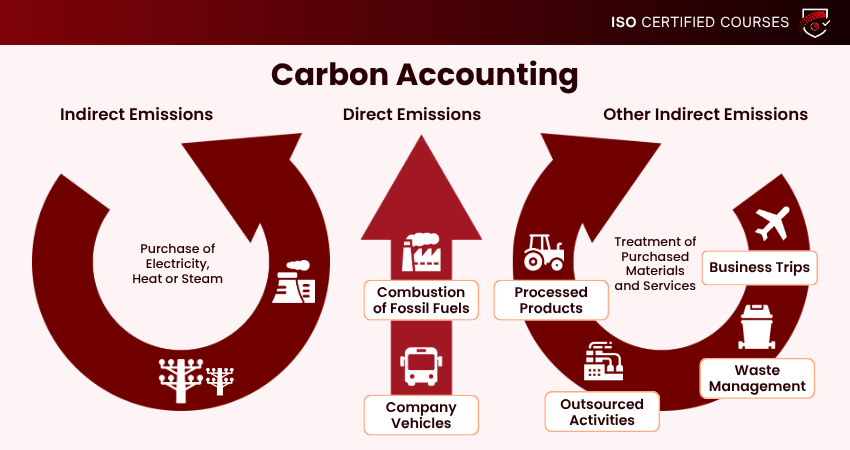
1) Scope 1 or Direct Emissions
Direct emissions, also known as Scope 1 emissions, are greenhouse gases released from sources owned or controlled by an organisation. These include activities like fuel use in company vehicles, manufacturing processes, and on-site energy generation.
For example, if a company operates delivery trucks or uses generators within its facilities, the emissions produced from these activities are considered direct emissions. These are often the easiest to measure because they are within the organisation’s control.

2) Scope 2 or Indirect Emissions
Indirect emissions, also known as Scope 2 emissions, are generated from the consumption of purchased energy, such as electricity, heating, or cooling. Although these emissions occur outside the organisation’s physical boundaries, they are still linked to its operations.
For instance, when a company uses electricity from the grid, the emissions produced during the generation of that electricity are classified as indirect emissions. These can vary depending on the energy source used, such as renewable or fossil fuels.
3) Scope 3 or Supply Chain Emissions
Supply chain emissions, also known as Scope 3 emissions, include indirect emissions across a business’s value chain. They are often the largest and most complex category for many organisations, covering activities like raw material extraction, transportation, product use, and disposal.
For example, emissions generated by suppliers, logistics partners, or even customers using a product fall under this category. Measuring these emissions can be challenging, but they provide a complete view of a company’s overall environmental impact.
Why is Carbon Accounting Important?
Carbon Accounting helps organisations understand and manage their environmental impact effectively. It provides key data to support informed decisions and meet sustainability goals. Measuring emissions identifies major sources, while tracking progress helps businesses monitor performance and improve over time.
It also ensures regulatory compliance by meeting evolving environmental laws and reporting standards. In addition, it supports better decision-making through data-driven strategies that reduce emissions and improve efficiency. By improving transparency, Carbon Accounting strengthens trust and credibility with investors, customers, and other stakeholders.
Learn to measure, monitor, and report climate impact with confidence through the
ISO 14097 Greenhouse Management Training
– Join now!
How Does Carbon Accounting Work?
Carbon Accounting follows a structured process that helps organisations measure and manage their greenhouse gas emissions effectively. It ensures accurate tracking, analysis, and reporting of emissions across operations:
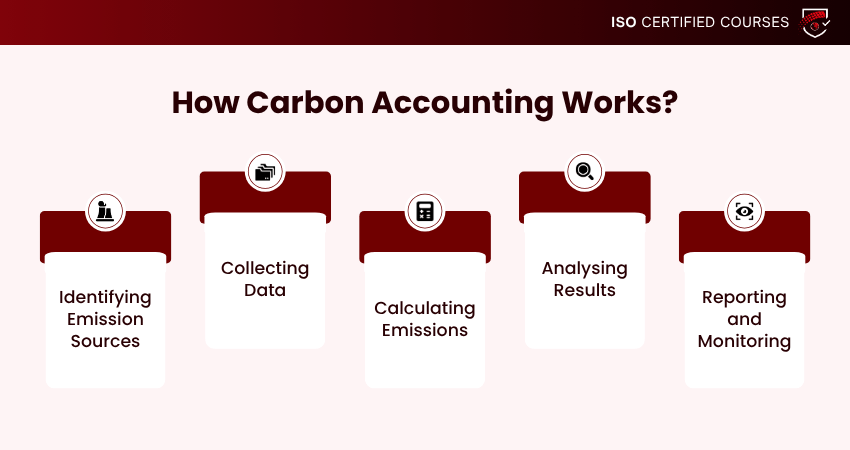
1) Identifying Emission Sources: Recognises direct, indirect, and supply chain emission points.
2) Collecting Data: Gathers information such as fuel usage, electricity consumption, and transport activities.
3) Calculating Emissions: Converts data into CO₂ equivalent (CO₂e) using standard emission factors.
4) Analysing Results: Identifies high-emission areas and opportunities for reduction.
5) Reporting and Monitoring:
Documents findings to track progress and meet regulatory requirements.
What is the Outcome of Carbon Accounting?
Carbon Accounting provides organisations with clear and measurable insights into their environmental impact, enabling better planning and long-term sustainability. It helps businesses turn emission data into actionable outcomes:
1) Carbon Footprint Visibility: Provides a complete view of total emissions across operations. This helps organisations understand their overall environmental impact clearly.
2) Emission Hotspot Identification: Highlights areas with the highest carbon output. This enables businesses to focus on the most critical sources first.
3) Goal Setting and Tracking: Supports setting realistic reduction targets and monitoring progress. This ensures continuous improvement over time.
4) Improved Decision-making: Enables informed strategies to reduce emissions and optimise operations. This leads to more efficient and sustainable business practices.
5) Enhanced Reporting: Produces accurate reports for compliance and stakeholder communication. This improves transparency and builds stakeholder trust.
Become an expert in environmental assurance and emissions verification processes with the
ISO 14065 Training
– Register today!
Benefits of Carbon Accounting
Carbon Accounting offers several practical benefits that help organisations improve both their environmental and business performance. It provides clear insights that support smarter decisions and long-term sustainability:
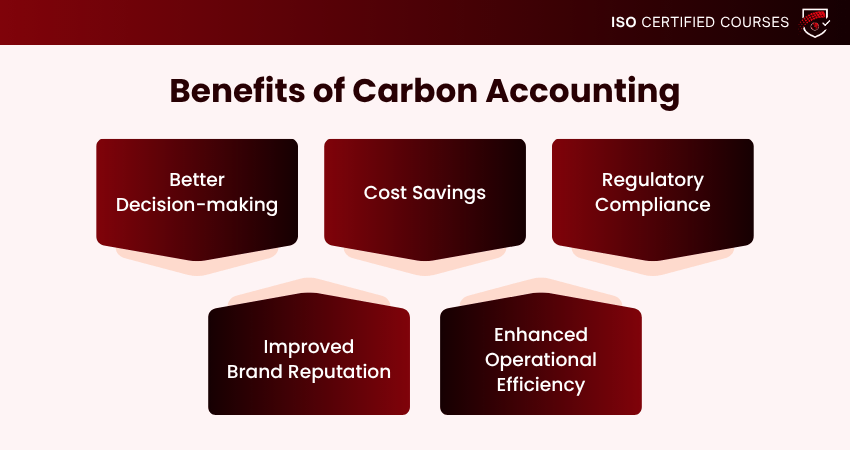
1) Better Decision-making: Helps identify key emission sources and prioritise reduction efforts. This enables more informed and effective business strategies.
2) Cost Savings: Highlights areas of high energy use and inefficiency. This allows organisations to reduce waste and lower operational costs.
3) Regulatory Compliance: Ensures adherence to environmental laws and reporting standards. This helps avoid penalties and maintain legal compliance.
4) Improved Brand Reputation: Demonstrates commitment to sustainability and responsible practices. This builds trust with customers, investors, and partners.
5) Enhanced Operational Efficiency:
Encourages optimisation of processes and resource usage. This leads to improved productivity and reduced environmental impact.
Challenges of Carbon Accounting
Carbon Accounting can be complex to implement, especially for organisations with large operations and extended supply chains. While it offers many benefits, businesses often face several practical challenges during the process:
1) Data Collection Difficulties: Gathering accurate data from multiple sources can be time-consuming. This becomes more challenging when dealing with different systems and locations.
2) Complex Calculations: Converting activity data into emissions requires standard factors and methodologies. If not managed carefully, this can lead to data inconsistencies and reporting errors.
3) Supply Chain Limitations: Obtaining reliable data from suppliers and partners is often difficult. This makes it harder to measure full value chain emissions accurately.
4) Changing Regulations: Environmental laws and reporting standards continue to evolve. This requires organisations to regularly update their processes and reporting methods.
5) Initial Implementation Costs: Setting up systems, tools, and training requires investment. This can create a challenge for smaller organisations in the early stages.
Gain skills to reduce environmental impact and enhance sustainability performance with the
ISO 20121 Event Sustainability Management System Training
- Join now!
Why Should My Business Use Carbon Accounting?
Carbon Accounting helps businesses manage their environmental impact while improving overall performance and sustainability. It provides a clear framework to identify inefficiencies and take meaningful action across operations:
1) Improves Operational Efficiency: Identifies areas of high energy use and waste. This helps businesses optimise processes and reduce costs.
2) Supports Sustainability Goals: Provides data to set and achieve emission reduction targets. This ensures measurable progress over time.
3) Enhances Compliance Readiness: Prepares businesses for current and future environmental regulations. This minimises the risk of penalties and disruptions.
4) Strengthens Brand Value: Demonstrates commitment to responsible and sustainable practices. This builds trust with customers and investors.
5) Drives Innovation and Growth:
Encourages adoption of cleaner technologies and smarter solutions. This helps businesses stay competitive in a changing market.
Conclusion
Carbon Accounting gives businesses a clear path to understand, measure, and reduce their environmental impact. It not only supports sustainability goals but also improves efficiency, compliance, and decision-making. By adopting it effectively, organisations can stay competitive, build trust, and contribute to a more responsible and sustainable future.
Gain practical skills to manage emissions and achieve sustainability goals confidently with the ISO Training – Join today!
Search Smarter
Quickly search through our blog content for what interests you
- Top ISO 9001 Internal Audit Questions and Answers in 2026
- ISO 27005 vs ISO 31000: How to Choose the Right Risk Framework
- Challenges of ISO 14001 and How to Overcome Them
- Top 14 Benefits of ISO 45001 Certification
- What are the ISO 27001 Requirements: A Complete 2026 Guide
- 12 Benefits of ISO 27001 Certification for Business
- ISO 27001 vs ISO 27002: Key Difference and Uses Cases
- ISO 17025 vs ISO 9001: Key Differences and Similarities
- ISO 45001 Requirements for Occupational Health & Safety
- ISO 9001, 14001, and 45001: Key Differences and Similarities
- ISO 27001 vs SOC 2: Understanding Key Differences
- ISO 17025 Requirements: Explained in Detail
- What is ISO 27001 Gap Analysis? A Complete Overview
- ISO 17025: An Overview of Laboratory Accreditation
- What is ISO 27001: An Overview of the Information Security Standard
- ISO 27001 Controls from Annex A: What Changed in ISO 27001:2022?
- What is ISO 50001: Meaning, Requirements & Clauses Explained
- Top 10 Benefits of ISO 50001: A Detailed Explanation
- What is a Quality Management System (QMS): A Comprehensive Overview
- ISO 22000: Food Safety Management System Explained
- What is the Statement of Applicability (SoA) in ISO/IEC 27001?
- What is ISO 31000? The Risk Management Standard Explained
- What Is ISO 13485? Understanding Its 8 Key Sections
- ISO 56000: A Comprehensive Guide to Innovation Management
- What is ISO 14064? Components, Execution, and Benefits Explained
- Carbon Footprint: Definition, Types, and How to Calculate It
- ISO 22301: Requirements, Benefits and How to Implement It?
- ISO 9001 vs ISO 9002: Key Differences You Should Know
- Ecological Footprint: Meaning, Importance, and Purpose
- Compliance Management System: Components and How to Implement
- What is Competency Management? Benefits, Tips and Best Practices
- ISO 9001 and 27001: Quality Management vs Information Security Management
- ISO 27001 Annex A Controls: Everything You Need to Know
- ISO 27001 Audit: A Complete Guide to the Audit Process
- ISO 9001 vs ISO 14001: Key Differences and Similarities
No match found
Frequently Asked Questions
What are the Different Methods of Carbon Accounting?
Carbon Accounting methods include activity-based, spend-based, and hybrid approaches. Activity-based uses real data like fuel or energy use for accuracy, while spend-based estimates emissions from financial data. Hybrid methods combine both to improve precision and provide a more complete emissions picture.
Is Carbon Accounting Difficult?
Carbon Accounting can be challenging due to data collection, complex calculations, and tracking supply chain emissions. However, with the right tools, frameworks, and expertise, it becomes manageable. Many organisations use software and standard guidelines to simplify the process and improve accuracy.
What Does a Carbon Accountant do?
A Carbon Accountant measures and reports an organisation’s greenhouse gas emissions. They collect data, calculate carbon footprints, ensure compliance, and identify ways to reduce emissions, helping businesses make informed and sustainable decisions.