

























Ecological Footprint: Meaning, Importance, and Purpose
An Ecological Footprint shows the amount of land and water needed to support your lifestyle, along with the resources required to absorb the waste you produce. It helps individuals and organisations understand how their actions affect natural resources. It highlights environmental impact and supports sustainable decision-making.

Are we living within the Earth’s limits, or slowly crossing them? It is a simple question, but it reveals a bigger reality about how we live. From the food we eat to the way we travel and consume energy, our daily choices place a growing demand on the planet’s natural resources. This is where the idea of an Ecological Footprint becomes important.
It helps you know how your lifestyle impacts the environment and whether those habits are sustainable in the long run. By looking at your footprint, you can clearly see how much you rely on nature. In this blog, we will explore what is an Ecological Footprint, why it matters, and practical steps you can take to reduce it. Let's dive in!
What is an Ecological Footprint?
An Ecological Footprint is a way to measure how dependent humans are on natural resources. It shows how much biologically productive land and water area is needed to support a particular lifestyle, business, or activity, including the resources required to absorb the waste produced.
In simple terms, it shows how much pressure we put on the environment through our daily choices. It considers elements like food consumption, energy usage, transportation, housing, and waste generation. If your footprint is larger than what Earth can sustain, it means you are consuming resources more quickly than they can be restored. This condition is commonly known as an ecological overshoot.

Why the Ecological Footprint is Important?
Understanding the importance of the Ecological Footprint helps you recognise the impact of your actions on the environment. Here are the key reasons why it matters:
1) Highlights Resource Overuse: It clearly shows when people use more resources than the Earth can replace, helping everyone understand the increasing strain on natural resources.
2) Encourages Sustainable Choices: By identifying which activities use the most resources, it helps individuals and organisations make more environmentally friendly decisions.
3) Supports Environmental Awareness: It raises awareness about how daily habits impact the planet, making sustainability more relatable and easier to understand.
4) Helps in Policy and Planning: Governments and organisations use Ecological Footprint data to create strategies for sustainable development and resource management.
5) Promotes Responsibility and Accountability: It encourages individuals, organisations, and countries to take responsibility for their resource use and work towards a more balanced and fair distribution.
6) Protects Future Generations:
By understanding and reducing our footprint, we help ensure that natural resources remain available for future generations.
What is the Purpose of an Ecological Footprint?
The Ecological Footprint serves several important purposes in helping us understand and manage our impact on the environment. Its purposes include:
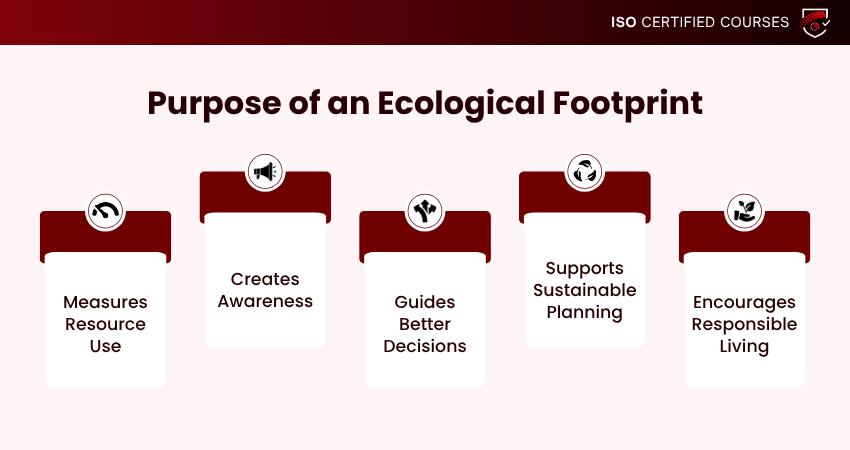
1) Measures Resource Use: It provides a clear way to calculate how much natural resources are used to support a lifestyle, business, or activity.
2) Creates Awareness: It helps people understand how their daily actions affect the environment, encouraging more mindful behaviour.
3) Guides Better Decisions: It supports individuals, businesses, and governments in making choices that reduce environmental impact.
4) Supports Sustainable Planning: It helps in designing systems, cities, and policies that use resources more efficiently and responsibly.
5) Encourages Responsible Living:
It promotes a balanced use of resources, ensuring that people can’t take more from the Earth than it can replace.
How to Calculate the Ecological Footprint?
Calculating an Ecological Footprint involves analysing different aspects of consumption and converting them into the amount of land needed to sustain them. The process typically includes the following components:
1) Food Consumption: The land required to grow crops and raise livestock
2) Energy Use: The resources needed to produce electricity and fuel
3) Transportation: Emissions and fuel consumption from travel
4) Housing: Land used for buildings and infrastructure
5) Waste Generation: The capacity needed to absorb waste, especially carbon emissions
A commonly used equation to calculate the Ecological Footprint is:

Where:
1) Ti = Annual consumption (in tons) of product i by a nation
2) Yw = World-average yield for product i
3) EQFi = Equivalence factor for product i, used to standardise different types of land
This formula helps convert consumption into Global Hectares (gha), a standard unit used to measure ecological demand, showing how much biologically productive land and water area is required to support a specific lifestyle or population.
Step into the growing field of environmental compliance by registering for
ISO 14065 Training
today!
5 Simple Ways to Reduce Your Ecological Footprint
Reducing your Ecological Footprint does not require drastic lifestyle changes. Small, consistent actions can make a notable difference over time. Let's check five simple ways that can help you reduce it:
1) Optimise Your Travel Habits
Travel is one of the biggest sources of environmental impact. Choosing better ways to move around can lower your footprint. Walking, cycling, or using public transport instead of driving reduces fuel consumption and emissions. Sharing rides with others is also helpful, as it reduces the number of vehicles on the road and lowers overall fuel consumption.
2) Manage Your Energy Usage Efficiently
Saving energy is one of the easiest ways to reduce your Ecological Footprint. It is not limited to just one place as it applies to all areas of daily life, including workplaces, travel, and general activities. You can try to switch to energy-saving appliances, use LED bulbs, and turn off devices when not in use. Using renewable energy, like solar power, can also be a better option.
3) Adopt Effective Recycling Practices
Waste management is another critical area where individuals can make a difference. Recycling helps reduce the need for raw materials and lowers environmental strain. Separate materials like paper, plastic, glass, and metal so they can be reused. Composting food waste is also useful and good for the soil. These small habits can reduce waste in the long run.
4) Explore Sustainable Eating Habits
The food we intake has a significant impact on our Ecological Footprint. Adopting more sustainable eating habits can make a meaningful difference. Buying local and seasonal produce also helps reduce the environmental cost of transportation and storage. Proper planning of meals and using leftovers efficiently can further lower your environmental impact.
5) Stay Mindful of Your Environment and the Rebound Effect
Being environmentally conscious is not always about individual actions. It also involves understanding the broader impact of our choices. Sometimes, saving resources in one area can lead to more use in another. This is called the rebound effect. For example, saving money on electricity might lead to using more devices. This can cancel out the benefits.
Learn how to assess environmental impacts effectively by signing for
ISO 14040 Training
now!
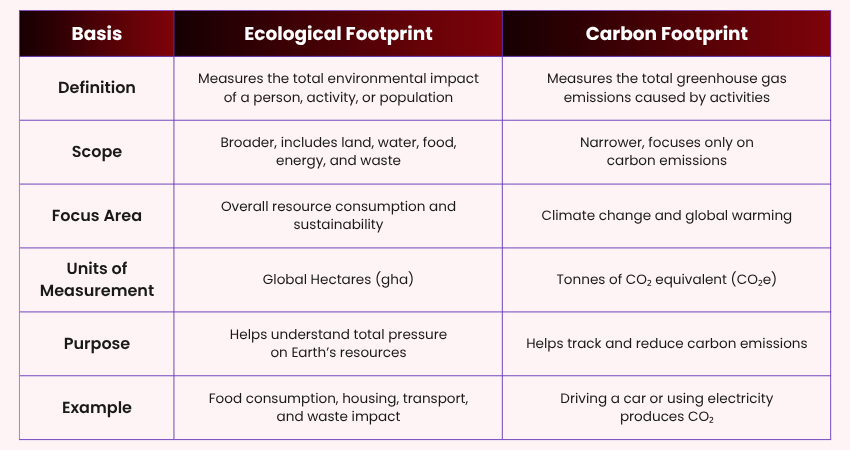
Ecological Footprint vs Carbon Footprint
A Carbon Footprint , in particular, measures the amount of greenhouse gases, particularly carbon dioxide, emitted by human activities. It focuses mainly on energy use and emissions.
On the other hand, an Ecological Footprint is broader. It includes not only carbon emissions but also land use, water consumption, food production, and waste management. While carbon footprint highlights climate change, Ecological Footprint provides a clearer view of sustainability. The table below highlights the difference between Ecological Footprint and Carbon Footprint:
Conclusion
The Ecological Footprint brings out a simple yet powerful way to understand how our everyday choices affect the planet. By becoming more aware of our footprint, we can start making smarter and more responsible decisions. Small changes, such as improving travel habits, managing energy use, and choosing sustainable food options, can collectively make a significant difference.
Build a strong foundation in international standards with ISO Training – Sign up now!
Search Smarter
Quickly search through our blog content for what interests you
- Top ISO 9001 Internal Audit Questions and Answers in 2026
- ISO 27005 vs ISO 31000: How to Choose the Right Risk Framework
- Challenges of ISO 14001 and How to Overcome Them
- Top 14 Benefits of ISO 45001 Certification
- What are the ISO 27001 Requirements: A Complete 2026 Guide
- 12 Benefits of ISO 27001 Certification for Business
- ISO 27001 vs ISO 27002: Key Difference and Uses Cases
- ISO 17025 vs ISO 9001: Key Differences and Similarities
- ISO 45001 Requirements for Occupational Health & Safety
- ISO 9001, 14001, and 45001: Key Differences and Similarities
- ISO 27001 vs SOC 2: Understanding Key Differences
- ISO 17025 Requirements: Explained in Detail
- What is ISO 27001 Gap Analysis? A Complete Overview
- ISO 17025: An Overview of Laboratory Accreditation
- What is ISO 27001: An Overview of the Information Security Standard
- ISO 27001 Controls from Annex A: What Changed in ISO 27001:2022?
- What is ISO 50001: Meaning, Requirements & Clauses Explained
- Top 10 Benefits of ISO 50001: A Detailed Explanation
- What is a Quality Management System (QMS): A Comprehensive Overview
- ISO 22000: Food Safety Management System Explained
- What is the Statement of Applicability (SoA) in ISO/IEC 27001?
- What is ISO 31000? The Risk Management Standard Explained
- What Is ISO 13485? Understanding Its 8 Key Sections
- ISO 56000: A Comprehensive Guide to Innovation Management
- What is ISO 14064? Components, Execution, and Benefits Explained
- Carbon Footprint: Definition, Types, and How to Calculate It
- ISO 22301: Requirements, Benefits and How to Implement It?
- ISO 9001 vs ISO 9002: Key Differences You Should Know
- Carbon Accounting: Meaning, Benefits, and Challenges
- Compliance Management System: Components and How to Implement
- What is Competency Management? Benefits, Tips and Best Practices
- ISO 9001 and 27001: Quality Management vs Information Security Management
- ISO 27001 Annex A Controls: Everything You Need to Know
- ISO 27001 Audit: A Complete Guide to the Audit Process
- ISO 9001 vs ISO 14001: Key Differences and Similarities
No match found
Frequently Asked Questions
What are Examples of Ecological Footprint?
There are many everyday examples of the Ecological Footprint. Driving a car, using electricity, eating meat, and buying new products all add to your footprint. Even habits like fast fashion or frequently buying new gadgets increase your footprint because they use more resources and create waste.
What Country has the Largest Ecological Footprint?
Countries with high lifestyles and heavy resource use usually have the largest Ecological Footprints. China has the largest total Ecological Footprint due to its population size and industrial activity. However, countries like the United Arab Emirates and Qatar often rank high when looking at footprint per person.
What are the Key Components of an Ecological Footprint?
The components of an Ecological Footprint are:
1) Cropland: Land for growing food
2) Grazing Land: Space for animals
3) Forest Land: Resources like wood and paper
4) Fishing Areas: Oceans used for seafood
5) Built-up Land: Physical space for buildings and roads
6) Carbon Footprint: Land needed to absorb carbon emissions