
























ISO 45001 Requirements for Occupational Health & Safety
ISO 45001 establishes an OH&S management system to manage risks, improve safety, ensure well-being and drive improvement through 10 clauses. Its requirements focus on leadership commitment, employee participation, operational control, performance evaluation, and continual improvement. It helps prevent workplace injuries and illnesses.

Every safety rule exists to protect people and ensure they return home safely at the end of the day. This is why workplace health and safety are not just about policies or paperwork, it is about protecting lives, livelihoods, and overall well-being. When risks are ignored or poorly managed, the consequences can affect employees, families, and entire organisations.
To prevent such issues and maintain work on track, ISO 45001 offers a structured approach to managing occupational health and safety. In this blog, you will explore ISO 45001 Requirements along with what ISO 45001 actually refers to, its clauses, and how to implement it in your workplace. Let's get started!
What is ISO 45001?
ISO 45001 is an internationally recognised standard that sets out the requirements for an Occupational Health and Safety (OH&S) Management System. It offers a clear framework to help organisations identify hazards, manage risks, and improve workplace health and safety performance in a practical way.
The purpose of ISO 45001 is to reduce work-related injuries and illnesses by proactively managing any forms of risks and hazards. Unlike older safety standards that focused more on procedures, ISO 45001 places a strong emphasis on leadership, worker participation, and integrating health and safety into everyday business processes.
What are the Key ISO 45001 Requirements by Clause?
ISO 45001 is structured into clauses that explain how an organisation should plan, manage, monitor, and improve occupational health and safety. Here are those clauses: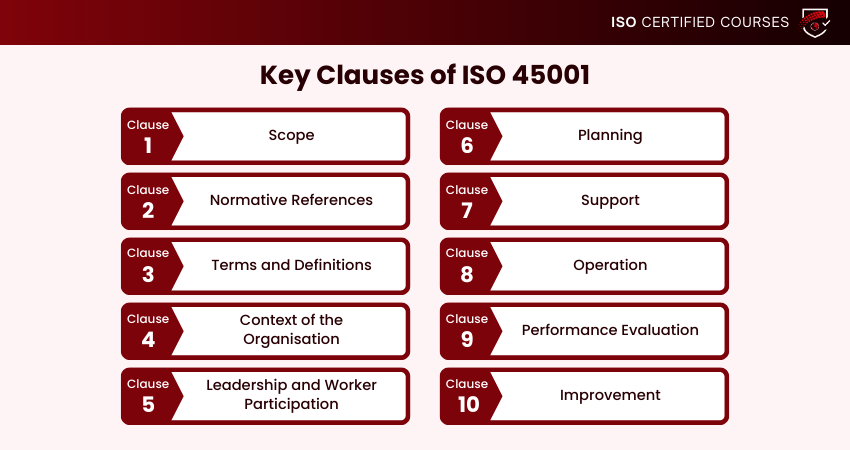
Clause 1: Scope
Clause 1 explains what ISO 45001 covers and who it applies to. It confirms that the standard can be used by any organisation, regardless of size or industry, to manage health and safety risks and provide safe working conditions.
1) Focuses on preventing work-related injury and illness
2) Covers workers, stakeholders, and other affected persons
3) Supports continual improvement of health and safety performance
4) Requires a defined scope for the OH&S Management system
Clause 2: Normative References
Clause 2 identifies any external standards that are required to apply ISO 45001. ISO 45001 does not include any normative references, which means organisations are not required to consult additional standards to implement the Occupational Health and Safety Management System.
Clause 3: Terms and Definitions
Clause 3 defines key terms used throughout ISO 45001 to ensure a common and consistent understanding of Occupational Health and Safety requirements across the organisation.
1) Defines terms such as hazard, OH&S risk, worker and worker participation
2) Supports consistent understanding during implementation
3) Reduces the risk of misinterpreting requirements
4) Helps organisations apply controls and responsibilities
Clause 4: Context of the Organisation
Clause 4 in ISO 45001 Requirement demands organisations to understand their internal and external environment and how it affects health and safety. This helps make sure that the OH&S system is relevant and effective.
1) Identify internal and external issues affecting OH&S
2) Understand worker and stakeholder expectations
3) Determine legal and regulatory obligations
4) Consider business activities, locations, and processes
Clause 5: Leadership and Worker Participation
This clause focuses on leadership responsibility and employee involvement. Leaders need to establish an OH&S policy, ensure roles and responsibilities are assigned, and promote a culture that supports safe working practices.
1) Demonstrate leadership commitment to health and safety
2) Establish and communicate safety policies
3) Encourage worker consultation and participation
4) Promote a positive safety culture
Implement and manage an effective OH&S Management System with ISO 45001 Lead Implementer Training – Sign up anytime!
Clause 6: Planning
Clause 6 is about identifying the potential risks and planning actions to control them. Organisations have to assess hazards, meet legal requirements, and set health and safety objectives.
1) Identify workplace hazards and assess risks
2) Consider opportunities to improve OH&S performance
3) Follow the legal and regulatory requirements
4) Set measurable health and safety objectives
Clause 7: Support
This clause ensures the organisation has the right people, resources, and information to run the OH&S Management System effectively. This includes competent personnel, appropriate training, awareness, communication, and documented information.
1) Provide adequate resources for Safety Management
2) Ensure workers are competent and trained
3) Raise awareness of health and safety policies and risks
4) Maintain necessary documented information
Clause 8: Operation
Clause 8 focuses on controlling day-to-day operations to reduce health and safety risks. This includes establishing safe work procedures, managing stakeholders, controlling outsourced processes, and preparing for emergency situations.
1) Implement controls to eliminate or reduce hazards
2) Establish safe work procedures
3) Plan, implement and test emergency preparedness and response
4) Test and review emergency response plans
Clause 9: Performance Evaluation
This clause requires organisations to monitor and measure how well their health and safety measures are working. For this, you can track indicators such as incidents, near misses, absenteeism, and compliance with legal requirements.
1) Measure compliance with legal requirements
2) Conduct internal audits
3) Review incidents and near misses
4) Carry out management reviews
Clause 10: Improvement
The final clause focuses on learning from incidents and improving health and safety performance over time. Continuous improvement is a significant requirement of ISO 45001. This is because the goal is not just to fix problems but to learn from them.
1) Investigate incidents and nonconformities
2) Take corrective actions to prevent recurrence
3) Identify improvement opportunities
4) Update risk assessments when needed
Assess compliance and improve workplace safety systems with ISO 45001 Internal Auditor Training – Register today!
How to Implement ISO 45001 in Your Organisation?
ISO 45001 is a step-by-step process that focuses on building a strong and effective health and safety system. Here's how you can implement it:
Step 1: Commit to Safety
This step focuses on leadership commitment. Leaders have to support occupational health and safety and make it a priority across the organisation. Without leadership involvement, the ISO 45001 implementation will not be effective.
1) Demonstrate commitment to health and safety
2) Set clear safety goals and expectations
3) Lead by example through safe practices
Step 2: Conduct a Gap Analysis
A gap analysis compares your current health and safety practices against ISO 45001 Requirements. This helps identify strengths, weaknesses, and areas that need improvement.
1) Review existing safety processes and documents
2) Prioritise areas needing immediate attention
3) Use findings to plan implementation steps
Step 3: Develop an Implementation Plan
Depending on the gap analysis, develop an implementation plan with clear actions, responsibilities, and timelines. This plan outlines the actions needed to meet ISO 45001 Requirements in a clear and organised way.
1) Define tasks and responsibilities
2) Plan risk assessments and policy updates
3) Track progress throughout implementation
Step 4: Engage Employees
Employee involvement is a key requirement of ISO 45001. Employees should be actively involved in safety discussions and decision-making to ensure the system works in real situations.
1) Consult employees on safety issues
2) Encourage reporting of hazards and incidents
3) Form safety committees where appropriate
Step 5: Monitor and Evaluate
This step is all about ensuring that the ISO 45001 system is working as planned. Regular monitoring helps find issues early and ensures continuous improvement of health and safety performance.
1) Monitor workplace safety performance
2) Conduct inspections and internal audits
3) Review incidents and near misses
Step 6: Certification
After implementing and reviewing the system, organisations may choose to seek ISO 45001 Certification. It involves an independent external audit that verifies conformity with ISO 45001 Requirements. While it is completely voluntary, it provides strong credibility and reassurance to stakeholders.
1) Prepare for external audits
2) Demonstrate system effectiveness
3) Maintain certification through regular reviews
Conclusion
ISO 45001 provides a clear and practical framework for managing workplace health and safety in a proactive way. By understanding ISO 45001 Requirements and following a step-by-step implementation approach, organisations can reduce risks, prevent work-related injuries, and meet legal obligations more effectively. Moreover, it helps form a culture where safety is embedded into everyday operations.
Next step towards creating safer, healthier workplaces with ISO 45001 Training – Start your journey now!
Search Smarter
Quickly search through our blog content for what interests you
- Top ISO 9001 Internal Audit Questions and Answers in 2026
- ISO 27005 vs ISO 31000: How to Choose the Right Risk Framework
- Challenges of ISO 14001 and How to Overcome Them
- Top 14 Benefits of ISO 45001 Certification
- What are the ISO 27001 Requirements: A Complete 2026 Guide
- 12 Benefits of ISO 27001 Certification for Business
- ISO 27001 vs ISO 27002: Key Difference and Uses Cases
- ISO 17025 vs ISO 9001: Key Differences and Similarities
- ISO 9001, 14001, and 45001: Key Differences and Similarities
- ISO 27001 vs SOC 2: Understanding Key Differences
- ISO 17025 Requirements: Explained in Detail
- What is ISO 27001 Gap Analysis? A Complete Overview
- ISO 17025: An Overview of Laboratory Accreditation
- What is ISO 27001: An Overview of the Information Security Standard
- ISO 27001 Controls from Annex A: What Changed in ISO 27001:2022?
- What is ISO 50001: Meaning, Requirements & Clauses Explained
- Top 10 Benefits of ISO 50001: A Detailed Explanation
- What is a Quality Management System (QMS): A Comprehensive Overview
- ISO 22000: Food Safety Management System Explained
- What is the Statement of Applicability (SoA) in ISO/IEC 27001?
- What is ISO 31000? The Risk Management Standard Explained
- What Is ISO 13485? Understanding Its 8 Key Sections
- ISO 56000: A Comprehensive Guide to Innovation Management
- What is ISO 14064? Components, Execution, and Benefits Explained
- Carbon Footprint: Definition, Types, and How to Calculate It
- ISO 22301: Requirements, Benefits and How to Implement It?
- ISO 9001 vs ISO 9002: Key Differences You Should Know
- Carbon Accounting: Meaning, Benefits, and Challenges
- Ecological Footprint: Meaning, Importance, and Purpose
- Compliance Management System: Components and How to Implement
- What is Competency Management? Benefits, Tips and Best Practices
- ISO 9001 and 27001: Quality Management vs Information Security Management
- ISO 27001 Annex A Controls: Everything You Need to Know
No match found
Frequently Asked Questions
No FAQs available for this blog.