
























ISO 17025 Requirements: Explained in Detail
ISO 17025 Requirements define how testing and calibration laboratories must operate to ensure accurate, reliable, competent, and impartial testing results. It focuses on technical competence, controlled equipment, validated methods, and effective management systems. It helps build global trust and consistent laboratory performance.

How confident are you that your laboratory results will be accepted by regulators, auditors, and international clients without question? When the whole world runs behind regulations, confidence alone is not enough. Laboratories are expected to prove their technical competence, accuracy, and consistency through recognised international standards.
This is where ISO 17025 becomes essential. It sets clear requirements for how testing and calibration laboratories should operate and ensures they stand up to scrutiny anywhere in the world. In this blog, you can explore the ISO 17025 Requirements, their key benefits, and the practical steps to achieve them. Read ahead to learn more!
What is ISO 17025?
ISO 17025 is an international standard that specifies the general requirements for the competence of testing and calibration laboratories. The standard focuses on two equally important aspects. First, it ensures that laboratories have the technical competence to produce valid and accurate results. Second, it requires a management system that supports consistency, impartiality, and continual improvement.
It sets out the rules that labs have to follow to prove they are technically capable and able to produce accurate and reliable results. It is applicable to all independent labs, in-house labs, research labs, and government laboratories.

Is ISO 17025 a Requirement for Labs?
ISO 17025 is not a legal requirement, but in many cases it becomes essential. Many government bodies, regulators, and large organisations only accept test or calibration results from ISO 17025 accredited laboratories.
Even where it is not compulsory, many labs choose to certify themselves with ISO 17025 voluntarily. This is because it helps them demonstrate high credibility, improve internal processes, reduce errors, and build confidence among customers and stakeholders.
Strengthen your role in laboratory quality and compliance leadership with our ISO 17025 Lead Implementer Training – Join now!
Key Requirements of ISO 17025
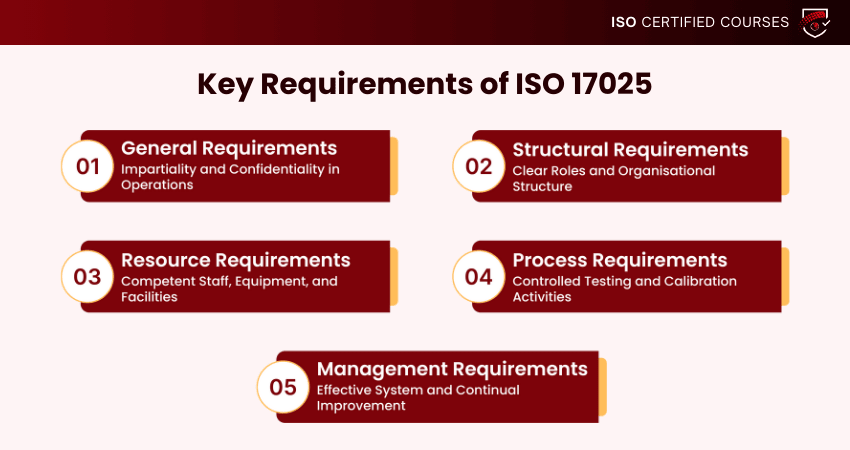
ISO 17025 is divided into five key requirement areas. Each requirement supports reliable testing and consistent laboratory performance. Now, let’s check those ISO 17025 Requirements:
1) General Requirements
General requirements focus on impartiality and confidentiality. Laboratories have to make sure their work is free from bias or pressure. It means your results should not be influenced by any financial interests, management pressure, or customer demands.
Confidentiality is also important. Labs are required to protect customer information, test data, and results. Clear rules should explain how information is stored, shared, and protected.
2) Structural Requirements
Structural requirements define how the laboratory is organised. The standard requires clear identification of legal status, management structure, roles, and responsibilities.
The important roles and authorities are defined and communicated so that employees can clearly understand their duties and reporting lines. This clarity helps ensure accountability and supports consistent decision-making across laboratory operations.
3) Resource Requirements
Resource requirements address the people, facilities, and equipment needed to carry out lab activities. Employees need to be competent based on education, training, experience, and skills. Labs are expected to document requirements, provide training where needed, and regularly review their performance.
Also, the lab facilities have to be suitable for testing or calibration activities. Environmental conditions such as temperature, humidity, lighting, and cleanliness should be controlled where they affect results. In the same way, equipment must be suitable, properly maintained, and regularly calibrated.
4) Process Requirements
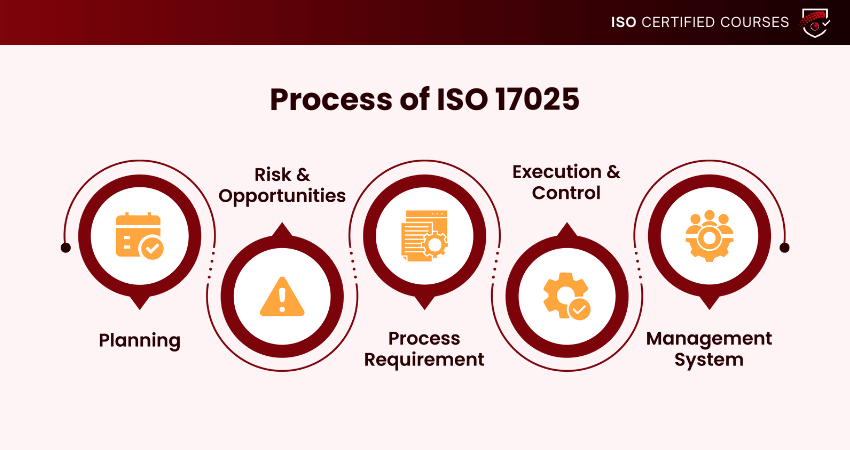
Process requirements cover how tests and calibrations are carried out from start to finish. Labs need to use suitable tests and calibration methods. These methods must be validated to show they are accurate and fit for use.
Sampling, handling of test items, and storage conditions are properly controlled to prevent contamination or damage. Also, uncertainty in the measurements must be understood and evaluated where required. As a final step, results must be reported clearly and accurately, with test reports or calibration certificates containing all information.
5) Management Requirements
Management requirements ensure that the laboratory’s management system supports consistent operation and improvement with accurate documentation. These include document control, record keeping, handling complaints, corrective actions, internal audits, and management reviews.
When there are any problems, labs need to find the root cause and take action to prevent them from happening again. Regular internal audits and management reviews help ensure the system remains effective and updated.
Learn the fundamentals of laboratory compliance with our ISO 17025 Foundation Training – Register today!
Benefits of ISO 17025 Accreditation
Achieving ISO 17025 accreditation offers many benefits beyond meeting regulatory and customer requirements. Here are the key benefits:
1) Global Recognition
1) Accepted by regulators and customers across multiple countries
2) Eliminates the need for repeated testing in different regions
3) Supports international trade and cross-border operations
4) Increases trust with global clients and partners
5) Enhances the laboratory’s international credibility
2) Consistent Data Standards
1) Ensures accurate and repeatable test results
2) Reduces errors through standardised methods
3) Improves traceability of measurements and data
4) Maintains consistency across different tests and technicians
5) Strengthens confidence in reported results
3) Tender Eligibility
1) Meets mandatory qualification criteria for many tenders
2) Expands access to government and private contracts
3) Improves chances of winning high-value projects
4) Demonstrates technical competence and regulatory alignment
50 Positions the laboratory as a qualified service provider
4) Preferred Partner Status
1) Builds long-term trust with customers and stakeholders
2) Increases customer confidence in test and calibration results
3) Encourages repeat business and long-term contracts
4) Strengthens professional reputation in the industry
5)Positions the lab as a reliable and credible partner
5) Competitive Advantage
1) Helps you stand out from non-accredited competitors
2) Shows a strong focus on quality and accurate results
3) Improves the laboratory’s reputation and brand image
4) Supports business growth and helps retain clients
5) Makes the laboratory a reliable industry standard
Perform successful testing and calibration in laboratories with our ISO 17025 Lead Auditor Training – Sign up soon!
The Main Changes in the Latest Version of ISO/IEC 17025
The latest version of ISO/IEC 17025 introduced important updates to make the standard more flexible, practical, and aligned with modern laboratory operations. Instead of focusing on rigid procedures, it emphasises results, effectiveness, and risk-based thinking.
1) Alignment with ISO 9001: Laboratories now integrate ISO 17025 with existing Quality Management Systems of ISO 9001.
2) IT and Digital Developments: Recognises the use of Laboratory Information Management Systems (LIMS), electronic records, automated testing, and digital data handling.
3) Senior Management Responsibilities: Senior management is now expected to take control of impartiality, resource allocation, and the overall effectiveness of the management system.
4) Modernised Terminology: The language has been updated to better reflect current laboratory practices, making the requirements clearer, more relevant, and easier to understand.
Overall, these changes give laboratories more freedom to design systems that suit their operations, while still ensuring reliable results, technical competence, and global acceptance.
Conclusion
ISO 17025 is a powerful benchmark for laboratories that want to demonstrate technical competence, build trust, and compete in demanding markets. By meeting ISO 17025 Requirements, labs can ensure accurate results, gain global recognition, and reduce errors to better market credibility and business growth. It provides a strong foundation for sustainable quality and trust in a competitive environment.
Elevate your laboratory’s technical competence with our ISO 17025 Training – Start your journey now!
Search Smarter
Quickly search through our blog content for what interests you
- Top ISO 9001 Internal Audit Questions and Answers in 2026
- ISO 27005 vs ISO 31000: How to Choose the Right Risk Framework
- Challenges of ISO 14001 and How to Overcome Them
- Top 14 Benefits of ISO 45001 Certification
- What are the ISO 27001 Requirements: A Complete 2026 Guide
- 12 Benefits of ISO 27001 Certification for Business
- ISO 27001 vs ISO 27002: Key Difference and Uses Cases
- ISO 17025 vs ISO 9001: Key Differences and Similarities
- ISO 45001 Requirements for Occupational Health & Safety
- ISO 9001, 14001, and 45001: Key Differences and Similarities
- ISO 27001 vs SOC 2: Understanding Key Differences
- What is ISO 27001 Gap Analysis? A Complete Overview
- ISO 17025: An Overview of Laboratory Accreditation
- What is ISO 27001: An Overview of the Information Security Standard
- ISO 27001 Controls from Annex A: What Changed in ISO 27001:2022?
- What is ISO 50001: Meaning, Requirements & Clauses Explained
- Top 10 Benefits of ISO 50001: A Detailed Explanation
- What is a Quality Management System (QMS): A Comprehensive Overview
- ISO 22000: Food Safety Management System Explained
- What is the Statement of Applicability (SoA) in ISO/IEC 27001?
- What is ISO 31000? The Risk Management Standard Explained
- What Is ISO 13485? Understanding Its 8 Key Sections
- ISO 56000: A Comprehensive Guide to Innovation Management
- What is ISO 14064? Components, Execution, and Benefits Explained
- Carbon Footprint: Definition, Types, and How to Calculate It
- ISO 22301: Requirements, Benefits and How to Implement It?
- ISO 9001 vs ISO 9002: Key Differences You Should Know
- Carbon Accounting: Meaning, Benefits, and Challenges
- Ecological Footprint: Meaning, Importance, and Purpose
- Compliance Management System: Components and How to Implement
- What is Competency Management? Benefits, Tips and Best Practices
- ISO 9001 and 27001: Quality Management vs Information Security Management
- ISO 27001 Annex A Controls: Everything You Need to Know
- ISO 27001 Audit: A Complete Guide to the Audit Process
- ISO 9001 vs ISO 14001: Key Differences and Similarities
No match found
Frequently Asked Questions
No FAQs available for this blog.