
























ISO 17025: An Overview of Laboratory Accreditation
ISO 17025 is an international standard that defines the competence requirements for testing and calibration laboratories, ensuring the accuracy of results. It focuses on both management practices and technical operations to ensure laboratories deliver accurate results, practice consistent processes, and use reliable methods.

Laboratories play an integral role in ensuring safety, quality, and accuracy across many industries. Their work requires consistent methods, demonstrated competence, and internationally accepted standards. To meet these expectations, understanding What is ISO 17025 becomes essential, as it helps laboratories deliver reliable testing and calibration results while demonstrating technical competence.
According to ILAC statistics, more than 114,600 laboratories were accredited by ILAC MRA signatories in 2024, demonstrating ISO 17025’s global adoption. Building on this, the blog explains what ISO 17025 is, its importance, and how it compares with ISO 9001, while highlighting its role in supporting consistency worldwide. Let’s get started!
What is ISO 17025?
ISO 17025 is an international standard that provides the requirements for the competence of testing and calibration laboratories. It offers a framework that laboratories follow to ensure their testing and calibration activities are consistent, reliable, and accurate. It covers staff competence, equipment calibration, testing methods, and Quality Management Systems.
The primary purpose of ISO 17025 is to build trust and confidence in the results provided by the laboratory. By following this standard, laboratories can demonstrate that their results are accurate, reliable and internationally recognised. This helps customers, regulators, and stakeholders rely on the accuracy of their data across industries.

Why is ISO 17025 Important?
ISO/IEC 17025 is important because it ensures that testing and calibration laboratories operate competently and produce reliable, technically valid results. It provides confidence that laboratory data is accurate, consistent, and traceable, which is critical for decision-making across industries.
By following ISO 17025, laboratories can demonstrate impartiality, technical competence, and consistency in their operations. This builds trust with customers, regulators, and accreditation bodies, supports international recognition of results, and helps laboratories meet regulatory, contractual, and industry expectations.
Requirements of ISO 17025 Accreditation
ISO/IEC 17025 is structured around five key requirement areas that together ensure competent testing, reliable results, and consistent laboratory operations. These key requirements are outlined below:
1) General Requirements
General requirements focus on impartiality and confidentiality. Laboratories must ensure their activities are free from bias, conflicts of interest, or undue pressure, while protecting customer information, test data, and results through clearly defined confidentiality controls.
2) Structural Requirements
Structural requirements define how the laboratory is organised and managed. They require clear identification of legal status, management structure, roles, responsibilities, and authorities to support accountability, effective communication, and consistent decision-making.
3) Resource Requirements
Resource requirements cover personnel, facilities, and equipment. Laboratories must ensure staff are competent, facilities are suitable, environmental conditions are controlled where necessary, and equipment is properly maintained, calibrated, and fit for intended testing or calibration activities.
4) Process Requirements
Process requirements address how testing and calibration activities are performed. Laboratories must use appropriate and validated methods, control sampling and handling of test items, evaluate measurement uncertainty where required, and report results clearly and accurately.
5) Management Requirements
Management requirements ensure the laboratory’s management system supports consistent operation and continual improvement. These include document and record control, handling nonconformities and complaints, corrective actions, internal audits and management reviews to maintain effectiveness and relevance.
Develop skills to plan, conduct, and report effective ISO 17025 internal audits with ISO 17025 Internal Auditor Training – Register today!
Benefits of ISO 17025 Accreditation
ISO 17025 provides various benefits for laboratories to improve their quality, reliability, and trust. Let’s look at some of the key benefits:
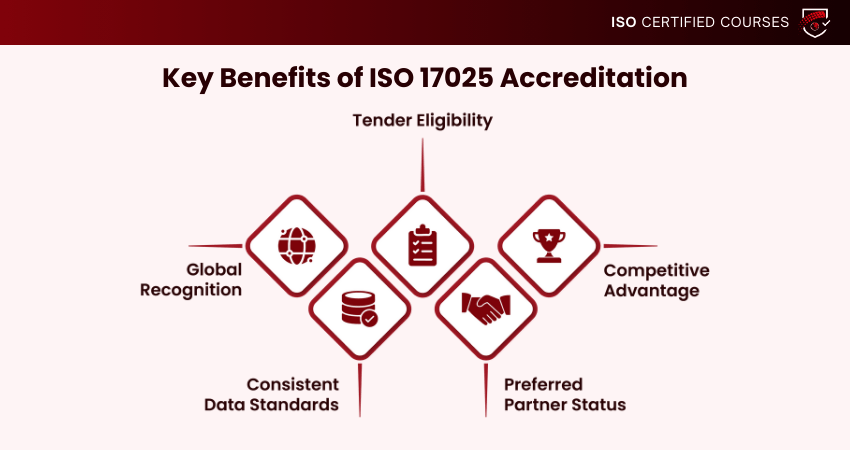
1) Global Recognition
1) ISO 17025 Accreditation confirms compliance with international testing and calibration standards.
2) It ensures accurate and reliable results for customers.
3) It strengthens the laboratory's credibility in global markets.
4) It enhances the laboratory's reputation as a trusted international service provider.
2) Consistent Data Standards
1) ISO 17025 ensures uniform testing and calibration processes across industries.
2) It delivers reliable and repeatable results that meet global standards.
3) It enables easy comparison of data from different laboratories.
4) It builds trust through consistent and high-quality reporting.
3) Tender Eligibility
1) Global recognition of ISO 17025 increases credibility during tender applications.
2) It supports eligibility for government and private-sector contracts.
3) It demonstrates commitment to quality, competence, and compliance.
4) It reduces the need for additional audits during tender assessments.
4) Preferred Partner Status
1) ISO 17025 Accreditation improves the laboratory’s reputation as a reliable partner.
2) It attracts clients who prefer working with accredited laboratories.
3) It gives stakeholders confidence that international standards are being followed.
4) It strengthens long-term client relationships through proven reliability.
5) Competitive Advantage
1) ISO 17025 helps laboratories stand out from non-accredited competitors.
2) It improves marketability by adhering to international standards.
3) It enhances efficiency and consistency for higher-quality outcomes.
4) It supports business growth by opening access to new markets and industries.
Learn how to implement and manage ISO 17025 systems with ISO 17025 Lead Implementer Training – Join today!
What is the Process for ISO 17025 Accreditation?
The ISO 17025 Accreditation process follows a structured approach to demonstrate its technical competence and readiness. Let’s look at them below:
Step 1: Understanding ISO 17025 Requirements
Laboratories must be familiar with the ISO 17025 standards and scope. This includes an understanding of both management and technical requirements and providing appropriate training to all personnel involved in testing and calibration activities.
Step 2: Document Laboratory Activities
Clear documentation is essential for ISO 17025 Accreditation. Laboratories must document key elements, such as quality policies, standard operating procedures, and detailed work instructions, to ensure processes are consistent and repeatable.
Step 3: Identify Gaps and Improve Processes
Once the documentation is finished, laboratories need to review existing practices to identify gaps for improvement. This step is crucial to ensure every process is working effectively and in alignment with ISO 17025 needs.
Step 4: Review Organisational Readiness
In the final step, before applying for accreditation, laboratories must confirm they meet all the requirements of the standard. This includes complete documentation, an active internal audit programme, and records of management reviews to demonstrate effective implementation and continual improvement.
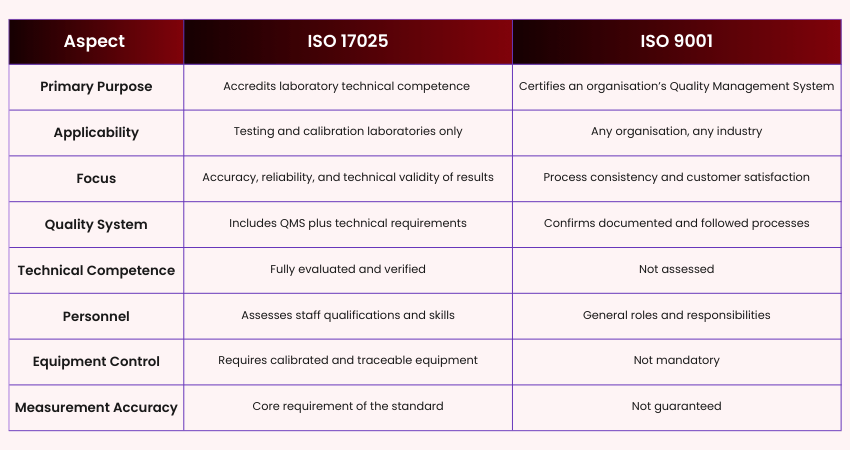
ISO 17025 vs ISO 9001: A Comparison for Laboratories
ISO 17025 and ISO 9001 are often confused, but they serve different purposes. Let’s look at their key differences in the table below.
Conclusion
Understanding What is ISO 17025 becomes integral for laboratories to deliver accurate, reliable, and credible testing and calibration results. Focusing on technical competence, impartiality, and consistent processes helps laboratories to build trust amongst customers, regulators, and stakeholders. Achieving ISO 17025 demonstrates a strong commitment to quality, precision and continual improvement in every operational aspect.
Build a strong understanding of ISO 17025 principles and laboratory competency basics with ISO 17025 Training now!
Search Smarter
Quickly search through our blog content for what interests you
- Top ISO 9001 Internal Audit Questions and Answers in 2026
- ISO 27005 vs ISO 31000: How to Choose the Right Risk Framework
- Challenges of ISO 14001 and How to Overcome Them
- Top 14 Benefits of ISO 45001 Certification
- What are the ISO 27001 Requirements: A Complete 2026 Guide
- 12 Benefits of ISO 27001 Certification for Business
- ISO 27001 vs ISO 27002: Key Difference and Uses Cases
- ISO 17025 vs ISO 9001: Key Differences and Similarities
- ISO 45001 Requirements for Occupational Health & Safety
- ISO 9001, 14001, and 45001: Key Differences and Similarities
- ISO 27001 vs SOC 2: Understanding Key Differences
- ISO 17025 Requirements: Explained in Detail
- What is ISO 27001 Gap Analysis? A Complete Overview
- What is ISO 27001: An Overview of the Information Security Standard
- ISO 27001 Controls from Annex A: What Changed in ISO 27001:2022?
- What is ISO 50001: Meaning, Requirements & Clauses Explained
- Top 10 Benefits of ISO 50001: A Detailed Explanation
- What is a Quality Management System (QMS): A Comprehensive Overview
- ISO 22000: Food Safety Management System Explained
- What is the Statement of Applicability (SoA) in ISO/IEC 27001?
- What is ISO 31000? The Risk Management Standard Explained
- What Is ISO 13485? Understanding Its 8 Key Sections
- ISO 56000: A Comprehensive Guide to Innovation Management
- What is ISO 14064? Components, Execution, and Benefits Explained
- Carbon Footprint: Definition, Types, and How to Calculate It
- ISO 22301: Requirements, Benefits and How to Implement It?
- ISO 9001 vs ISO 9002: Key Differences You Should Know
- Carbon Accounting: Meaning, Benefits, and Challenges
- Ecological Footprint: Meaning, Importance, and Purpose
- Compliance Management System: Components and How to Implement
- What is Competency Management? Benefits, Tips and Best Practices
- ISO 9001 and 27001: Quality Management vs Information Security Management
- ISO 27001 Annex A Controls: Everything You Need to Know
- ISO 27001 Audit: A Complete Guide to the Audit Process
- ISO 9001 vs ISO 14001: Key Differences and Similarities
No match found
Frequently Asked Questions
No FAQs available for this blog.