
























What is ISO 14064? Components, Execution, and Benefits Explained
ISO 14064 is a standard for quantifying, reporting, and verifying greenhouse gas emissions and removals to support transparency and climate action. It enables organisations to improve sustainability practices, build stakeholder trust, ensure regulatory compliance, and contribute to effective climate change mitigation efforts.

Have you ever wondered how organisations measure and manage their impact on the environment? As the pressure to reduce carbon emissions grows, businesses need clear and reliable ways to monitor and communicate their efforts. This is where understanding What is ISO 14064 is becomes important, as it provides a framework for managing Greenhouse Gas (GHG) Emissions effectively.
With stricter regulations and rising expectations around carbon reporting, ISO 14064 helps organisations bring structure, accuracy, and credibility to how emissions are measured and reported. In this blog, you will learn about What is ISO 14064, its key components, the benefits of its implementation, and more. Let’s begin!
Table of Contents
1) What is ISO 14064?
2) What are the Components of ISO 14064?
3) How to Verify Under ISO 14064?
4) Benefits of Implementing ISO 14064
5) ISO 14064-1 vs GHG Protocol
6) Conclusion
What is ISO 14064?
ISO 14064 is an international standard from the ISO 14000 family that helps organisations measure, monitor, report, and verify Greenhouse Gas (GHG) emissions. It provides a clear and structured approach to managing Carbon Footprints, ensuring accuracy, transparency and consistency in emissions reporting.
The standard is divided into three key parts. ISO 14064-1 focuses on organisational GHG emissions and reporting. ISO 14064-2 covers project-level emissions and reductions, and ISO 14064-3 provides guidance on the validation and verification of GHG data to ensure credibility. This is important because the global Carbon Footprint Management market size is projected to reach £15.3 billion by 2030 .

What are the Components of ISO 14064?
The components of ISO 14064 focus on managing Greenhouse Gas (GHG) emissions at different levels, ensuring accurate measurement, reporting, and verification. Let’s look at its components below:
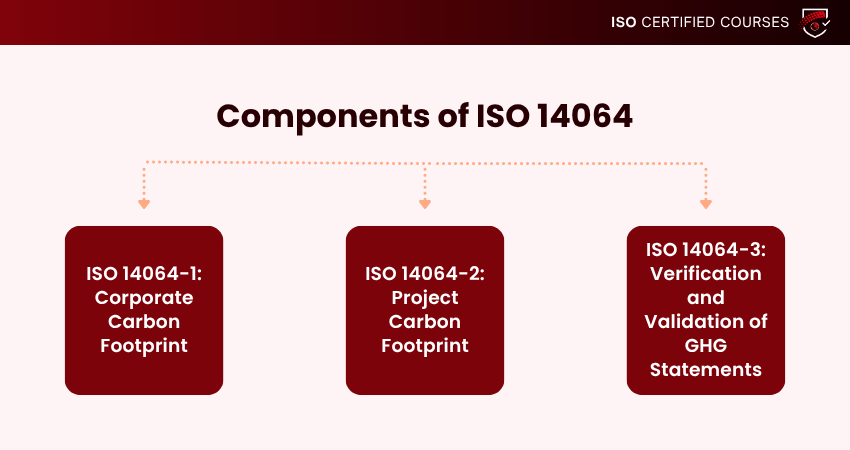
1) ISO 14064-1: Corporate Carbon Footprint
This component focuses on measuring and reporting an organisation’s Carbon Footprint. It includes direct emissions (Scope 1), indirect emissions from energy use (Scope 2), and other indirect emissions (Scope 3). It helps organisations create GHG inventories, track performance, and set reduction targets.
2) ISO 14064-2: Project Carbon Footprint
This component applies to specific projects designed to reduce emissions or increase carbon removal, such as renewable energy or reforestation initiatives. It provides guidance on defining baselines, monitoring changes and quantifying the impact of these projects in a consistent and transparent way.
ISO 14067: Product Carbon Footprint
Although separate from ISO 14064, this related standard focuses on assessing emissions at the product level. It helps organisations evaluate the environmental impact of products across their lifecycle, supporting better sustainability decisions.
3) ISO 14064-3: Verification and Validation of GHG Statements
This component ensures that reported GHG data is accurate and reliable. It outlines requirements for independent verification and validation. This helps organisations build trust with stakeholders and meet regulatory or reporting requirements.
How to Verify Under ISO 14064?
Verifying GHG emissions under ISO 14064 ensures data is accurate, transparent, and reliable. It involves preparing a structured emissions inventory and conducting independent verification to confirm its credibility and meet stakeholder expectations. Let's look at it below:
Step 1: Prepare Your Emissions Inventory in Accordance With ISO 14064-1
Begin by defining clear organisational and operational boundaries, including the entities, sites, and reporting period. It is important to distinguish between direct and indirect emissions to ensure proper classification. Then, organisations should collect data across Scope 1, 2, and 3 using recognised methods such as the GHG Protocol, ensuring alignment with ISO 14064 requirements.
To improve accuracy, activity-based data such as energy use, fuel consumption, and travel distance should be prioritised. Organisations must document emission factors, assumptions, and data sources, maintain clear records, and note any estimates. If external support is used, it should not be involved in verification to ensure independence.
Step 2: Obtain Verification Following ISO 14064-3
After the inventory is prepared, organisations must engage an independent, accredited verification body. They need to decide on an assurance level, either limited (basic review) or reasonable (detailed assessment). Generally, the verification process includes:
1) Scoping: It involves agreeing on boundaries, timeline and assurance level
2) Document Review: It involves assessing methods, data sources, and controls
3) Sampling and Testing: It involves Checking selected data against evidence
4) Checks: It involves Conducting remote or on-site validation
5) Corrections: It involves addressing gaps and improving data accuracy
Lastly, a verification statement is issued, confirming the scope, standards used, and assurance level. This statement serves as formal proof that the emissions data have been independently assessed. This is useful for enhancing transparency, strengthening stakeholder confidence, and supporting compliance with reporting requirements.
Strengthen your Carbon Auditing skills now with ISO 14065 Training – Register now!
Benefits of Implementing ISO 14064
Implementing ISO 14064 provides several benefits that help organisations strengthen their environmental performance and credibility. Let’s look at the key benefits below:
1) Improves Credibility: Third-party verification of GHG data enhances transparency and builds trust among stakeholders, customers, and investors. Also, it strengthens the organisation’s brand reputation by demonstrating a commitment to sustainability.
2) Strengthens Operational Efficiency: Identifying key emission sources enables organisations to optimise resource use, reduce waste, and improve energy efficiency. This can lead to cost savings and more streamlined operations over time.
3) Better Market Opportunities: ISO 14064 makes it easier for organisations to participate in carbon markets and attract environmentally conscious investors. Also, it helps businesses to align with sustainability expectations, opening new growth and partnership opportunities.
ISO 14064-1 vs GHG Protocol
Understanding the difference between ISO 14064-1 and the GHG Protocol is important for organisations aiming to measure and report GHG emissions. While both frameworks support carbon accounting, they serve different roles in practice. Let’s look at the differences table below:
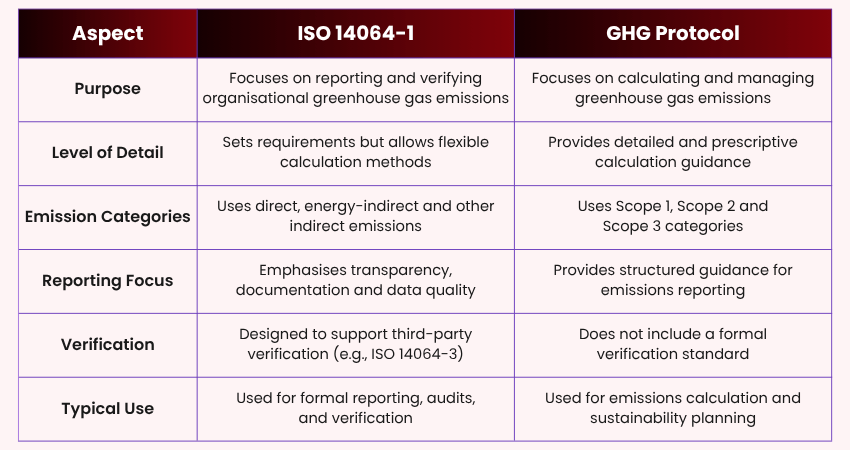
The key difference between ISO 14064-1 and the GHG Protocol lies in how they guide organisations. The GHG Protocol is more detailed and prescriptive, offering clear rules for categorising and calculating emissions, especially for Scope 3. This makes it easier for organisations to follow a standardised approach.
In contrast, ISO 14064-1 is more flexible and focuses on ensuring transparency, consistency, and verification. It allows organisations to define their methods but requires proper documentation and justification. In practice, many organisations use the GHG Protocol for calculations and ISO 14064-1 for reporting and verification to achieve a balanced approach.
Conclusion
Understanding What is ISO 14064 is crucial for organisations that are aiming to measure and manage their environmental impact. Providing a clear framework for tracking, reporting, and verifying emissions helps to support transparency, improve efficiency and build stakeholder trust. Also, adopting ISO 14064 positions organisations to respond effectively to growing environmental expectations.
Develop global standards and build compliance skills that matter with ISO Training – Join now!
Search Smarter
Quickly search through our blog content for what interests you
- Top ISO 9001 Internal Audit Questions and Answers in 2026
- ISO 27005 vs ISO 31000: How to Choose the Right Risk Framework
- Challenges of ISO 14001 and How to Overcome Them
- Top 14 Benefits of ISO 45001 Certification
- What are the ISO 27001 Requirements: A Complete 2026 Guide
- 12 Benefits of ISO 27001 Certification for Business
- ISO 27001 vs ISO 27002: Key Difference and Uses Cases
- ISO 17025 vs ISO 9001: Key Differences and Similarities
- ISO 45001 Requirements for Occupational Health & Safety
- ISO 9001, 14001, and 45001: Key Differences and Similarities
- ISO 27001 vs SOC 2: Understanding Key Differences
- ISO 17025 Requirements: Explained in Detail
- What is ISO 27001 Gap Analysis? A Complete Overview
- ISO 17025: An Overview of Laboratory Accreditation
- What is ISO 27001: An Overview of the Information Security Standard
- ISO 27001 Controls from Annex A: What Changed in ISO 27001:2022?
- What is ISO 50001: Meaning, Requirements & Clauses Explained
- Top 10 Benefits of ISO 50001: A Detailed Explanation
- What is a Quality Management System (QMS): A Comprehensive Overview
- ISO 22000: Food Safety Management System Explained
- What is the Statement of Applicability (SoA) in ISO/IEC 27001?
- What is ISO 31000? The Risk Management Standard Explained
- What Is ISO 13485? Understanding Its 8 Key Sections
- ISO 56000: A Comprehensive Guide to Innovation Management
- Carbon Footprint: Definition, Types, and How to Calculate It
- ISO 22301: Requirements, Benefits and How to Implement It?
- ISO 9001 vs ISO 9002: Key Differences You Should Know
- Carbon Accounting: Meaning, Benefits, and Challenges
- Ecological Footprint: Meaning, Importance, and Purpose
- Compliance Management System: Components and How to Implement
- What is Competency Management? Benefits, Tips and Best Practices
- ISO 9001 and 27001: Quality Management vs Information Security Management
- ISO 27001 Annex A Controls: Everything You Need to Know
- ISO 27001 Audit: A Complete Guide to the Audit Process
- ISO 9001 vs ISO 14001: Key Differences and Similarities
No match found
Frequently Asked Questions
What is the Difference Between ISO 14064 and ISO 14067?
ISO 14064 focuses on measuring and reporting GHG emissions at the organisational or project level, known as the Corporate Carbon Footprint (CCF). In contrast, ISO 14067 measures the Product Carbon Footprint (PCF) which covers the emissions across a product or service’s entire lifecycle.
Is Carbon Reporting Mandatory in the UK?
Yes, carbon reporting is mandatory in the UK for many organisations under the Streamlined Energy and Carbon Reporting (SECR) framework. It requires eligible companies to report their energy use and GHG emissions.
Which Country is Carbon Free in the World?
As emissions are produced through transport, industry, and everyday activities, no place is completely carbon-free. However, Bhutan is widely recognised as the only carbon-negative country, as it absorbs more carbon dioxide than it produces.