














ISO 27005 vs ISO 31000: How to Choose the Right Risk Framework
ISO 27005 focuses on managing information security risks, while ISO 31000 provides a broad and flexible framework for enterprise-wide Risk Management. ISO 27005 suits IT and cyber security needs, whereas ISO 31000 supports organisational risk strategy. Together, they offer comprehensive Risk Management across all business areas.

When compliance, security, and governance are on the line, your choice of framework matters. In today's digital and business environments, risks are more complex and costly than ever before. Whether it is a cyberattack, data breach, or financial loss, organisations need structured approaches to identify, assess, and respond to threats.
That’s where ISO 27005 and ISO 31000 come into play. ISO 27005 helps you handle IT risks, while ISO 31000 helps you manage all types of risk across your organisation. So how do you know which one is right for you or if you should use both? In this blog, we’ll simplify ISO 27005 vs ISO 31000 and highlight the benefits of each to make smarter, risk-informed decisions. Let's dive in!
Table of Contents
1) ISO 27005: Risk Management in Information Security
2) ISO 31000: Risk Management Framework
3) ISO 27005 vs ISO 31000: Comparative Overview
4) ISO 27005 Audit Checklist
5) ISO 31000 Audit Checklist
6) Benefits of ISO 27005
7) Benefits of ISO 31000
8) Choosing Between ISO 27005 and ISO 31000
9) Conclusion
ISO 27005: Risk Management in Information Security
ISO 27005 is a specialised Risk Management standard that supports an Information Security Management System (ISMS). It helps create a structured process for managing risks that are related to information security. It provides detailed guidance on identifying, assessing, and treating risks that could compromise sensitive data and IT systems.
This helps you understand threats, know their impact, and apply necessary controls. It is best for businesses aiming to strengthen their cyber security and ensure continuous protection against evolving digital risks.
Key Concepts and Process
ISO 27005 outlines a Risk Management process tailored for IT security. The main steps are:
1) Context Establishment: Understand the organisation’s internal and external environment, like its goals, legal requirements, stakeholders, and risks.
2) Risk Identification: Identify threats, vulnerabilities, and events that could impact information assets.
3) Risk Analysis: Assess the likelihood and impact to know the seriousness of each risk.
4) Risk Evaluation: Compare risks to decide which risks are more important and which can be addressed later.
5) Risk Treatment: Choose and apply required measures to reduce or manage risks.
6) Communication and Consultation: Keep stakeholders informed to ensure clarity and alignment.
7) Monitoring and Review:
Track your risks, evaluate treatment effectiveness, and update the approach as needed.
ISO 31000: Risk Management Framework
ISO 31000 is a broader and a global standard that applies to all types of organisations and risks. It offers a structured framework to manage financial, operational, strategic, cyber security, and other types of risks effectively.
ISO 31000 helps build a culture where everyone understands and manages risks. It connects Risk Management with the company’s overall goals and supports resilience, performance, and long-term success. This makes it easier to work together in handling risks effectively.
Key Concepts and Process
ISO 31000 follows a repeatable process that can be applied to all types of risks. The process includes:
1) Risk Integration: Risk Management should be part of all business activities, from planning to operations and decision-making.
2) Customised Approach: The process should be adapted to the organisation’s goals, size, structure, and external environment.
3) Stakeholder Engagement: Regular communication and consultation with internal and external stakeholders help maintain transparency and shared understanding.
4) Structured Risk Process: It includes context establishment, risk identification, analysis, evaluation, treatment, monitoring, and keeping the involved parties informed.
5) Continuous Improvement:
The process is ongoing, allowing organisations to adapt to new challenges and improve Risk Management over time.
ISO 27005 vs ISO 31000: Comparative Overview
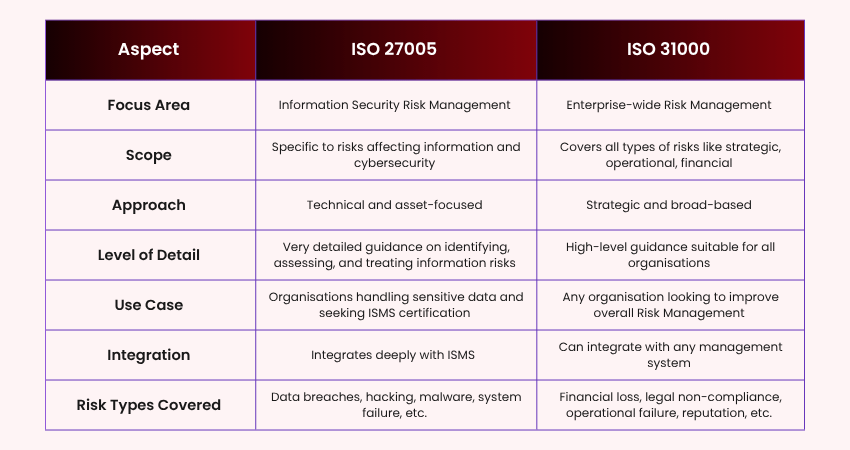
ISO 27005 and ISO 31000 are both internationally recognised standards for managing risk, but they are different in their scope, purpose, and industry relevance. Here's how they differ:
ISO 27005
1) Scope: ISO 27005 is focused specifically on Information Security Risk Management, addressing threats that affect your information assets.
2) Purpose: Built to manage risks affecting information systems, data, and digital assets.
3) Terminology: Uses information security-specific language and concepts, making it ideal for cyber security professionals and IT teams.
4) Integration: Supports risk assessment, treatment, and continuous improvement within an ISMS.
5) Risk Types Addressed: Focuses mainly on technical, operational, and digital risks such as malware attacks, insider threats, data breaches, and infrastructure failures.
6) Industry Relevance: Best for IT companies, financial institutions, e-commerce businesses, and any organisation handling sensitive or regulated data.
7) Ongoing Use:
Designed to keep track of risks and adjust as needed in fast-changing IT environments where new threats appear often.
ISO 31000
1) Scope: ISO 31000 is a universal Risk Management framework that applies to all risk types like strategic, financial, operational, legal, and more.
2) Purpose: Offers a unified framework for managing all types of risks.
3) Industry Relevance: Suitable for all sectors, from corporate and government to manufacturing, education, and public services.
4) Integration: Easily integrates into any management system or business model, supporting strategic planning, performance, and governance.
5) Flexibility: Customisable to the organisation’s size, structure, risk appetite, and industry.
6) Risk Types Addressed: Covers a wide range, including financial, reputational, legal, strategic, safety, environmental, and operational risks.
7) Strategic Alignment: Encourages linking Risk Management to business goals, performance metrics, and stakeholder expectations.
Include analysing the risks in your daily business decisions with our
ISO 31000 Foundation Training
– Register now!
ISO 27005 Audit Checklist
The ISO 27005 Audit Checklist helps organisations assess their Information Security Risk Management practices. It covers five key areas:
1) A documented framework with assigned roles and resources
2) A structured approach to identifying threats, vulnerabilities, and assets
3) Consistent risk analysis using defined criteria for impact and likelihood
4) Selection and implementation of risk treatments
5) Continuous monitoring, internal audits, and management reviews
The checklist ensures risks are documented, communicated, and updated regularly. It also promotes stakeholder involvement and continuous improvement based on audit findings. Regular use of this checklist improves ISMS alignment, decision-making, and resilience against evolving information security threats.
ISO 31000 Audit Checklist
The ISO 31000 Audit Checklist helps organisations evaluate the effectiveness of their Risk Management framework. It covers key areas such as:
1) Having a formal policy
2) Defined roles and responsibilities
3) Integration into all business processes
4) Clear communication and reporting of risks
5) Systematic identification and documentation of risks
The checklist ensures proper resource allocation, systematic risk identification, consistent analysis, and prioritisation. By following it, organisations can strengthen governance, align risk with strategic goals, and build a proactive risk culture that supports informed decision-making and long-term success.
Benefits of ISO 27005
Implementing ISO 27005 gives organisations a clear, flexible, and practical way to manage information security risks. Key benefits include:
1) Clear Risk Understanding: Helps you identify, assess, and deal with key information security risks, so you can make good and right decisions.
2) Flexible Approach: Can be adjusted to fit your business, whether you want to focus on specific assets or events.
3) Repeatable and Consistent Process: Encourages using the same method each time, reducing mistakes and making results easier to check and trust.
4) Balanced Effort: Helps you manage time well between finding risks and putting controls in place.
5) ISO 27001 Alignment:
Supports ISO 27001 compliance by ensuring all ISMS controls are risk-based, aiming for audit readiness.
Benefits of ISO 31000
ISO 31000 does more than just meet compliance needs. It helps make risk awareness an important part of everyday decisions. Here are its benefits:
1) Proactive Risk Management: Helps you find and deal with risks before they become big problems. It also reduces the disruptions.
2) Informed Decision-making: Needs thinking about risks in both daily choices and long-term plans, helping you stay on track with business goals.
3) More Flexibility and Stability: Builds a culture where teams can adapt quickly and keep things running smoothly, even when things change.
4) Stronger Stakeholder Confidence: Shows investors, customers, and regulators that you take Risk Management seriously.
5) Follows Global Standards: Matches international best practices for risks, boosting your reputation and opening new business opportunities.
Improve your risk practices with our
ISO 27005 Lead Auditor Training
– Join soon!
Choosing Between ISO 27005 and ISO 31000
Selecting the right Risk Management standard is significant to building an effective risk strategy. While ISO 27005 and ISO 31000 are internationally recognised, they serve different purposes. So, here’s a brief look into making a choice between them:
Apply ISO 27005 for Information Security Risks
ISO 27005 offers a practical way to manage information security risks. It addresses risks to confidentiality, integrity, and availability of data and IT systems.
Choose ISO 27005 if :
1) You are implementing or maintaining an ISMS of ISO 27001.
2) You handle risks related to cyber security, data privacy, or meeting legal requirements.
3) You need clear steps to find and deal with threats to your important information and systems.
4) Your risk team includes IT, security, or compliance professionals.
ISO 27005 works for threat modelling, asset classification, control selection, and risk treatment. You can also defend against cyber threats such as malware, insider attacks, data leaks, and technical failures.
Apply ISO 31000 for Enterprise-wide Risk Management
ISO 31000 is ideal for involving risk thinking into decision-making, governance, and corporate culture.
Choose ISO 31000 if :
1) You are building or improving an Enterprise Risk Management (ERM) programme.
2) Your business needs to handle many risks in different teams or departments.
3) You want to include risk thinking in your planning and leadership activities.
4) You're focusing on governance, performance, and risk-informed decision-making.
ISO 31000 supports senior leadership, Risk Managers, and boards in aligning Risk Management with the organisation’s mission, values, and goals. It makes sure risk isn’t handled separately but becomes a natural part of daily decisions and actions.
Combine Both for a Holistic Risk Management Approach
In reality, cyber risks can disrupt operations, reputations, and strategy. That is why many organisations benefit from using ISO 31000 and ISO 27005 together.
Use Both if :
1) You want to align your information security risk practices with the overall risk governance structure.
2) You are dealing with different types of risks and need to focus more on IT and cyber threats.
3) You are trying to build a workplace where leaders and technical teams understand and manage risks together.
4) You want to use clear, consistent risk terms across the entire organisation.
Together, they offer a unified and robust Risk Management System. This enhances decision-making, improves resilience, and supports regulatory compliance.
Conclusion
Choosing the right Risk Management standard of ISO 27005 vs ISO 31000 is not just a compliance exercise. It is a strategic decision that impacts your organisation’s performance and long-term success. While each standard serves a unique purpose, they’re not mutually exclusive. In fact, combining both can create a layered approach to Risk Management in today’s uncertain world.
Identify and manage information security risks with our ISO 27005 Foundation Training – Sign up today!
Search Smarter
Quickly search through our blog content for what interests you
- Top ISO 9001 Internal Audit Questions and Answers in 2026
- Challenges of ISO 14001 and How to Overcome Them
- Top 14 Benefits of ISO 45001 Certification
- What are the ISO 27001 Requirements: A Complete 2026 Guide
- 12 Benefits of ISO 27001 Certification for Business
- ISO 27001 vs ISO 27002: Key Difference and Uses Cases
- ISO 17025 vs ISO 9001: Key Differences and Similarities
- ISO 45001 Requirements for Occupational Health & Safety
- ISO 9001, 14001, and 45001: Key Differences and Similarities
- ISO 27001 vs SOC 2: Understanding Key Differences
- ISO 17025 Requirements: Explained in Detail
- What is ISO 27001 Gap Analysis? A Complete Overview
- ISO 17025: An Overview of Laboratory Accreditation
- What is ISO 27001: An Overview of the Information Security Standard
- ISO 27001 Controls from Annex A: What Changed in ISO 27001:2022?
- What is ISO 50001: Meaning, Requirements & Clauses Explained
- Top 10 Benefits of ISO 50001: A Detailed Explanation
- What is a Quality Management System (QMS): A Comprehensive Overview
- ISO 22000: Food Safety Management System Explained
- What is the Statement of Applicability (SoA) in ISO/IEC 27001?
- What is ISO 31000? The Risk Management Standard Explained
- What Is ISO 13485? Understanding Its 8 Key Sections
- ISO 56000: A Comprehensive Guide to Innovation Management
- What is ISO 14064? Components, Execution, and Benefits Explained
- Carbon Footprint: Definition, Types, and How to Calculate It
- ISO 22301: Requirements, Benefits and How to Implement It?
- ISO 9001 vs ISO 9002: Key Differences You Should Know
- Carbon Accounting: Meaning, Benefits, and Challenges
- Ecological Footprint: Meaning, Importance, and Purpose
- Compliance Management System: Components and How to Implement
- What is Competency Management? Benefits, Tips and Best Practices
- ISO 9001 and 27001: Quality Management vs Information Security Management
- ISO 27001 Annex A Controls: Everything You Need to Know
No match found
Frequently Asked Questions
What is the ISO 27005 Risk Treatment Plan?
An ISO 27005 risk treatment plan refers to the actions needed to handle information security risks. It includes the chosen risk treatment strategy (avoid, reduce, share, accept the risk), implementation timelines, assigned responsibilities, and resources required.
What is the Current Version of ISO 27005?
The current version of ISO 27005 is ISO/IEC 27005:2022. It includes improved alignment with ISO 27001 and ISO 31000 and updates on emerging risk types in cyber security.
What is the Last Version of ISO 31000?
The latest version of ISO 31000 is ISO 31000:2018. It offers principles and a framework for enterprise-wide Risk Management. It helps organisations identify, assess, and treat risks effectively across all sectors.