








What are the ISO 27001 Requirements: A Complete 2026 Guide
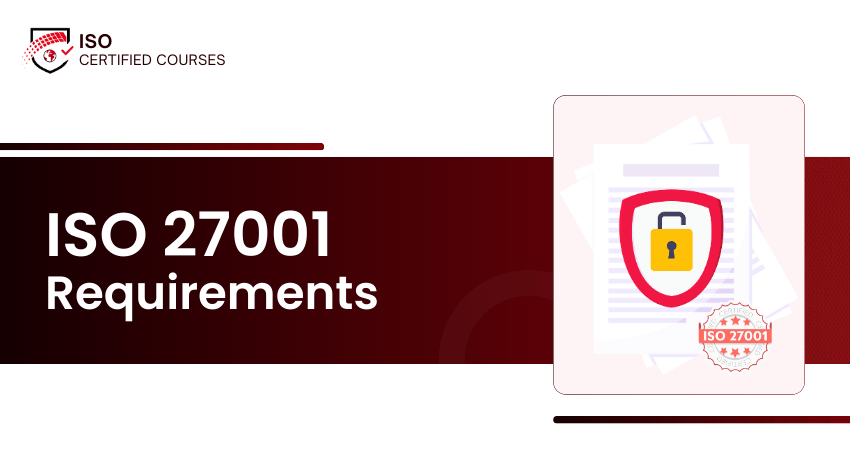
ISO 27001 Requirements define how organisations establish, operate, and continually improve an Information Security Management System. They focus on Risk Management, leadership, controls, monitoring, and continual improvement to maintain strong security practices. This helps support compliance with legal and regulatory requirements.

How confident are you that your organisation could survive a serious data breach tomorrow? With cyber threats increasing every day, information security can no longer be ignored. One incident can lead to lost data, disrupted work, and serious damage. This is why organisations need a clear and reliable way to protect their information.
Relying on basic or informal security measures is no longer enough. That's your perfect time to switch to ISO 27001. Its requirements offer a simple and structured approach to managing information security. In this blog, we’ll explore the ISO 27001 Requirements to understand risks and protect sensitive data from cyber breaches. Let's begin!
What are ISO 27001 Requirements?
ISO 27001 Requirements are the rules and expectations that organisations need to meet to implement an effective Information Security Management System (ISMS). These requirements help you manage risks and focus on Confidentiality, Integrity and Availability (CIA).
ISO 27001 Requirements are applicable to people, processes, and technology. They include leadership involvement, written policies, risk assessments, employee training, incident handling, and continuous improvement. When done correctly, ISO 27001 can become a part of everyday work rather than being a compliance task.
Why ISO 27001 Requirements are Important for Organisations?
The main idea behind ISO 27001 is risk-based thinking. Instead of forcing every organisation to use the same security tools, it asks you to identify your own risks and choose controls that make sense for your business. This makes ISO 27001 flexible and suitable for both small companies and large enterprises.
Even more, ISO 27001 helps organisations manage risks in a structured and organised way. Instead of reacting to problems after they happen, businesses learn to identify weaknesses early and put controls in place to reduce risk. This proactive approach makes organisations more secure and more resilient.
ISO 27001 Clauses Explained (Clause 0 to Clause 10)
There are 10 clauses in ISO 27001. From that, the first three clauses explain the background, purpose, and key definitions of the ISO 27001 standard. The core ISO 27001 Requirements start from clause 4 to clause 10. These explain what organisations should do to design, operate, and improve their ISMS.
Now, let’s check those ten clauses in detail:
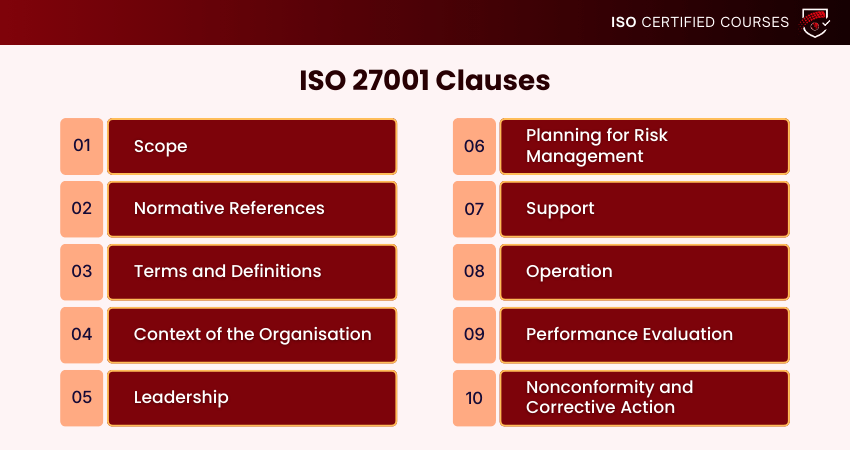
ISO 27001 Clause 1: Scope
The first clause defines the scope of the ISO 27001 standard rather than the scope of your ISMS. It explains that ISO 27001 has set some requirements for establishing, implementing, maintaining, and continually improving an ISMS.
1) Explains the purpose of ISO 27001
2) Focuses on ISMS
3) Supports ongoing improvement
4) No action or documents required
5) Applies to all types of organisations
ISO 27001 Clause 2: Normative References
This clause lists the supporting standards that are essential for applying ISO 27001 correctly. It mainly refers to ISO/IEC 27000, which provides common terms and concepts related to Information Security Management. Some of the references other than ISO 27000 are:
1) ISO/IEC 27002:
Best-practice guidance for selecting and implementing security controls
2) ISO/IEC 27005:
Information security risk assessment and risk treatment planning
3) ISO/IEC 27006:
Requirements for certification bodies and ISO 27001 audits
4) ISO/IEC 27007:
Guidance on planning and conducting ISMS audits
5) ISO/IEC 27008:
Evaluating and improving ISMS control effectiveness
ISO 27001 Clause 3: Terms and Definitions
The third clause explains important terms used throughout the ISO 27001 standard. These definitions ensure that everyone involved in the ISMS understands information security concepts in the same way.
1) Defines key information security terms
2) Ensures common understanding across teams
3) Supports accurate risk assessments
4) Reduces misunderstandings during audits
5) No mandatory documentation required
Gain a strong understanding of information security basics through
ISO 27001 Foundation Training
– Register today!
ISO 27001 Clause 4: Context of the Organisation
This clause asks organisations to understand themselves and their environment. It includes looking at internal factors such as structure and processes, and external factors such as laws and market conditions. It also involves people who care about information security, such as customers, regulators, suppliers, and employees.
1) Consider laws and regulations that affect data security
2) Check how information is used across the business
3) Identify internal weaknesses that could cause security issues
4) Be aware of external risks and industry changes
5) Make sure security plans fit real business activities
ISO 27001 Clause 5: Leadership
The fifth clause explains that information security needs strong leadership to achieve ISO 27001 compliance. Senior management, such as a Chief Information Security Officer or business leaders, are required to establish an information security policy that aligns with business objectives.
1) Assign clear roles to maintain and manage information security
2) Approve a business-appropriate security policy
3) Align security goals with daily operations
4) Promote information security awareness
5) Provide resources to support the ISMS
ISO 27001 Clause 6: Planning for Risk Management
This section focuses on how organisations identify and manage risks that can happen with information security. It requires a structured risk assessment process and the setting of measurable information security objectives.
1) Identify, analyse and evaluate risks
2) Define risk assessment criteria
3) Plan risk treatment actions
4) Set measurable security objectives
5) Maintain records of your risk assessment
ISO 27001 Clause 7: Support
This clause in ISO 27001 Requirements ensures that the ISMS is properly supported with people, skills, awareness, communication, and documentation. It focuses on making sure employees understand their security responsibilities.
1) Train employees on security
2) Ensure staff understand responsibilities
3) Maintain awareness programmes
4) Control documents and records
5) Communicate security information
Discover the steps to implement an effective ISMS with
ISO 27001 Lead Implementer Training
– Sign up soon!
ISO 27001 Clause 8: Operation
Here, you have to implement your plans into action. As organisations, you can implement risk treatment measures, manage changes, and ensure security controls operate effectively in daily activities.
1) Follow risk treatment plans
2) Apply selected security controls
3) Manage operational changes
4) Control outsourced processes
5) Keep evidence of operations
ISO 27001 Clause 9: Performance Evaluation
This clause requires organisations to monitor and evaluate the effectiveness of the ISMS. This includes internal audits and management reviews to ensure security controls remain effective. These audits also help identify weaknesses and ensure requirements are met.
1) Monitor your security performance
2) Measure security effectiveness
3) Conduct internal audits
4) Conduct management reviews
5) Identify improvement opportunities
ISO 27001 Clause 10: Nonconformity and Corrective Action
Clause 10 focuses on continual improvement of the ISMS. When nonconformities occur, organisations must take corrective action, address root causes, and improve processes to prevent recurrence.
1) Identify security issues and process failures
2) Take timely corrective actions to fix problems
3) Investigate root causes of nonconformities
4) Apply controls to prevent repeat issues
5) Use lessons learned to drive continual improvement
Conclusion
ISO 27001 Requirements provide a clear approach to managing information security risks in an increasingly complex digital environment. With this, businesses can move beyond basic security measures and build a structured, reliable ITSM. It encourages a culture where information security becomes part of everyday decision-making rather than a one-time project. As cyber threats continue to grow, adopting these requirements is a smart step towards stronger security.
Start managing information security effectively with ISO 27001 Training – Explore now!
Search Smarter
Quickly search through our blog content for what interests you
- Top ISO 9001 Internal Audit Questions and Answers in 2026
- ISO 27005 vs ISO 31000: How to Choose the Right Risk Framework
- Challenges of ISO 14001 and How to Overcome Them
- Top 14 Benefits of ISO 45001 Certification
- 12 Benefits of ISO 27001 Certification for Business
- ISO 27001 vs ISO 27002: Key Difference and Uses Cases
- ISO 17025 vs ISO 9001: Key Differences and Similarities
- ISO 45001 Requirements for Occupational Health & Safety
- ISO 9001, 14001, and 45001: Key Differences and Similarities
- ISO 27001 vs SOC 2: Understanding Key Differences
- ISO 17025 Requirements: Explained in Detail
- What is ISO 27001 Gap Analysis? A Complete Overview
- ISO 17025: An Overview of Laboratory Accreditation
- What is ISO 27001: An Overview of the Information Security Standard
- ISO 27001 Controls from Annex A: What Changed in ISO 27001:2022?
- What is ISO 50001: Meaning, Requirements & Clauses Explained
- Top 10 Benefits of ISO 50001: A Detailed Explanation
- What is a Quality Management System (QMS): A Comprehensive Overview
- ISO 22000: Food Safety Management System Explained
- What is the Statement of Applicability (SoA) in ISO/IEC 27001?
- What is ISO 31000? The Risk Management Standard Explained
- What Is ISO 13485? Understanding Its 8 Key Sections
- ISO 56000: A Comprehensive Guide to Innovation Management
- What is ISO 14064? Components, Execution, and Benefits Explained
- Carbon Footprint: Definition, Types, and How to Calculate It
- ISO 22301: Requirements, Benefits and How to Implement It?
- ISO 9001 vs ISO 9002: Key Differences You Should Know
- Carbon Accounting: Meaning, Benefits, and Challenges
- Ecological Footprint: Meaning, Importance, and Purpose
- Compliance Management System: Components and How to Implement
- What is Competency Management? Benefits, Tips and Best Practices
- ISO 9001 and 27001: Quality Management vs Information Security Management
- ISO 27001 Annex A Controls: Everything You Need to Know
No match found
Frequently Asked Questions
Is ISO 27001 a Legal Requirement?
ISO 27001 is not a legal requirement. It is a voluntary international standard published by the ISO. However, many organisations adopt it to meet contract requirements, show that they take security seriously, and support compliance with laws such as data protection regulations.
Is ISO 27001 Mandatory in the UK?
ISO 27001 is not mandatory in the UK. However, many UK organisations are required to meet information security expectations set by customers, regulators, or public sector frameworks.
What is Mandatory in ISO 27001?
The mandatory elements of ISO 27001 are the requirements defined in Clauses 4 to 10. Organisations also need to conduct risk assessments, define an ISMS scope, maintain documented information, perform internal audits, and carry out management reviews.