




Challenges of ISO 14001 and How to Overcome Them
Challenges of ISO 14001 include high costs, complex documentation, time limits, and ways to balance efficiency and sustainability. Strong leadership, training, employee involvement, and phased implementation can address these challenges. With the right approach, they can be turned into opportunities for lasting improvement.

A greener, cleaner tomorrow is one of the biggest promises any modern organisation can make, and the International Organization for Standardization (ISO) 14001 standard helps them with it. But this journey towards greener horizons is filled with rough waters. From tight deadlines and heavy documentation to employee resistance and limited resources, the numerous Challenges of ISO 14001 can feel overwhelming.
Still, each of these challenges presents an opportunity to build resilience and create lasting impact. Wondering how? This blog explores the key Challenges of ISO 14001 and offers practical solutions to overcome them. Read on and set the benchmark for sustainable environmental success.
Table of Contents
1) The Challenges of ISO 14001 Standard
a) Tight Timeframes
b) High Costs
c) Overwhelming Workload
d) Weak Alignment with Business Processes
e) Overly Broad Scope
f) Complicated Documentation Requirements
g) Inadequate Training
h) Employee Resistance and Low Engagement
i) Challenges in Data Collection and Analysis
j) Limited Understanding of Environmental Impacts
2) How to Overcome ISO 14001 Challenges?
3) Conclusion
The Challenges of ISO 14001 Standard
From tight timeframes and overwhelming workload to data collection challenges and pressure from external stakeholders, these are the Challenges of ISO 14001 you need to watch out for:
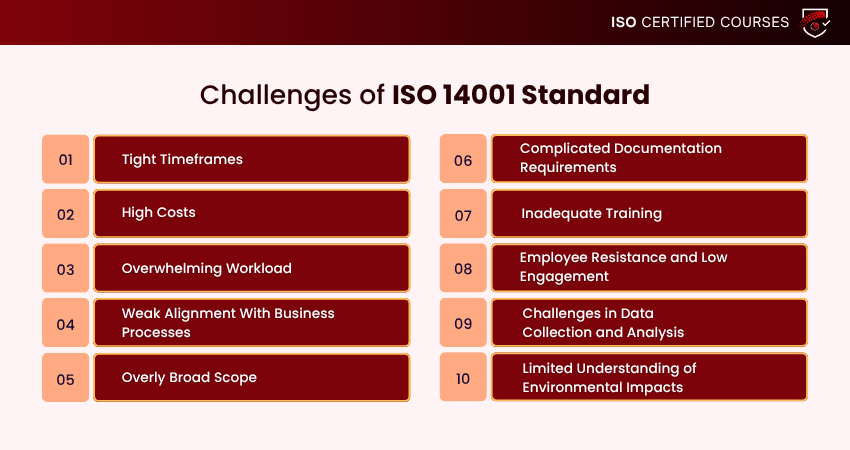
1) Tight Timeframes
Organisations often set aggressive deadlines for certification without fully allowing for planning, training, process redesign, etc.
Delays arise when existing operations need to be aligned with the Environmental Management System (EMS), which can take longer than anticipated.
Rushed implementation can lead to skipping thorough internal reviews or risk assessments.
This results in non-conformities during audits.
2) High Costs
1) Cost is high not just in monetary terms but also in allocating human resources, training, audits and documenting procedures.
2) For smaller organisations, even modest expenditures or shifts in resource allocation can strain budgets.
3) The cost of external consultancy or hiring Specialists may balloon if internal expertise is lacking.
4) This increases the dependency on outside help.
3) Overwhelming Workload
1) Documentation, internal audits, record-keeping, identifying environmental aspects and impacts all add extra tasks.
2) Integrating new environmental responsibilities into daily business operations adds to employee workload.
3) Ongoing monitoring and reporting of environmental metrics create recurring demands.
4) This may overload staff already handling operational duties.
4) Weak Alignment with Business Processes
1) EMS may be seen as a separate or “bolt-on” system rather than integrated with core operations like production, procurement and maintenance.
2) When environmental objectives are not part of strategy or KPIs, they tend to be sidelined.
3) Operational inefficiencies may result if EMS requirements conflict with existing business KPIs, such as prioritising speed over environmental controls.
5) Overly Broad Scope
1) Organisations may try to cover all environmental services immediately rather than focusing on the most significant ones first.
2) Including indirect environmental impacts, such as supply chain and product lifecycle, increases complexity.
3) Attempting to cover peripheral or low-impact areas from day one can dilute focus and undervalue high-impact issues.
6) Complicated Documentation Requirements
1) ISO 14001 requires a variety of documented policies, procedures, records, and evidence of compliance.
2) Keeping documentation up-to-date, including revisions and version control, is often a cumbersome task.
3) Different departments may use different document control practices.
4) This can result in gaps, duplication, or errors in records.
7) Inadequate Training
1) Employees may lack knowledge of EMS requirements, environmental impacts, or how to follow procedures.
2) Sometimes, only selected staff are trained. Others are unaware of their roles and responsibilities under EMS.
3) Training programs may not keep up with updates to the EMS or legal requirements.
4) This can lead to outdated practices in parts of the organisation.
8) Employee Resistance and Low Engagement
1) A resistance to change is common. Employees may see EMS as an extra burden, bureaucracy or unnecessary change.
2) Lack of visible leadership support or incentives can lower employee ownership.
3) Some employees may distrust EMS if they view it as compliance-focused rather than impactful.
4) It's a challenge to make them see it as a way of genuinely improving the environment and workplace.
Protect the planet through powerful audits. Register for our
ISO 14001 Internal Auditor Training
and elevate your organisation’s eco-performance!
9) Challenges in Data Collection and Analysis
1) Gathering reliable data on waste, emissions, resource use, etc., can be hard, especially if systems aren’t set up for measurement.
2) Data overload can occur when too many indicators are collected, without clear guidance on which are most relevant or how their trends should be interpreted.
3) Inconsistent systems across sites make consolidation difficult.
4) Without standardised metrics, comparisons can become misleading.
10) Limited Understanding of Environmental Impacts
1) Organisations may not fully understand or identify all the environmental impacts relevant to their operations.
2) Lifecycle thinking or supply chain impacts are often neglected.
3) Sometimes indirect impacts, such as those from vendor operations or product end-use, are ignored.
4) This reduces the overall effectiveness of environmental initiatives.
11) Insufficient Commitment From Top Management
1) Without leadership buy-in across time, funding and strategic priority, EMS efforts often lose momentum.
2) Top management may treat EMS certification as merely “ticking the box” rather than seeding environmental thinking into decision making.
3) During economic downturns, top management may shift priorities such as cost reduction and immediate profit away from environmental initiatives.
12) Pressure From External Stakeholders and Compliance Needs
1) Regulatory compliance requirements may change or vary by jurisdiction. Keeping up with it can be tough.
2) Stakeholders and customers increasingly demand environmental performance.
3) There can be a risk to reputation if their expectations are not met.
4) Constantly changing regulations or stakeholder expectations can force frequent EMS updates.
5) This creates compliance fatigue and uncertainty.
Need for Ongoing Improvement and Performance Tracking
1) ISO 14001 requires continual improvement, and maintaining performance over time is challenging.
2) Regular internal audits, management reviews and corrective actions are needed, but they often get deprioritised once the initial certification is achieved.
3) Once basic compliance is achieved, organisations may lack the mechanisms or motivation to push for higher environmental performance.
4) This can lead to stagnation in terms of organisational progress.
Step up as a champion of sustainability with our
ISO 14001 Lead Implementer Training
- Sign up now!
How to Overcome ISO 14001 Challenges?
The Challenges of ISO 14001 can be overcome with the following proven steps, including strong leadership support and phased implementation and targeted training:
1) Strong Leadership Support
Gaining consistent backing from senior management is vital. Leaders must actively fuel the implementation process, dedicate the required resources and define clear environmental targets. Frequent messages from top executives go a long way to highlight the significance of ISO 14001 EMS across the organisation.
2) Focused and Practical Training
Delivering role-specific training on ISO 14001 and environmental practices is crucial. It boosts awareness and capability among employees. Refresher sessions help make sure that the employees stay updated and continue applying best practices as effectively as possible.
3) Clear and Consistent Communication
Openly communicating the advantages of ISO 14001 and the company’s environmental aspirations is vital. It builds trust, understanding and acceptance at every level. Regular updates and feedback channels are important to ensure everyone stays informed and aligned with environmental goals.
4) Active Employee Involvement
Encouraging staff to get involved during planning and implementation promotes a sense of ownership and minimises resistance. Forming green teams or employee committees offers a forum for sharing ideas and strengthening participation.
5) Step-by-Step (Phased) Implementation & Performance Monitoring
Breaking the implementation into manageable phases reduces complexity. Setting measurable KPIs and tracking results regularly helps identify areas for improvement. Ongoing internal audits and management reviews support continual alignment with ISO standards.
Conclusion
Don't look at the Challenges of ISO 14001 as hurdles, but as a chance to help your organisation grow greener and smarter. By engaging employees, embracing better leadership and committing to continuous improvement, these obstacles can open new doors. In the end, it's more than about checking boxes; it's about paving the way toward a sustainable, future-ready tomorrow.
Make environmental awareness not just a mission, but an organisational culture. Sign up for our ISO 14001 Training now!
Search Smarter
Quickly search through our blog content for what interests you
- Top ISO 9001 Internal Audit Questions and Answers in 2026
- ISO 27005 vs ISO 31000: How to Choose the Right Risk Framework
- Top 14 Benefits of ISO 45001 Certification
- What are the ISO 27001 Requirements: A Complete 2026 Guide
- 12 Benefits of ISO 27001 Certification for Business
- ISO 27001 vs ISO 27002: Key Difference and Uses Cases
- ISO 17025 vs ISO 9001: Key Differences and Similarities
- ISO 45001 Requirements for Occupational Health & Safety
- ISO 9001, 14001, and 45001: Key Differences and Similarities
- ISO 27001 vs SOC 2: Understanding Key Differences
- ISO 17025 Requirements: Explained in Detail
- What is ISO 27001 Gap Analysis? A Complete Overview
- ISO 17025: An Overview of Laboratory Accreditation
- What is ISO 27001: An Overview of the Information Security Standard
- ISO 27001 Controls from Annex A: What Changed in ISO 27001:2022?
- What is ISO 50001: Meaning, Requirements & Clauses Explained
- Top 10 Benefits of ISO 50001: A Detailed Explanation
- What is a Quality Management System (QMS): A Comprehensive Overview
- ISO 22000: Food Safety Management System Explained
- What is the Statement of Applicability (SoA) in ISO/IEC 27001?
- What is ISO 31000? The Risk Management Standard Explained
- What Is ISO 13485? Understanding Its 8 Key Sections
- ISO 56000: A Comprehensive Guide to Innovation Management
- What is ISO 14064? Components, Execution, and Benefits Explained
- Carbon Footprint: Definition, Types, and How to Calculate It
- ISO 22301: Requirements, Benefits and How to Implement It?
- ISO 9001 vs ISO 9002: Key Differences You Should Know
- Carbon Accounting: Meaning, Benefits, and Challenges
- Ecological Footprint: Meaning, Importance, and Purpose
- Compliance Management System: Components and How to Implement
- What is Competency Management? Benefits, Tips and Best Practices
- ISO 9001 and 27001: Quality Management vs Information Security Management
- ISO 27001 Annex A Controls: Everything You Need to Know
No match found
Frequently Asked Questions
No FAQs available for this blog.