
























ISO 27001 vs ISO 27002: Key Difference and Uses Cases
ISO 27001 sets ISMS requirements, while ISO 27002 provides practical guidance for implementing security controls effectively. Together, they help organisations manage information security risks consistently across people, processes and technology. This alignment builds trust, supports regulations and strengthens security governance.

In the world of Information Security, ISO 27001 and ISO 27002 often walk hand in hand but they’re far from identical. While ISO 27001 is the master architect, sketching the grand blueprint for your digital fortress, ISO 27002 is the craftsman, handing you the tools and techniques to build it. Together, they form a powerful alliance, each playing a distinct and complementary role in fortifying your organisation’s defences.
This blog takes a deep dive into the key differences between ISO 27001 vs ISO 27002, helping you decide which standard best fits your security strategy. So read on and uncover how these guardians work in harmony to protect your digital world!
Table of Contents
1) What is ISO 27001?
2) What is ISO 27002?
3) ISO 27001 vs ISO 27002: What are the Key Differences?
4) ISO 27001 vs ISO 27002: How to Choose the Right Standard?
5) When Should You Use Each Standard?
6) Advantages and Challenges of using ISO 27001 and ISO 27002
7) Conclusion
What is ISO 27001?
ISO 27001 is a standard of global repute that helps organisations secure their information assets. It was crafted by the International Organization for Standardization (ISO) and the International Electrotechnical Commission (IEC). It outlines a systematic approach to establishing and continually improving Information Security Management Systems (ISMS).
The standard addresses people, processes and technology, with a strong focus on risk-based security controls. The main aim of ISO 27001 is to protect information by maintaining confidentiality, integrity, and availability.
What is ISO 27002?
ISO 27002 is an internationally recognised standard offering guidance on choosing, implementing and managing Information Security controls. It complements the ISO 27001 standard by providing practical advice and best practices. While ISO 27001 outlines what needs to be done, ISO 27002 explains how to apply controls across areas such as Access Management, data protection, physical security and incident response.
The 2022 revision modernised the standard by organising controls into four categories: organisational, people, physical and technological. This structure supports a risk-based approach to managing Information Security.
ISO 27001 vs ISO 27002: What are the Key Differences?
Here are the key distinctions between ISO 27001 vs ISO 27002:
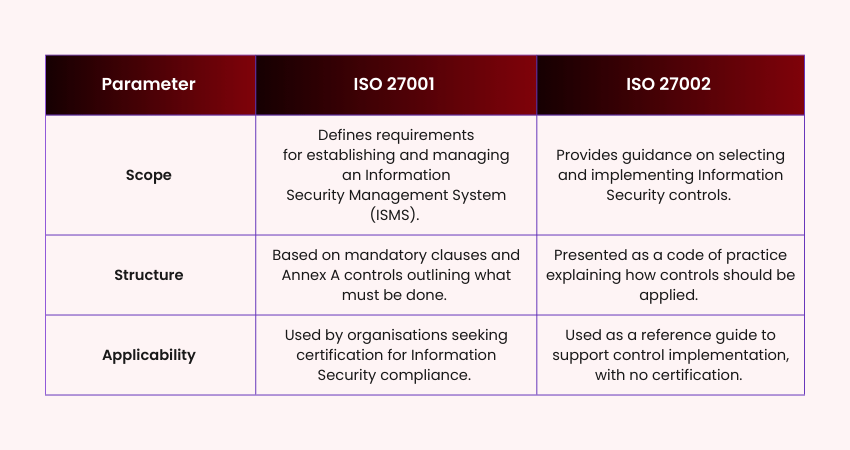
1) Scope
ISO 27001:2022 has a broad organisational scope and defines the full requirements of an Information Security Management System (ISMS). It covers areas such as organisational context, leadership, planning, risk assessment, operations, performance evaluation, continual improvement, and the use of Annex A controls.
ISO 27002:2022 has a narrower scope and focuses only on information security controls. It does not define ISMS requirements but instead provides detailed guidance on how the Annex A controls referenced in ISO 27001 can be implemented and managed effectively.
2) Structure
ISO 27001:2022 follows a clause-based structure, consisting of Clauses 1 to 10, which set mandatory ISMS requirements, followed by Annex A listing the controls. This structure is designed to support governance, risk management and continual improvement.
ISO 27002:2022 follows a control-based structure rather than a clause-based one. It explains each control individually and groups them into four themes: organisational, people, physical, and technological, offering practical implementation guidance instead of management system requirements.
Turn compliance into a culture. Sign up for our ISO 27001 Training and lead the charge in Information Security!
3) Applicability
ISO 27001 applies to the entire organisation and is used to establish, operate, and improve an ISMS based on risk. Organisations must meet their requirements and conduct risk assessments to determine applicable controls.
ISO 27002 supports ISO 27001 by explaining how selected controls can be applied in practice. Not all controls are mandatory; relevance is determined through the ISO 27001 risk assessment process and documented in the Statement of Applicability.
ISO 27001 vs ISO 27002: How to Choose the Right Standard?
The following information will help you make your pick between ISO 27001 vs ISO 27002
1) ISO 27002 isn't a Certified Standard
1) ISO 27001 is a certifiable standard that organisations can be formally assessed against to prove compliance with Information Security requirements.
2) ISO 27002 is not a certifiable standard. It serves as a collection of best practices for implementing security controls within an ISO 27001 framework.
2) ISO 27002 Provides More Details Than ISO 27001
1) The ISO 27001 standard lists the specific security controls for organisations to follow in Annex A.
2) It does not provide details on these controls.
3) ISO 27002 explains all the security controls outlined in ISO 27001’s Annex A.
3) ISO 27001 Allows for Risk Assessment
1) ISO 27001 requires organisations to perform a formal Risk Assessment as part of establishing and operating an ISMS.
2) Based on the Risk Assessment, organisations decide which Annex A controls are applicable and document this in the Statement of Applicability (SoA).
3) On the contrary, the supplementary standards don’t make any such distinctions. It simply details the controls.
4) ISO 27001 has Mandatory Clauses
1) ISO 27001 has many mandatory clauses (clauses 4 to 10) that must be complied with for the ISO 27001 certification.
2) ISO 27002 controls aren’t compulsory.
3) At best, they are a reference set of Information Security controls that organisations can use.
When Should You Use Each Standard?
Choosing between ISO 27001 vs ISO 27002 depends on your organisation’s objectives and current security maturity. You should use ISO 27001 in the following scenarios:
1) Establishing an ISMS:
It is suitable when an organisation wants to design, implement, and manage a structured ISMS to control security risks.
2) Certification Requirements:
It’s ideal for organisations aiming to achieve third-party certification and prove their compliance with international standards.
3) Risk-based Management:
It’s best used when the focus is on identifying, assessing and treating Information Security risks in a structured manner.
4) Demonstrating Commitment:
It helps organisations show a strong commitment to Information Security to partners, clients and other stakeholders.
On the other hand, you should use ISO 27002 in the following scenarios:
1) Control Implementation Guidance:
It’s used when detailed direction is needed on selecting and applying specific Information Security controls.
2) Improving an Existing ISMS:
It supports organisations looking to strengthen or refine controls within an established ISMS.
3) Best Practice Reference:
It acts as a practical reference to internationally recognised best practices for Information Security controls.
4) Non-certification Use:
It is suitable for organisations that do not seek certification but want to align their security controls with globally accepted guidance.
Advantages and Challenges of Using ISO 27001 and ISO 27002
Using ISO 27001 and ISO 27002 together is beneficial when an organisation has enough time and resources and aims to go beyond basic compliance. Here are the key benefits of applying them together:
1) Reduced Implementation Uncertainty:
ISO 27002 complements ISO 27001 by providing practical guidance on implementing security controls. This removes ambiguity and helps organisations build an effective ISMS that delivers real security outcomes.
2) Supports Continuous Improvement:
ISO 27002 encourages ongoing refinement of controls and processes. This enables organisations to respond effectively to evolving security threats.
3) Improves Security Awareness and Training:
By adding context to ISO 27001 controls, ISO 27002 makes security expectations easier to understand. This helps with more effective training and awareness initiatives.
4) Supports Audit and Certification Readiness:
Together, the standards align the “what” and the “how” of Information Security. This reduces rework during audits and can accelerate the overall certification process.
Now let’s explore the challenges associated with ISO 27001 and ISO 27002:
1) Increased Complexity:
Implementing both standards requires additional technical knowledge or external support. This can increase compliance complexity and place extra demands on staff.
2) Risk of Overengineering Controls:
Organisations may implement controls excessively to meet audit expectations without fully considering the business context.
3) Higher Documentation Requirements:
Combining both standards increases the documentation demands. This leads to more records to manage and higher administrative effort.
4) Greater Time and Cost Commitment:
Adopting ISO 27001 and ISO 27002 together can increase initial time and financial investment. Misinterpreting ISO 27002 guidance as mandatory may also lead to unnecessary rework or remediation costs.
Conclusion
ISO 27001 and ISO 27002 aren’t rivals; they’re partners in building a resilient security framework. One sets the stage while the other fine-tunes the performance. Understanding the key ISO 27001 vs ISO 27002 differences and their unique roles can help you craft a strategy that’s both structured and actionable. So, start with the proper standard and lead with confidence.
Every strong defence begins with a solid foundation. Sign up for our
ISO 27001 Foundation Training
and secure your organisation's future!
Search Smarter
Quickly search through our blog content for what interests you
- Top ISO 9001 Internal Audit Questions and Answers in 2026
- ISO 27005 vs ISO 31000: How to Choose the Right Risk Framework
- Challenges of ISO 14001 and How to Overcome Them
- Top 14 Benefits of ISO 45001 Certification
- What are the ISO 27001 Requirements: A Complete 2026 Guide
- 12 Benefits of ISO 27001 Certification for Business
- ISO 17025 vs ISO 9001: Key Differences and Similarities
- ISO 45001 Requirements for Occupational Health & Safety
- ISO 9001, 14001, and 45001: Key Differences and Similarities
- ISO 27001 vs SOC 2: Understanding Key Differences
- ISO 17025 Requirements: Explained in Detail
- What is ISO 27001 Gap Analysis? A Complete Overview
- ISO 17025: An Overview of Laboratory Accreditation
- What is ISO 27001: An Overview of the Information Security Standard
- ISO 27001 Controls from Annex A: What Changed in ISO 27001:2022?
- What is ISO 50001: Meaning, Requirements & Clauses Explained
- Top 10 Benefits of ISO 50001: A Detailed Explanation
- What is a Quality Management System (QMS): A Comprehensive Overview
- ISO 22000: Food Safety Management System Explained
- What is the Statement of Applicability (SoA) in ISO/IEC 27001?
- What is ISO 31000? The Risk Management Standard Explained
- What Is ISO 13485? Understanding Its 8 Key Sections
- ISO 56000: A Comprehensive Guide to Innovation Management
- What is ISO 14064? Components, Execution, and Benefits Explained
- Carbon Footprint: Definition, Types, and How to Calculate It
- ISO 22301: Requirements, Benefits and How to Implement It?
- ISO 9001 vs ISO 9002: Key Differences You Should Know
- Carbon Accounting: Meaning, Benefits, and Challenges
- Ecological Footprint: Meaning, Importance, and Purpose
- Compliance Management System: Components and How to Implement
- What is Competency Management? Benefits, Tips and Best Practices
- ISO 9001 and 27001: Quality Management vs Information Security Management
- ISO 27001 Annex A Controls: Everything You Need to Know
No match found
Frequently Asked Questions
No FAQs available for this blog.