
























What is ISO 50001: Meaning, Requirements & Clauses Explained
ISO 50001 is a global standard that helps organisations manage energy use, improve efficiency, reduce costs and cut environmental impact. It provides a structured framework to monitor and optimise energy performance across operations. This helps organisations improve sustainability while meeting regulatory and business goals.

Energy costs are rising. Environmental expectations are increasing. Regulations are tightening. For organisations across every sector, managing energy effectively is no longer optional, it’s essential. This is where ISO 50001, the globally recognised standard for Energy Management Systems (EnMS), becomes increasingly valuable.
To help you understand how this standard can be applied in practice, in this blog, we will discuss What is ISO 50001, its key requirements, how the clauses are structured, and why it matters for your business. By the end, you will have a clear understanding of how ISO 50001 can support smarter energy decisions and strengthen long-term organisational performance.
What is ISO 50001?
ISO 50001 is an international standard developed by the International Organization for Standardization (ISO) that specifies requirements for establishing, implementing, maintaining, and improving an Energy Management System (EnMS). Its primary goal is to help organisations adopt a systematic approach to managing energy, improving energy efficiency, lowering energy use, and reducing greenhouse gas emissions.
Originally published in 2011 and updated in 2018, ISO 50001 aligns with the High-Level Structure (HLS) used in other management system standards like ISO 9001 and ISO 14001, making integration seamless.
In essence, ISO 50001 helps organisations:
1) Reduce energy costs
2) Increase operational efficiency
3) Improve environmental performance
4) Strengthen sustainability initiatives
Whether you operate a manufacturing plant, educational institution, corporate office, or a data centre, ISO 50001 provides a practical framework to manage and optimise energy use.

What are the Key Requirements for ISO 50001?
ISO 50001 sets out clear expectations for how an organisation should manage energy systematically. These requirements are not about technical engineering standards, but about management processes that drive better decisions and measurable improvement. Some of the key requirements include:
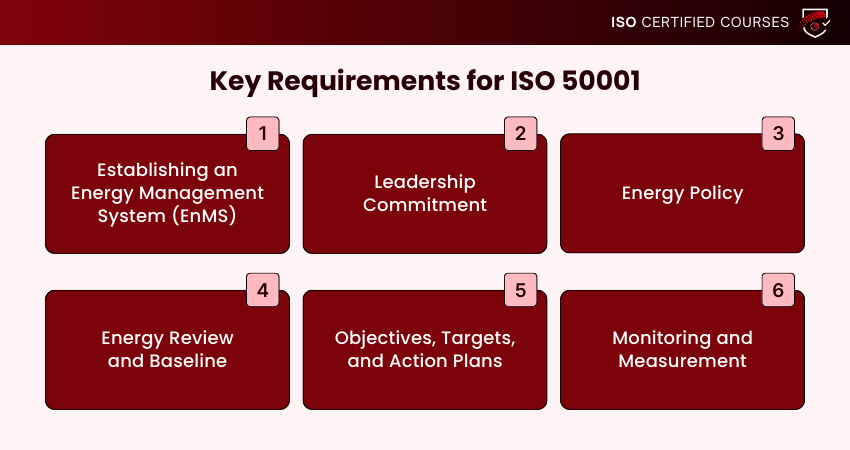
1) Establishing an Energy Management System (EnMS):
Organisations must create a structured system that defines how energy is managed across the business. This includes policies, responsibilities, procedures, and documentation.
2) Leadership Commitment:
Senior leadership must demonstrate active involvement. Energy Management should not sit only with facilities teams; it must be embedded into strategic decision-making.
3) Energy Policy:
The organisation must define a clear energy policy that commits to continual improvement in energy performance and efficient energy use.
4) Energy Review and Baseline:
Organisations must analyse current energy usage, identify significant energy uses, and establish an energy baseline against which performance can be measured.
5) Objectives, Targets, and Action Plans:
Clear energy objectives must be set. These should be measurable and supported by action plans that outline responsibilities, resources, and timelines.
6) Monitoring and Measurement:
Energy performance must be monitored using data. This allows organisations to track progress, identify inefficiencies, and make evidence-based decisions.
7) Competence and Awareness:
People whose work affects energy performance must understand their role. Awareness is essential to embed energy-conscious behaviour across teams.
8) Continuous Improvement:
The system must evolve over time. Regular reviews, internal audits, and improvement actions ensure Energy Management remains effective.
Strengthen your ISO 50001 auditing knowledge to drive reliable assessments by registering in
ISO 50001 Internal Auditor Training
now!
Which Clauses Constitute the ISO 50001 Standard?
ISO 50001 follows the Annexe SL structure, aligning with standards such as ISO 9001, ISO 14001, and ISO 45001 to support easier integration. It is structured into ten clauses, each covering a key element of an Energy Management System and explaining how it supports improved energy performance. Below, we discuss each clause in detail:
Clauses 1-3: Introductory Clauses
These clauses establish the foundation of the standard.
Clause 1:
This clause defines the scope of ISO 50001 and confirms that it applies to any organisation seeking to improve energy performance.
Clause 2:
This clause lists normative references, which are external documents that support the standard.
Clause 3:
This clause provides key terms and definitions, ensuring consistency in how concepts such as energy performance, energy baseline, and significant energy use are understood.
While these clauses do not contain requirements, they provide essential context for interpreting the standard correctly.
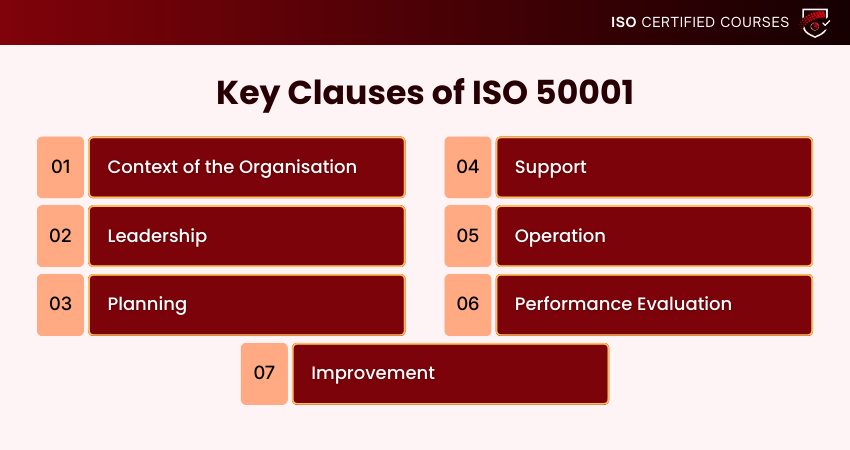
Clause 4: Context of the Organisation
This clause requires organisations to understand their internal and external environment in relation to energy performance.
It includes identifying:
1) Internal issues such as infrastructure, processes, and culture
2) External issues such as market conditions, regulations, and stakeholder expectations
3) Interested parties, including customers, regulators, employees, and communities
4) The scope of the Energy Management System
Organisations must also define the boundaries of their EnMS and document how Energy Management applies across sites, functions, and activities. This ensures Energy Management is tailored to the organisation rather than applied as a generic framework.
Clause 5: Leadership
Clause 5 places strong emphasis on leadership involvement.
Top management is responsible for:
1) Establishing the energy policy
2) Ensuring energy objectives align with strategic direction
3) Providing resources for the EnMS
4) Promoting continual improvement
5) Assigning roles and responsibilities
Without leadership ownership, Energy Management often becomes a technical exercise rather than a strategic priority. This clause ensures accountability starts at the top. It also encourages organisations to integrate energy considerations into business planning, procurement, and operational decisions.
Strengthen ISO 50001 auditing competence to evaluate systems, manage risks and drive improvement by registering in
ISO 50001 Lead Auditor Training
today!
Clause 6: Planning
Clause 6 focuses on structured planning for improved energy performance.
It requires organisations to:
1) Identify risks and opportunities related to energy performance
2) Conduct an energy review to analyse how energy is used
3) Determine significant energy uses (SEUs)
4) Establish an energy baseline
5) Define energy performance indicators (EnPIs)
6) Set measurable objectives and targets
7) Develop action plans to achieve improvements
This clause transforms Energy Management from guesswork into a data-driven process. Organisations understand energy usage better and pinpoint areas for the most impactful improvements.
Clause 7: Support
Clause 7 addresses the resources and support needed to operate the Energy Management System effectively.
This includes:
1) Providing adequate resources for energy initiatives
2) Ensuring people are competent to perform energy-related tasks
3) Raising awareness about the energy policy and objectives
4) Communicating energy-related information internally and externally
5) Maintaining documented information such as procedures, records, and plans
Energy Management succeeds when people across the organisation understand its importance and know how their actions influence energy performance.
Clause 8: Operation
Clause 8 focuses on putting plans into action.
Organisations must implement controls related to significant energy uses, such as:
1) Defining operational criteria for energy-efficient practices
2) Managing changes that could impact energy performance
3) Considering energy performance in procurement decisions
4) Evaluating energy efficiency when designing facilities, systems, and equipment
This clause ensures that Energy Management is embedded into everyday operations rather than treated as a separate initiative.
Clause 9: Performance Evaluation
Clause 9 is about measuring whether the system is working.
Organisations are required to:
1) Monitor and measure energy performance
2) Analyse energy data and trends
3) Evaluate compliance with legal and other obligations
4) Conduct internal audits of the EnMS
5) Carry out management reviews to assess effectiveness
These activities help organisations understand what is improving, what is not, and where corrective actions are required. Without evaluation, Energy Management becomes a theoretical exercise. This clause ensures it remains practical and measurable.
Clause 10: Improvement
Clause 10 focuses on continual improvement.
Organisations must:
1) Address nonconformities when issues occur
2) Take corrective actions to prevent recurrence
3) Identify opportunities for improvement
4) Continually enhance the effectiveness of the EnMS and energy performance
This reinforces that ISO 50001 is not a one-time initiative. It is an ongoing cycle of learning, refinement, and performance improvement.
Master ISO 50001 implementation skills to lead energy management systems and boost career growth by signing up in
ISO 50001 Lead Implementer Training
today!
Why is ISO 50001 Important for Your Business?
ISO 50001 is not just a compliance standard; it offers strategic advantages that directly contribute to business growth and environmental sustainability. Here are the keyways it supports business success:
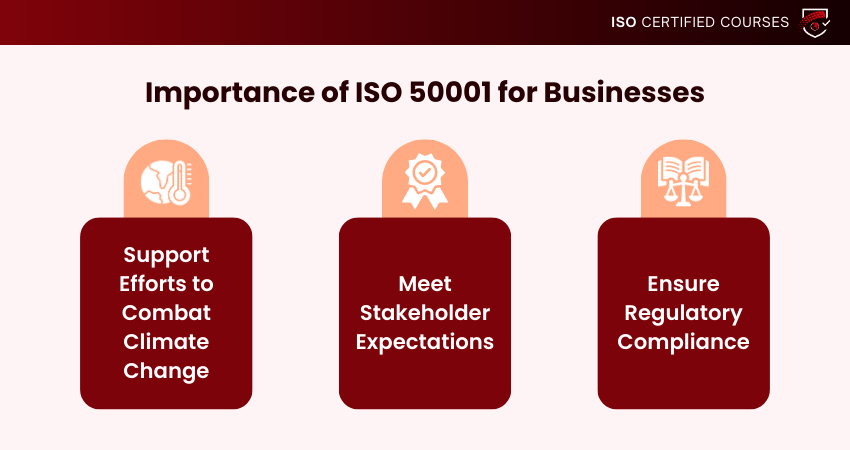
1) Support Efforts to Combat Climate Change
Energy consumption is a leading cause of greenhouse gas emissions worldwide. By adopting ISO 50001, organisations can:
1) Reduce carbon footprints
2) Align with global climate action goals
3) Implement sustainable operational practices
This makes your organisation a responsible player in combating climate change.
2) Meet Stakeholder Expectations
Today, stakeholders demand transparency and responsibility from businesses. ISO 50001 helps organisations:
1) Build trust among customers, regulators, and investors
2) Strengthen reputation and credibility
3) Demonstrate commitment to sustainability initiatives
Energy-efficient businesses often outperform competitors due to their responsible approach.
3) Ensure Regulatory Compliance
With energy-related regulations becoming more stringent globally, ISO 50001 enables businesses to:
1) Stay compliant with local and international laws
2) Avoid penalties and legal risks
3) Align energy practices with industry standards
Compliance not only protects an organisation legally but also gives it a competitive edge.
Conclusion
Understanding What is ISO 50001 empowers organisations to manage energy more intelligently, improve performance, and reduce long-term costs. By strengthening leadership commitment and embedding continual improvement, the standard supports sustainable growth. It also enhances resilience, meets regulatory expectations, and enables smarter, data-driven energy decisions across every sector.
Build energy management skills and reduce costs with
ISO 50001 Courses
– Sign up now!
Search Smarter
Quickly search through our blog content for what interests you
- Top ISO 9001 Internal Audit Questions and Answers in 2026
- ISO 27005 vs ISO 31000: How to Choose the Right Risk Framework
- Challenges of ISO 14001 and How to Overcome Them
- Top 14 Benefits of ISO 45001 Certification
- What are the ISO 27001 Requirements: A Complete 2026 Guide
- 12 Benefits of ISO 27001 Certification for Business
- ISO 27001 vs ISO 27002: Key Difference and Uses Cases
- ISO 17025 vs ISO 9001: Key Differences and Similarities
- ISO 45001 Requirements for Occupational Health & Safety
- ISO 9001, 14001, and 45001: Key Differences and Similarities
- ISO 27001 vs SOC 2: Understanding Key Differences
- ISO 17025 Requirements: Explained in Detail
- What is ISO 27001 Gap Analysis? A Complete Overview
- ISO 17025: An Overview of Laboratory Accreditation
- What is ISO 27001: An Overview of the Information Security Standard
- ISO 27001 Controls from Annex A: What Changed in ISO 27001:2022?
- Top 10 Benefits of ISO 50001: A Detailed Explanation
- What is a Quality Management System (QMS): A Comprehensive Overview
- ISO 22000: Food Safety Management System Explained
- What is the Statement of Applicability (SoA) in ISO/IEC 27001?
- What is ISO 31000? The Risk Management Standard Explained
- What Is ISO 13485? Understanding Its 8 Key Sections
- ISO 56000: A Comprehensive Guide to Innovation Management
- What is ISO 14064? Components, Execution, and Benefits Explained
- Carbon Footprint: Definition, Types, and How to Calculate It
- ISO 22301: Requirements, Benefits and How to Implement It?
- ISO 9001 vs ISO 9002: Key Differences You Should Know
- Carbon Accounting: Meaning, Benefits, and Challenges
- Ecological Footprint: Meaning, Importance, and Purpose
- Compliance Management System: Components and How to Implement
- What is Competency Management? Benefits, Tips and Best Practices
- ISO 9001 and 27001: Quality Management vs Information Security Management
- ISO 27001 Annex A Controls: Everything You Need to Know
- ISO 27001 Audit: A Complete Guide to the Audit Process
- ISO 9001 vs ISO 14001: Key Differences and Similarities
No match found
Frequently Asked Questions
No FAQs available for this blog.