


















What is a Quality Management System (QMS): A Comprehensive Overview
A Quality Management System is a set of processes and controls that help organisations ensure consistent quality, meet customer needs and comply with standards. It focuses on defined processes, risk management, and continuous improvement. It also helps businesses improve efficiency, reduce errors, and build long-term customer trust.

Sustainable success does not happen by chance. Behind every trusted brand and high-performing organisation is a clear system that keeps quality at the centre of everything they do. These businesses know that consistent quality builds credibility, strengthens customer trust, and sets them apart in a competitive market. That consistency is achieved through a well-designed Quality Management System.
A Quality Management System provides a structured way to manage processes, reduce risks, and drive continuous improvement across the organisation. In this blog, you will learn what a Quality Management System is, its core elements, the different types, and how it helps organisations achieve long-term, reliable success.
What is a Quality Management System (QMS)?
A Quality Management System (QMS) is a structured framework of policies, processes, and responsibilities used to plan, control, and improve product or service quality. It ensures that quality standards are met consistently while maintaining customer satisfaction and regulatory compliance.
Most QMS frameworks are based on the Plan-Do-Check-Act (PDCA) cycle, a model that promotes continuous improvement. It involves planning processes, implementing them, reviewing performance through audits or monitoring, and taking corrective steps to improve outcomes.

What are the Core Elements of Quality Management Systems?
Even though QMS models may differ across industries, they are built on a common set of core elements. These elements help businesses stay organised and focused on quality. Here are the core elements of a Quality Management System:
1) Quality Policy:
It is a formal statement that defines the organisation’s commitment to quality. It sets the direction and establishes the overall intent regarding quality performance.
2) Quality Objectives:
These are measurable goals derived from the quality policy. They provide clear targets for improvement, such as reducing defects, improving delivery time, or increasing customer satisfaction.
3) Process Management:
A QMS is built on clearly defined processes. This includes identifying key activities, assigning responsibilities, and ensuring processes are controlled and consistent.
4) Roles and Responsibilities:
Everyone in the organisation needs to understand their role in maintaining quality. Clear accountability ensures tasks are performed correctly and consistently.
5) Resource Management:
This includes managing people, infrastructure, equipment, and training required to maintain quality standards.
6) Performance Measurement:
Monitoring performance through data collection and analysis helps organisations evaluate whether quality objectives are being met.
7) Continuous Improvement:
QMS is focused on ongoing improvement. Organisations regularly review performance, identify gaps, and implement changes to enhance quality.
Types of Quality Management Systems
Organisations can choose from different types of Quality Management Systems depending on their industry, size, and operational goals. While all QMS approaches aim to improve quality and consistency, each method follows its own approach.
Below are the most common types of Quality Management Systems:
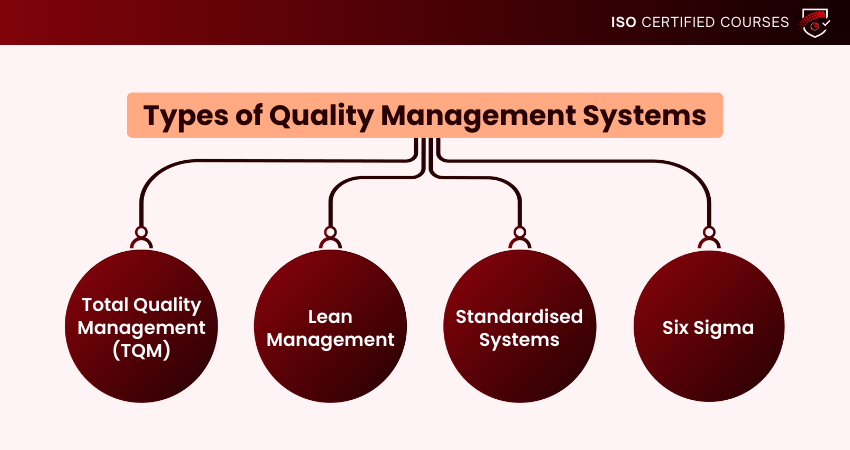
1) Total Quality Management (TQM)
Total Quality Management (TQM) focuses on improving quality across the entire organisation. Instead of limiting quality to one department, TQM involves every employee, from senior leadership to frontline staff.
The main goal is to achieve long-term success through customer satisfaction. It encourages teamwork, open communication, and a culture where everyone takes responsibility for improving processes, products, and services.
2) Lean Management
Lean management focuses on eliminating waste while maximising value. The main objective is to ensure that every activity adds value from the customer’s perspective, and the unnecessary steps are removed from the process.
Waste can include defects, overproduction, waiting time, unnecessary movement, or excess inventory. By streamlining processes, Lean improves process efficiency and reduces costs without compromising quality.
3) Standardised Systems
Standardised systems follow internationally recognised frameworks such as ISO 9001. This ISO standard is focused on Quality Management System, and it clearly defines what organisations can do to control quality.
Standardised systems help strengthen customer confidence and market reputation. When a business aligns with globally recognised standards, it shows a commitment to quality and accountability.
4) Six Sigma
Six Sigma is a data-driven methodology aimed at reducing defects and process variation. It uses statistical tools and follows the Define, Measure, Analyse, Improve and Control (DMAIC) framework to achieve near-perfect quality in your products and services.
By focusing on measurable results, Six Sigma helps organisations identify root causes of problems rather than treating surface-level symptoms. This leads to improved efficiency, lower operational costs, and high-quality outcomes.
Understand risk-based thinking and process control with
ISO 9001 Training
– Register today!
How to Establish and Implement a Quality Management System?
Setting up a Quality Management System takes planning, commitment, and teamwork. Below are the main steps to establish and implement a QMS:
1) Define Quality Objectives and Scope:
Identify your business goals, customer needs and compliance requirements, and clearly define the scope of your QMS.
2) Create a Quality Policy:
Develop a clear quality policy and ensure senior management actively supports and promotes continuous improvement.
3) Document Key Processes:
List and map your main business processes, assign responsibilities and create clear procedures to maintain consistency and clarity.
4) Set up Document and Record Control:
Implement a document control system to manage versions, approvals and proper record keeping.
5) Train Employees and Promote Quality Awareness:
Provide regular training on QMS procedures and encourage employees to take responsibility for maintaining quality standards.
6) Manage Risks:
Identify possible risks early and implement corrective actions like simple risk assessment methods to prevent recurring issues.
7) Monitor Performance With Internal Audits:
Schedule regular internal audits and monitor performance to ensure processes follow QMS requirements.
8) Measure Quality Results:
Track Key Performance Indicators (KPIs) such as defect rates and customer complaints and apply improvement methods to enhance efficiency and quality.
9) Prepare for Certification if Required:
Conduct gap analysis and align processes with standards before undergoing certification audits for QMS.
10) Review and Improve Regularly:
Perform regular management reviews to evaluate performance and update the QMS based on audit results and feedback.
Benefits of Quality Management Systems
A Quality Management System offers real, measurable benefits to the entire organisation. Let's now check those benefits:
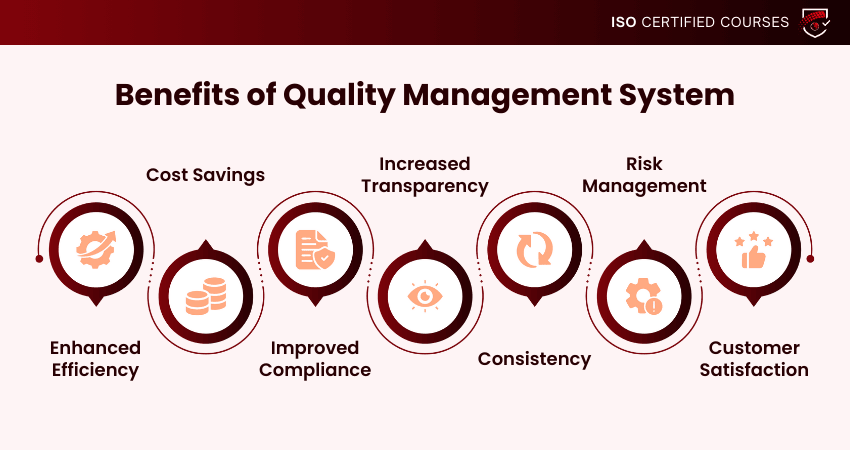
1) Enhanced Efficiency
QMS improves business efficiency by clearly defining processes and responsibilities. When employees follow standard procedures, work becomes more organised and predictable. This reduces delays, confusion, and unnecessary rework. As a result, teams can focus on productive tasks rather than fixing repeated mistakes.
2) Cost Savings
By preventing defects and reducing errors, a QMS helps lower operational costs. Fewer mistakes mean less waste, fewer product returns, and reduced rework expenses. Early detection of problems also avoids costly corrective actions later. Over time, these savings contribute to stronger financial performance.
3) Improved Compliance
A Quality Management System ensures that organisations meet legal, regulatory and industry requirements. Proper documentation and controlled processes make it easier to demonstrate compliance during audits. This reduces the risk of penalties or operational disruptions.
4) Increased Transparency
Clear documentation and defined roles improve transparency across the organisation. Employees understand their responsibilities and how their work affects overall quality. Organisations can also track performance using measurable indicators. This visibility supports better decision-making and accountability.
5) Consistency
Standardised processes in a QMS ensure that products and services meet the same quality standards every time. Customers receive reliable results regardless of who performs the task. Consistency strengthens brand reputation and customer loyalty. It also reduces variation and operational uncertainty.
6) Risk Management
A QMS encourages organisations to identify and assess risks before they become serious problems. Risk-based thinking helps prevent defects, delays, and compliance failures. By addressing issues early, businesses can also protect their operations and reputation. This proactive approach improves long-term stability.
7) Customer Satisfaction
Delivering consistent quality increases customer trust and satisfaction. When products and services meet expectations, customers are more likely to return. A QMS also helps organisations respond effectively to feedback and complaints. Over time, this strengthens customer relationships and supports business growth.
Maintain safe, compliant and high-quality food operations with
ISO 22000 Training
– Join now!
Quality Management Systems Requirements Across Industries
Different industries face unique risks, regulations and operational challenges, which is why Quality Management System requirements often vary across sectors. Understanding these requirements helps organisations implement the right QMS framework as per their needs. Some of the common requirements include:
1) IATF 16949
IATF 16949 is an international Quality Management standard specifically developed for the automotive industry. Developed by the International Automotive Task Force (IATF), it focuses on defect prevention and process improvement.
The standard requires organisations to implement strong risk management practices, continuous improvement, process control, and supplier management to ensure consistent, high-quality automotive products.
2) ISO 22000
ISO 22000 specifies the requirements for a Food Safety Management System (FSMS). It helps organisations in the food supply chain ensure that food is safe for consumption.
It combines key elements such as Hazard Analysis and Critical Control Points (HACCP), prerequisite programmes, risk-based thinking, and continuous improvement to control food safety hazards.
3) AS9100
AS9100 is a QMS designed specifically for the aerospace, aviation, and defence (AS&D) industries. The standard helps organisations improve process control, prevent defects, and ensure consistent product quality across the aerospace supply chain.
It builds upon ISO 9001 and adds strict requirements for risk management, product reliability, and safety. Organisations adopting AS9100 strengthen supply chain integrity and regulatory compliance.
4) ISO 17025:2017
ISO/IEC 17025:2017 focuses on the general requirements for testing and calibration laboratories. It ensures reliable testing procedures and valid measurement results.
It ensures that laboratories produce valid, reliable, and technically sound results by focusing on factors such as staff competence, equipment calibration, and method validation. This standard demonstrates a laboratory’s technical capability and Quality Management practices.
Enhance your lab’s credibility and performance with
ISO 17025 Training
– Sign up soon!
5) Hazard Analysis and Critical Control Points (HACCP)
HACCP is a systematic, preventive food safety approach that identifies, evaluates, and controls biological, chemical, and physical hazards throughout the food production process. It is widely recognised and used globally to ensure food safety across the entire food supply chain.
It is based on seven key principles, including hazard analysis, finding Critical Control Points (CCPs), establishing critical limits, monitoring procedures, corrective actions, verification, and documentation.
6) ISO 13485:2016
ISO 13485:2016 defines QMS requirements specifically for medical device manufacturers. It covers the design, development, production, installation, and servicing of medical devices. It ensures consistent delivery of safe and effective medical products.
It helps organisations demonstrate their ability to meet both customer expectations and strict medical regulatory requirements across global markets. It promotes continual improvement and risk-based decision-making throughout the medical device lifecycle.
7) ICH Q10
ICH Q10 outlines requirements for a Pharmaceutical Quality System (PQS) for the pharmaceutical industry. Developed by the International Council for Harmonisation, it ensures consistent drug quality, safety and regulatory alignment.
It applies across the entire product lifecycle, from pharmaceutical development to commercial manufacturing and product discontinuation. By implementing this, pharmaceutical organisations improve operational efficiency and maintain high product quality.
8) ISO 9001:2015
ISO 9001:2015 establishes general requirements for Quality Management Systems across industries. It focuses on meeting customer requirements, enhancing satisfaction, and improving organisational performance through a process-based approach and risk-based thinking.
Its flexible framework allows it to be integrated with other QMS standards, making it a strong foundation for overall business excellence. Many manufacturing, service, and other organisations use ISO 9001 to build and manage their QMS.
9) ISO 15189:2022
ISO 15189:2022 specifies quality and competence in medical laboratories. It focuses on ensuring accurate, reliable, and timely laboratory results that support patient care and clinical decision-making.
The standard supports a strong QMS framework within diagnostic services. It helps laboratories maintain compliance with regulatory and healthcare authority requirements. Ultimately, it enhances patient safety and trust in laboratory results.
10) FDA 21 CFR Part 820
FDA 21 CFR Part 820 is the Quality System Regulation (QSR) issued by the U.S. Food and Drug Administration (FDA) for medical device manufacturers. The regulation ensures that medical devices are consistently produced and controlled according to quality standards.
This regulation specifically applies to organisations distributing medical devices in the United States. This ensures that the medical devices are safe, effective, and consistently high in quality before they reach patients.
Which ISO Standards Require Quality Management?
Many ISO standards either include Quality Management requirements or are built directly upon a Quality Management framework. ISO 9001 is the global standard for QMS and forms the basis for many sector-specific standards.
Those include ISO 13485 for medical devices, IATF 16949 for automotive, AS9100 for aerospace, and more. Other ISO standards indirectly require or integrate QMS as part of their broader systems. Such standards are ISO 15189 for medical laboratories, ISO/IEC 17025 for testing and calibration labs, and even more to ensure accuracy and controlled processes.
ISO 9001 vs ISO 13485
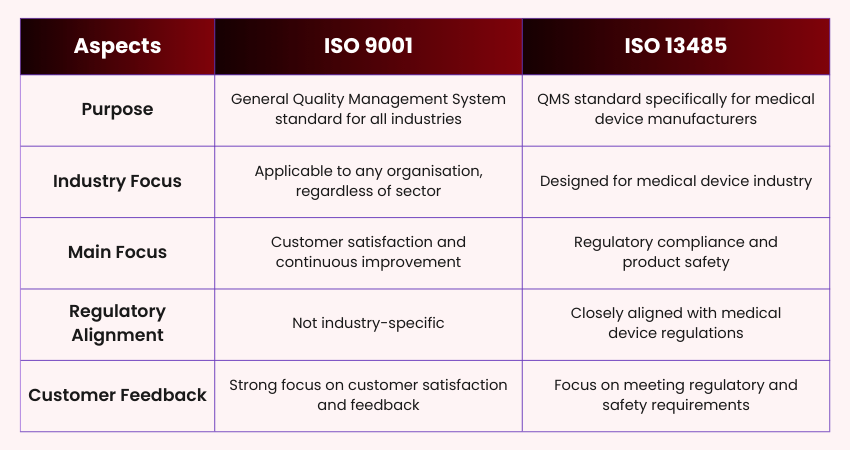
Both ISO 9001 and ISO 13485 are Quality Management standards, but they serve different purposes. ISO 9001 is a generic QMS and applicable to any business, irrespective of its size or sector. ISO 13485, on the other hand, is specifically designed for Quality Management in medical device manufacturing.
Here is a more detailed difference between ISO 9001 and ISO 13485:
Conclusion
A Quality Management System is a practical approach that helps organisations manage processes, maintain consistent quality, and continuously improve performance. Whether a business follows ISO 9001 or another industry-specific standard, the goal remains the same: to deliver safe, reliable, and high-quality products or services. A well-implemented QMS improves efficiency, reduces risks, and builds lasting customer trust.
Lead audits, ensure compliance and drive continuous improvement with
ISO Training
– Explore now!
Search Smarter
Quickly search through our blog content for what interests you
- Top ISO 9001 Internal Audit Questions and Answers in 2026
- ISO 27005 vs ISO 31000: How to Choose the Right Risk Framework
- Challenges of ISO 14001 and How to Overcome Them
- Top 14 Benefits of ISO 45001 Certification
- What are the ISO 27001 Requirements: A Complete 2026 Guide
- 12 Benefits of ISO 27001 Certification for Business
- ISO 27001 vs ISO 27002: Key Difference and Uses Cases
- ISO 17025 vs ISO 9001: Key Differences and Similarities
- ISO 45001 Requirements for Occupational Health & Safety
- ISO 9001, 14001, and 45001: Key Differences and Similarities
- ISO 27001 vs SOC 2: Understanding Key Differences
- ISO 17025 Requirements: Explained in Detail
- What is ISO 27001 Gap Analysis? A Complete Overview
- ISO 17025: An Overview of Laboratory Accreditation
- What is ISO 27001: An Overview of the Information Security Standard
- ISO 27001 Controls from Annex A: What Changed in ISO 27001:2022?
- What is ISO 50001: Meaning, Requirements & Clauses Explained
- Top 10 Benefits of ISO 50001: A Detailed Explanation
- ISO 22000: Food Safety Management System Explained
- What is the Statement of Applicability (SoA) in ISO/IEC 27001?
- What is ISO 31000? The Risk Management Standard Explained
- What Is ISO 13485? Understanding Its 8 Key Sections
- ISO 56000: A Comprehensive Guide to Innovation Management
- What is ISO 14064? Components, Execution, and Benefits Explained
- Carbon Footprint: Definition, Types, and How to Calculate It
- ISO 22301: Requirements, Benefits and How to Implement It?
- ISO 9001 vs ISO 9002: Key Differences You Should Know
- Carbon Accounting: Meaning, Benefits, and Challenges
- Ecological Footprint: Meaning, Importance, and Purpose
- Compliance Management System: Components and How to Implement
- What is Competency Management? Benefits, Tips and Best Practices
- ISO 9001 and 27001: Quality Management vs Information Security Management
- ISO 27001 Annex A Controls: Everything You Need to Know
No match found
Frequently Asked Questions
No FAQs available for this blog.