



ISO 27001 vs SOC 2: Understanding Key Differences
ISO 27001 focuses on building a risk-based Information Security Management System, while SOC 2 proves that security controls work effectively for customer data. Both standards help build trust, reduce risks, and provide a strong commitment to data security. Some organisations adopt both to strengthen credibility and market confidence.

Data breaches, customer distrust and lost contracts are real risks for businesses that fail to prove their security maturity. Know why? Today, clients and partners expect clear evidence that their data is protected instead of just promises. ISO 27001 vs SOC 2, being the most requested standards, often leave many organisations confused about which one they truly need.
Although both focus on Information Security, they serve different purposes and suit different business needs. Choosing the right framework can increase growth and boost your security compliance. This blog clearly explains ISO 27001 vs SOC 2, helping you decide the right path to protect data, win trust and support long-term business success. Let's get started!
ISO 27001 vs SOC 2: An Overview
At a high level, both ISO 27001 and SOC 2 aim to strengthen Information Security. However, they come from different backgrounds and are designed for slightly different purposes. Before exploring ISO 27001 vs SOC 2, let's check what they actually are:
What is ISO 27001?
ISO 27001, also known as ISO/IEC 27001, is an internationally recognised standard for Information Security Management Systems (ISMS). It provides a structured framework for identifying, managing and reducing Information Security risks across an organisation. Its key aspects of data protection include:
1) Confidentiality: Allowing access to information only to authorised users
2) Integrity: Protecting data from unauthorised changes or tampering
3) Availability: Ensuring information is accessible when needed by authorised users
What is SOC 2?
Service Organization Control 2 (SOC 2) is a compliance framework developed by the American Institute of Certified Public Accountants (AICPA). It is designed to evaluate how service providers store, process, or transmit customer data. SOC 2 reports are based on the five Trust Services Criteria (TSC) such as:
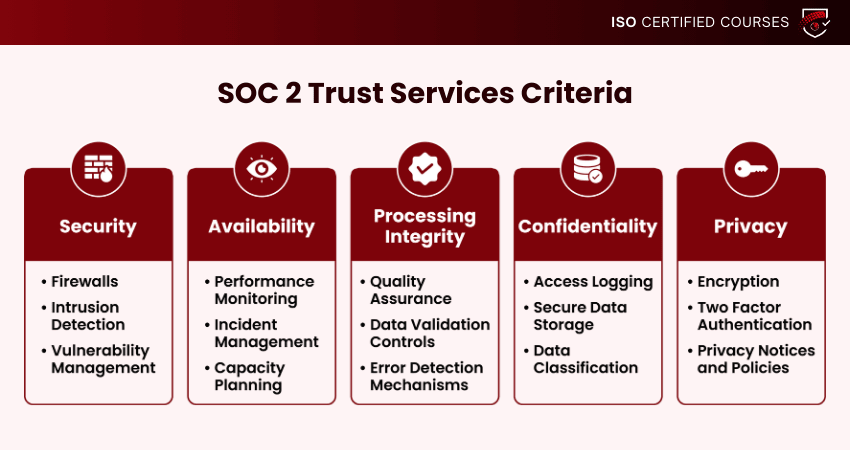
1) Security: Protects against unauthorised data access, breaches, and cyber threats
2) Availability: Ensures systems are accessible and operational as agreed with customers
3) Processing Integrity: Confirms that data is processed accurately and on time
4) Confidentiality: Restricts access to sensitive information to authorised individuals only
5) Privacy: Verifies that personal data is handled and protected with privacy
Difference Between ISO 27001 and SOC 2
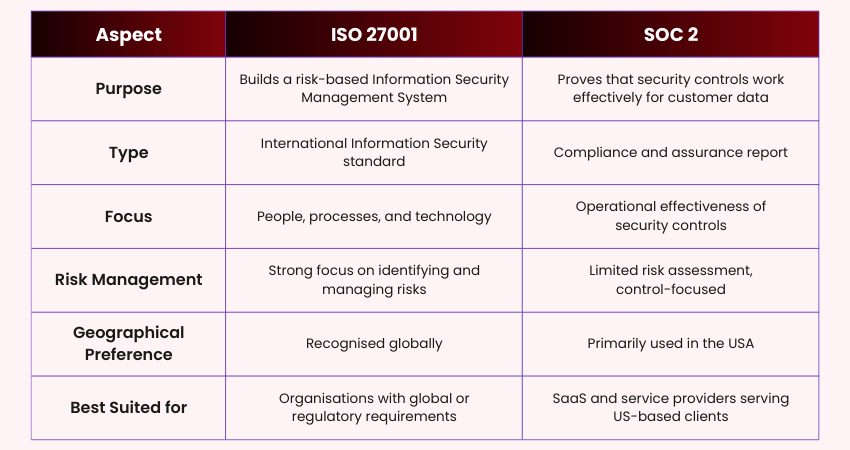
ISO 27001 and SOC 2 share a common goal of improving Information Security, they differ in structure, scope, regional preference, and audit approach. Let's check more about SOC 2 vs ISO 27001:
1) Requirements for Compliance
ISO 27001 requires organisations to create and maintain a full ISMS. This includes documented policies, defined roles, risk assessments, internal audits, management reviews, and continual improvement processes.
On the other hand, SOC 2 organises controls under its TSC. From those, only Security is mandatory for all SOC 2 reports. The remaining four criteria are included only if they are relevant to the organisation's services. It allows greater flexibility based on business relevance.
2) Location Significance
ISO 27001 is recognised globally and is commonly requested by international clients, regulators, and partners. It works well for organisations operating in multiple countries.
SOC 2 is more region-specific. It is primarily used in the United States and Canada, and many US-based clients expect SOC 2 reports from their vendors. If your customer base is international, ISO 27001 often carries broader recognition.
3) Presentation
ISO 27001 results in a formal certificate that can be publicly shared and used in marketing and tender documents. However, it does not provide detailed insight into individual security controls or system configurations.
On the contrary, SOC 2 results in a detailed audit report. These reports are usually confidential and shared under a non-disclosure agreement. They contain sensitive details about internal controls, which is why they are not typically made public.
4) Timeline
ISO 27001 vs SOC 2 differ in audit process and completion time. ISO 27001 Certification can typically take months to achieve, depending on organisational size and maturity.
SOC 2 audits cover a defined reporting period. A Type I report assesses controls at a particular time, while a Type II report evaluates control effectiveness over a period, often 6 to 12 months.
Equip yourself with essential ISMS knowledge with our ISO 27001 Foundation Training – Register today!
Comparing the Scope of SOC 2 and ISO 27001
The scope of ISO 27001 vs SOC 2 is a little different. ISO 27001 has a broad organisational scope, whereas SOC 2 is narrower and more service-focused. Let's have a detailed look at it:
Scope of ISO 27001
1) Suitable for any organisation, irrespective of size or industry
2) Covers organisation-wide Information Security risks
3) Provides a detailed framework for establishing and maintaining an ISMS
4) Requires a risk-based, structured approach with documented policies and procedures
5) Focuses on continuous improvement of security controls
Scope of SOC 2
1) Applies mainly to service organisations that handle customer data
2) Focuses on specific services and systems provided to customers
3) Allows flexibility in selecting controls based on business relevance
4) Well-suited for SaaS companies, cloud providers, and growing organisations
5) Quicker to implement compared to ISO 27001
In comparison between ISO 27001 and SOC 2, SOC 2 focuses on showing that security controls work for specific services, which makes it easier and faster to implement. ISO 27001 takes a wider approach by managing Information Security across the whole organisation. While SOC 2 is more flexible, ISO 27001 provides a long-term security structure and global acceptance.
Key Similarities Between ISO 27001 vs SOC 2
Despite their differences, ISO 27001 and SOC 2 share several important similarities. Both of them prioritise data security and risk reduction. They require organisations to implement strong access controls, incident response processes, and monitoring mechanisms.
Both frameworks also rely on independent external assessment or assurance to build trust with customers and stakeholders, as internal self-attestation alone is not sufficient. Similarly, ISO 27001 and SOC 2 support business growth by improving customer confidence and reducing security-related risks.
How to Become ISO 27001 Compliant?
Becoming ISO 27001 compliant is a structured journey. Here's how you can achieve it:
1) Define the ISMS Scope: Clearly define the boundaries of your ISMS by identifying relevant organisational units, systems, processes, and information assets.
2) Conduct a Risk Assessment: Identify information security risks, assess their likelihood and impact, and then choose the best course of action for risk treatment.
3) Develop Policies and Procedures: Create and document policies and procedures that address topics such as access control, incident response, asset management, supplier security, and business continuity.
4) Implement Security Controls: Apply appropriate security controls across people, processes, and technology to manage identified risks.
5) Internal Audits and Management Reviews: Conduct internal audits and management reviews to evaluate ISMS effectiveness and alignment with ISO 27001 requirements.
6) Address Identified Gaps: Resolve nonconformities or weaknesses identified during internal audits and reviews.
7) Independent Assessment: Undergo an independent assessment to verify alignment with ISO 27001 requirements.
8) Maintain and Improve: Sustain alignment through continual improvement, regular reviews, and ongoing monitoring of information security performance.
Take a proactive role in ISMS compliance with our
ISO 27001 Internal Auditor Training
– Join now!
How to Become SOC 2 Compliant?
Now that you know how to become ISO 27001 compliant, let's check for SOC 2:
1) Select Your TSC: Select the appropriate TSC based on business needs. Ensure Security is included, as it is mandatory for all SOC 2 reports.
2) Implement Controls: Design and implement controls aligned with the chosen criteria.
3) Apply Security Measures: Apply technical, operational, and monitoring measures to protect customer data.
4) Collect Supporting Evidence: Collect evidence such as logs, system reports, policies and incident records.
5) SOC 2 Audit: Undergo the SOC 2 audit.
a) Type I: Controls are assessed at a single point in time.
b) Type II: Controls are assessed over a defined period.
6) Get the Report: Receive the SOC 2 report and share it with customers or prospects under controlled conditions.
ISO 27001 vs SOC 2: Which One is Best for You?
Choosing ISO 27001 vs SOC 2 depends on your organisation's goals, customer expectations, location and available resources. Let's check which you can choose:
When to Choose ISO 27001?
ISO 27001 is a perfect choice if you want to build a strong ISMS from the ground up. It is widely recognised around the world, making it ideal for organisations with international clients. Although it requires more time and effort, ISO 27001 shows a serious and long-term commitment to Information Security.
When to Choose SOC 2?
SOC 2 is suitable for organisations that already have basic security controls and want to check how well those controls work. It is especially useful for service-based companies and is commonly expected by US-based customers.
When to Choose Both ISO 27001 and SOC 2?
Some organisations choose both standards. ISO 27001 helps create a strong security foundation, while SOC 2 helps regularly review and improve specific security controls. This approach works well for businesses with global operations and customers in different regions.
Conclusion
Both ISO 27001 and SOC 2 play an important role in helping organisations protect sensitive information and build customer trust. The right choice of ISO 27001 vs SOC 2 depends on your business goals, customer expectations, and geographic reach. By understanding the differences of each, you can choose the framework that best supports security, compliance, and long-term growth.
Build a strong foundation in Information Security Management with our ISO 27001 Training – Explore now!
Search Smarter
Quickly search through our blog content for what interests you
- Top ISO 9001 Internal Audit Questions and Answers in 2026
- ISO 27005 vs ISO 31000: How to Choose the Right Risk Framework
- Challenges of ISO 14001 and How to Overcome Them
- Top 14 Benefits of ISO 45001 Certification
- What are the ISO 27001 Requirements: A Complete 2026 Guide
- 12 Benefits of ISO 27001 Certification for Business
- ISO 27001 vs ISO 27002: Key Difference and Uses Cases
- ISO 17025 vs ISO 9001: Key Differences and Similarities
- ISO 45001 Requirements for Occupational Health & Safety
- ISO 9001, 14001, and 45001: Key Differences and Similarities
- ISO 17025 Requirements: Explained in Detail
- What is ISO 27001 Gap Analysis? A Complete Overview
- ISO 17025: An Overview of Laboratory Accreditation
- What is ISO 27001: An Overview of the Information Security Standard
- ISO 27001 Controls from Annex A: What Changed in ISO 27001:2022?
- What is ISO 50001: Meaning, Requirements & Clauses Explained
- Top 10 Benefits of ISO 50001: A Detailed Explanation
- What is a Quality Management System (QMS): A Comprehensive Overview
- ISO 22000: Food Safety Management System Explained
- What is the Statement of Applicability (SoA) in ISO/IEC 27001?
- What is ISO 31000? The Risk Management Standard Explained
- What Is ISO 13485? Understanding Its 8 Key Sections
- ISO 56000: A Comprehensive Guide to Innovation Management
- What is ISO 14064? Components, Execution, and Benefits Explained
- Carbon Footprint: Definition, Types, and How to Calculate It
- ISO 22301: Requirements, Benefits and How to Implement It?
- ISO 9001 vs ISO 9002: Key Differences You Should Know
- Carbon Accounting: Meaning, Benefits, and Challenges
- Ecological Footprint: Meaning, Importance, and Purpose
- Compliance Management System: Components and How to Implement
- What is Competency Management? Benefits, Tips and Best Practices
- ISO 9001 and 27001: Quality Management vs Information Security Management
- ISO 27001 Annex A Controls: Everything You Need to Know
No match found
Frequently Asked Questions
No FAQs available for this blog.