























What Is ISO 13485? Understanding Its 8 Key Sections
ISO 13485 sets requirements for a quality system in the medical device industry to ensure safe, effective products while meeting regulatory and customer needs. It supports consistent quality across design, manufacturing, and distribution processes. The standard also strengthens regulatory compliance and builds trust among stakeholders.

Have you ever wondered how medical devices such as diagnostic machines, implants, or monitoring equipment remain safe and reliable for patients? In healthcare, even small errors can have serious consequences. This is why organisations in the medical device industry follow strict quality standards like ISO 13485 to ensure safety, reliability, and regulatory compliance.
This is where understanding What is ISO 13485 becomes essential. ISO 13485 helps medical device organisations establish effective Quality Management Systems. This blog explores its importance, key elements, benefits, and main sections, and how it supports safe, compliant medical device production. Read on to learn more!
What is ISO 13485?
The ISO 13485 standard is an internationally recognised framework that defines the ISO 13485 requirements for a Quality Management System (QMS) in the medical device industry. It helps organisations ensure medical devices are consistently designed, manufactured, and delivered in line with regulatory and quality requirements. The standard also serves as a benchmark for organisations involved in the medical device lifecycle.
Achieving ISO 13485 Certification demonstrates that an organisation successfully meets ISO 13485 requirements and follows recognised quality management and regulatory practices. This helps build trust with regulators, stakeholders, and customers while supporting faster access to global markets. Although implementing ISO 13485 can be complex, the right processes, tools, and guidance can help organisations achieve and maintain long-term compliance.
Why is ISO 13485 Important?
The ISO 13485 standard is important because it provides a structured Quality Management System (QMS) that maintains product safety, regulatory compliance, and consistent quality in the medical device industry. It helps control processes across design, manufacturing, and distribution, reducing the risk of defects or safety issues.
ISO 13485 is also internationally recognised, which helps organisations meet global regulatory requirements and access international markets more easily. By implementing ISO 13485, companies can strengthen their credibility with regulators, healthcare providers, and customers while showing their commitment to producing safe and reliable medical devices.
What is the Current Version of ISO 13485?
The current version of ISO 13485 is ISO 13485:2016, published in March 2016. This revision replaced ISO 13485:2003 and introduced updates to better align with regulatory requirements in the medical device industry.
Key enhancements introduced in ISO 13485:2016 include:
1) Greater Focus on Risk Management: The standard emphasises identifying and controlling risks throughout the medical device lifecycle.
2) Clearer Management Responsibilities: Organisations must define leadership roles to ensure the effective implementation of the Quality Management System.
3) Stronger Supplier Control: Companies are required to monitor and manage suppliers to maintain consistent product quality.
4) Improved Traceability Procedures: Enhanced traceability helps track medical devices and components across the supply chain.
5) Structured Complaint Handling: Organisations must establish processes to record and address customer complaints effectively.
ISO 13485:2016 remains aligned with ISO 9001: 2008, as the updates introduced in ISO 9001:2015 were not considered necessary for medical device quality management systems.
Gain practical skills to assess and improve medical device quality processes through the
ISO 13485 Internal Auditor Training
– Register now!
What are the Eight Sections of ISO 13485?
ISO 13485:2016 is organised into eight sections (clauses) that define the requirements for a Quality Management System (QMS) in the medical device industry. The first three clauses provide introductory information, while clauses 4 to 8 contain the main auditable requirements.
The eight sections of ISO 13485 include:
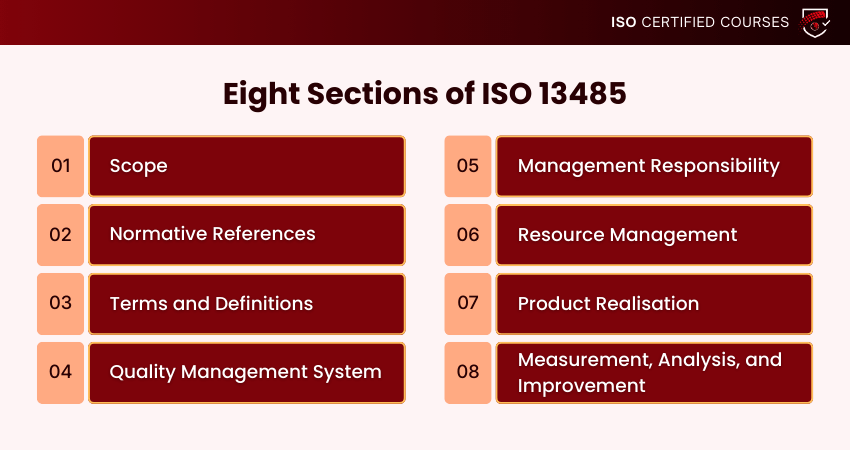
1) Scope: Outlines the purpose and applicability of the standard for organisations involved in the medical device lifecycle.
2) Normative References: Lists referenced standards or documents required for applying ISO 13485.
3) Terms and Definitions: Provides key terminology used in the standard to ensure consistent understanding.
4) Quality Management System: Outlines the general requirements for establishing and maintaining a QMS, including documentation, quality manuals, and control of records.
5) Management Responsibility: Focuses on leadership commitment, customer focus, quality policies, planning, and management reviews.
6) Resource Management: Covers the provision of resources, employee competence and training, infrastructure, and work environment needed to maintain quality.
7) Product Realisation: Addresses the processes involved in planning, designing, developing, purchasing, manufacturing, and delivering medical devices.
8) Measurement, Analysis, and Improvement:
Includes monitoring processes, customer feedback, internal audits, control of nonconforming products, and corrective or preventive actions for improvement.
5 Key Elements of ISO 13485
ISO 13485 is built around five core elements that support an effective Quality Management System (QMS) for medical devices. These elements help organisations meet ISO 13485 requirements, maintain product safety, regulatory compliance, and consistent quality. The key elements of ISO 13485 are outlined below:
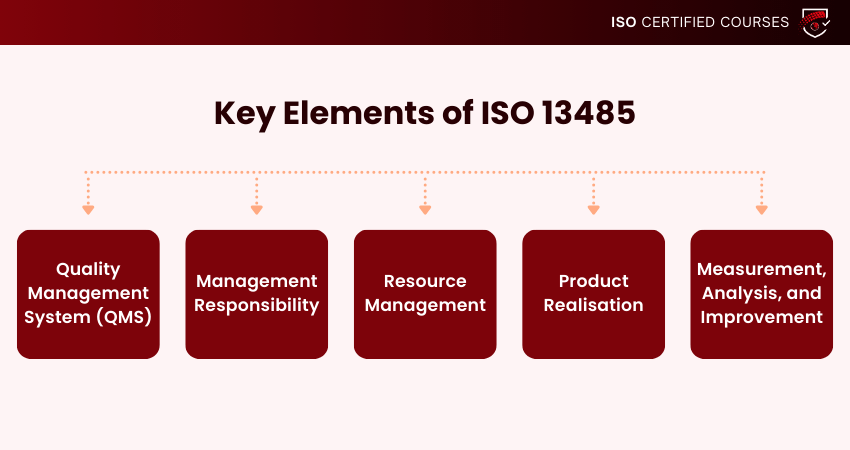
1) Quality Management System (QMS)
This element focuses on establishing and maintaining a structured Quality Management System within the organisation. It includes documented procedures, quality manuals, and records that ensure processes are controlled and consistently followed. Proper documentation helps demonstrate compliance with regulatory and quality standards.
2) Management Responsibility
Top management plays an important role in ensuring the success of the QMS. Leaders are responsible for defining quality policies, setting objectives, assigning responsibilities, and conducting regular management reviews. Strong leadership commitment helps ensure that quality and regulatory compliance remain central to organisational operations.
3) Resource Management
Organisations must provide the necessary resources to support the Quality Management System. This includes trained personnel, suitable infrastructure, equipment, and a controlled work environment. Proper resource management ensures that medical devices are developed and manufactured under reliable conditions.
4) Product Realisation
Product realisation covers the processes involved in planning, designing, developing, and manufacturing medical devices. It ensures that products meet both regulatory requirements and customer expectations. This element also includes supplier management, purchasing controls, and maintaining product traceability throughout production.
5) Measurement, Analysis, and Improvement
This element focuses on monitoring the effectiveness of the Quality Management System and determining opportunities for improvement. Organisations must evaluate performance through internal audits, customer feedback, and product monitoring, while addressing nonconforming products through corrective and preventive actions.
Gain practical skills to implement and manage ISO 13485 quality frameworks through the
ISO 13485 Lead Implementer Training
– Register now!
What are the Benefits of ISO 13485 Accreditation?
Achieving ISO 13485 accreditation offers several benefits for organisations in the medical device industry. It helps strengthen quality management practices, improve operational efficiency, and demonstrate compliance with international standards.
Key benefits of ISO 13485 accreditation include:
1) Assurance of Quality Practices: Certification demonstrates that an organisation follows recognised quality standards, assuring stakeholders of the reliability of its processes and medical devices.
2) Easier Access to Global Markets: ISO 13485 is internationally recognised, making it easier for organisations to sell medical devices in international markets.
3) Stronger Business Partnerships: Certified organisations are more likely to become preferred partners for customers and suppliers.
4) Better Opportunities in Contracts and Tenders: Many procurement processes require ISO 13485 Certification as a prerequisite for participation.
5) Competitive Advantage: Accreditation provides a reputational advantage over competitors that do not follow recognised quality standards.
6) Improved Operational Efficiency: Implementing a compliant Quality Management System helps streamline processes, reduce errors, and lower operational costs.
7) Reduced Risk of Recalls or Rework: Strong quality controls reduce the likelihood of product defects, which helps avoid costly recalls or product corrections.
8) Proactive Risk Management: Organisations can identify and manage potential risks before they impact product quality or safety.
9) Centralised Documentation and Information: Maintaining organised records creates a reliable and accessible source of information across the organisation.
10) Support for Continuous Improvement:
ISO 13485 encourages ongoing evaluation and improvement of processes to enhance overall performance.
Gain advanced auditing skills for ISO 13485 medical device quality systems through the
ISO 13485 Lead Auditor Training
– Join today!
What is the Key Difference Between ISO 13485 and ISO 9001?
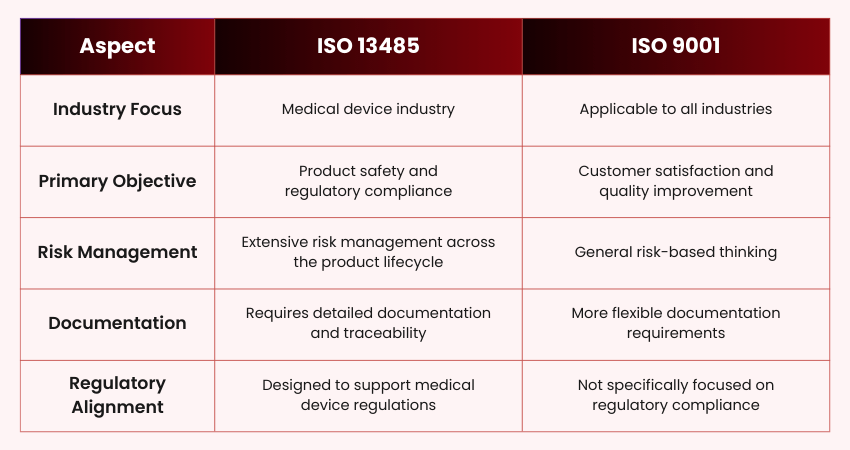
The key difference between ISO 13485 and ISO 9001 lies in their focus. ISO 13485 is a specialised Quality Management System (QMS) standard for the medical device industry, emphasising product safety, regulatory compliance, and risk management.
In contrast, ISO 9001 is a general quality management standard used across many industries and focuses on process improvement and customer satisfaction. ISO 13485 also requires stricter documentation and traceability. The main differences are shown in the table below:
Conclusion
In essence, understanding What is ISO 13485 helps organisations recognise its role in ensuring quality, safety, and regulatory compliance in the medical device industry. By implementing an ISO 13485 Quality Management System, companies can improve efficiency, strengthen quality processes, and build trust with regulators, partners, and customers while supporting global market access.
Learn ISO 13485 principles to strengthen medical device quality and safety with the ISO 13485 Training – Join now!
Search Smarter
Quickly search through our blog content for what interests you
- Top ISO 9001 Internal Audit Questions and Answers in 2026
- ISO 27005 vs ISO 31000: How to Choose the Right Risk Framework
- Challenges of ISO 14001 and How to Overcome Them
- Top 14 Benefits of ISO 45001 Certification
- What are the ISO 27001 Requirements: A Complete 2026 Guide
- 12 Benefits of ISO 27001 Certification for Business
- ISO 27001 vs ISO 27002: Key Difference and Uses Cases
- ISO 17025 vs ISO 9001: Key Differences and Similarities
- ISO 45001 Requirements for Occupational Health & Safety
- ISO 9001, 14001, and 45001: Key Differences and Similarities
- ISO 27001 vs SOC 2: Understanding Key Differences
- ISO 17025 Requirements: Explained in Detail
- What is ISO 27001 Gap Analysis? A Complete Overview
- ISO 17025: An Overview of Laboratory Accreditation
- What is ISO 27001: An Overview of the Information Security Standard
- ISO 27001 Controls from Annex A: What Changed in ISO 27001:2022?
- What is ISO 50001: Meaning, Requirements & Clauses Explained
- Top 10 Benefits of ISO 50001: A Detailed Explanation
- What is a Quality Management System (QMS): A Comprehensive Overview
- ISO 22000: Food Safety Management System Explained
- What is the Statement of Applicability (SoA) in ISO/IEC 27001?
- What is ISO 31000? The Risk Management Standard Explained
- ISO 56000: A Comprehensive Guide to Innovation Management
- What is ISO 14064? Components, Execution, and Benefits Explained
- Carbon Footprint: Definition, Types, and How to Calculate It
- ISO 22301: Requirements, Benefits and How to Implement It?
- ISO 9001 vs ISO 9002: Key Differences You Should Know
- Carbon Accounting: Meaning, Benefits, and Challenges
- Ecological Footprint: Meaning, Importance, and Purpose
- Compliance Management System: Components and How to Implement
- What is Competency Management? Benefits, Tips and Best Practices
- ISO 9001 and 27001: Quality Management vs Information Security Management
- ISO 27001 Annex A Controls: Everything You Need to Know
- ISO 27001 Audit: A Complete Guide to the Audit Process
- ISO 9001 vs ISO 14001: Key Differences and Similarities
No match found
Frequently Asked Questions
Is ISO 13485 Mandatory for Medical Devices?
ISO 13485 is not legally mandatory in all countries, but many regulators require a compliant Quality Management System for medical devices. Because ISO 13485 aligns with global regulations, it is widely accepted and often expected for market approval and regulatory compliance.
What Qualifications are Required to Become an ISO Auditor?
To become an ISO auditor, individuals must complete an accredited ISO Lead Auditor training and pass the required exams. Candidates usually need a relevant educational background, 2 to 5 years of work experience, and strong knowledge of ISO standards, auditing practices, risk assessment, and report writing.
Is ISO 13485 Required in the UK?
ISO 13485 is not strictly mandatory in the UK, but it is widely required in practice for medical devices. The UK Medical Devices Regulations 2002 require manufacturers to implement a Quality Management System (QMS). ISO 13485 is the recognised standard used to demonstrate compliance with these regulatory requirements.