
























ISO 22301: Requirements, Benefits and How to Implement It?
ISO 22301 is an international standard for Business Continuity Management Systems, providing a framework to prepare, respond and recover from disruptions. It helps organisations identify critical operations and manage risks to minimise downtime. It strengthens resilience by ensuring service continuity and efficient recovery.

Unexpected disruptions can strike any organisation, from cyber incidents to natural disasters or system failures. Without proper planning, such events can lead to operational downtime, financial loss, and reputational damage. This is where ISO 22301 plays a critical role in ensuring business continuity.
Understanding ISO 22301 helps organisations build resilience, maintain essential operations, and recover quickly from disruptions. In this blog, you will learn What is ISO 22301, its requirements, importance, implementation steps and key benefits to strengthen organisational preparedness.
What is ISO 22301?
ISO 22301 is an internationally recognised standard for Business Continuity Management Systems (BCMS). It provides a structured framework that helps organisations identify potential disruptions, assess risks, and maintain critical operations during unexpected events such as cyberattacks, natural disasters, or system failures.
The standard focuses on preparedness, response, and recovery, ensuring that businesses can minimise downtime and protect key services, stakeholders, and reputation. By implementing ISO 22301, organisations demonstrate resilience and a proactive approach to managing disruptions, strengthening stakeholder confidence and supporting long-term operational stability.
The Latest Version of the Standard
ISO 22301:2019 is the most recent version of the standard, published on 31 October 2019 as an update to ISO 22301:2012. This revised version was designed to be more streamlined and practical, making it easier for organisations to implement and align with modern business continuity.
The transition from ISO 22301:2012 to ISO 22301:2019 was initially set with a deadline of 30 April 2023, as outlined by the United Kingdom Accreditation Service (UKAS). This timeline was extended due to the COVID-19 situation, allowing organisations additional time to adapt. Overall, the updated version was well-received, with many viewing the transition as a valuable and manageable improvement.
Why is ISO 22301 Important?
ISO 22301 enables organisations to develop their capabilities for handling unanticipated disturbances while maintaining operational partnerships. It provides a structured framework that helps organisations identify risks, prepare for emergencies, and ensure that critical services continue during incidents such as cyberattacks, natural disasters, or system failures.
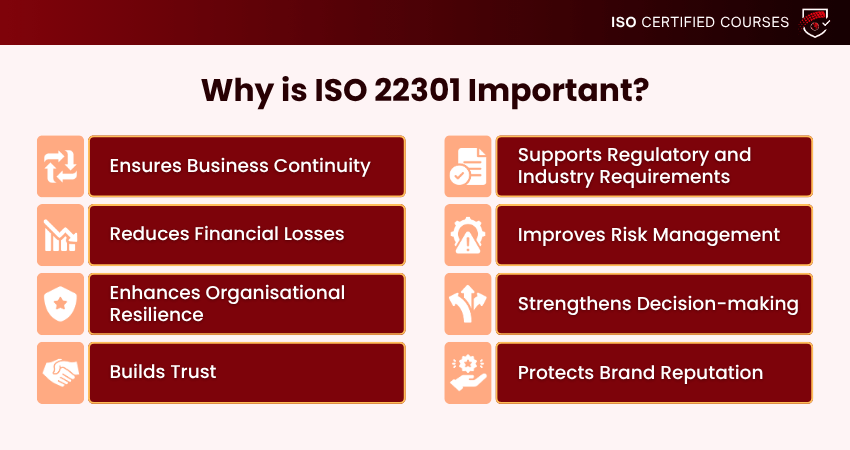
Some of the key importance of ISO 22301 standards are;
1) Ensures business continuity during disruptions and unexpected events
2) Reduces financial losses caused by operational downtime
3) Enhances organisational resilience and preparedness
4) Builds trust with customers, partners, and stakeholders
5) Supports compliance with regulatory and industry requirements
6) Improves risk management and response strategies
7) Strengthens decision-making during crisis situations
8) Protects brand reputation and customer confidence
Looking to lead audits with confidence? Master business continuity auditing with our ISO 22301 Lead Auditor Training – Register now!
How Does ISO 22301 Work?
ISO 22301 provides organisations with the framework to maintain their business operations during various disruptive events, including natural disasters and system breakdowns. The system identifies essential business functions through Business Impact Analysis (BIA) while it evaluates their associated risks.
Organisations then establish preventive controls, response procedures, and recovery plans to minimise disruption and restore services within acceptable timeframes. This helps the organisations work to keep their operations running while they complete their service restoration process.
The standard uses policies, procedures, and resources to implement these strategies effectively. Organisations develop continuity plans and allocate the necessary resources. All elements are integrated into a Business Continuity Management System. This ensures a structured and coordinated approach to managing disruptions.
Key Requirements of ISO 22301
The ISO 22301 standard establishes essential business requirements through its 10 clauses, which help enterprises develop their Business Continuity Management System. The clauses of the standard require organisations to execute their risk management programmes through established methods that protect their operations during times of crisis. The Clauses are explained in detail below:
1) Clause 1: Scope
Clause 1 defines the purpose and applicability of ISO 22301 within an organisation. It outlines the boundaries and relevance of the standard across different industries and operations. This ensures organisations understand how to apply the framework effectively.
2) Clause 2: Normative References
This clause highlights essential reference documents required for implementing ISO 22301. It ensures alignment with other relevant standards and frameworks. These references support consistency and accuracy in applying the standard.
3) Clause 3: Terms & Definitions
Clause 3 provides key terminology used throughout ISO 22301 to ensure clarity and consistency. It helps organisations understand critical concepts related to business continuity. This avoids misinterpretation during implementation and documentation.
4) Clause 4: Context of the Organisation
This clause requires organisations to understand their internal and external environment. It involves identifying stakeholders, legal requirements, and critical processes that must be maintained. Based on this, the scope of the BCMS is defined and documented.
5) Clause 5: Leadership
Clause 5 emphasises the importance of top management commitment in implementing ISO 22301. Leaders must establish policies, assign roles, and ensure adequate resources are available. Their involvement drives accountability and supports effective business continuity practices.
6) Clause 6: Planning
This clause focuses on identifying risks, opportunities, and their impact on business operations. Organisations must set measurable objectives and develop action plans to address disruptions. Proper planning ensures preparedness and compliance with regulatory requirements.
7) Clause 7: Support
Clause 7 highlights the need for resources, competence, and awareness within the organisation. It includes infrastructure, communication, training, and documented information. Ensuring proper support enables effective implementation and operation of the BCMS.
8) Clause 8: Operation
This clause covers the execution of business continuity processes and plans. It includes conducting Business Impact Analysis, risk assessments, and developing recovery strategies. Regular testing ensures that procedures are effective and ready for real-world disruptions.
9) Clause 9: Performance evaluation
Clause 9 focuses on monitoring, measuring, and evaluating the effectiveness of the BCMS. It includes internal audits and performance reviews to ensure compliance. Regular evaluation helps identify gaps and improve system performance.
Clause 10: Improvement
Clause 10 ensures continuous improvement of the BCMS by addressing non-conformities. Organisations must identify root causes and implement corrective actions. This ongoing process helps strengthen resilience and adapt to evolving risks.
Who Can Implement ISO 22301?
ISO 22301 provides flexible implementation options which organisations of every size and industry can use. The standard establishes a structured framework which enables organisations to maintain operational resilience and operational continuity throughout any business environment. It helps organisations strengthen their ability to manage disruptions effectively.
The following types of organisations can implement ISO 22301 based on their operational organisations:
1) Small and Medium-sized Enterprises (SMEs): Small and medium-sized enterprises can use ISO 22301 to protect their business operations while handling operational interruptions. It establishes structured continuity frameworks which help organisations function during emergency situations.
2) Large Enterprises: ISO 22301 enables large organisations to handle their complex business operations through effective management. It establishes standardised procedures which help multiple departments and locations work together efficiently.
3) Government and Public Sector Organisations: Public sector bodies can implement ISO 22301 to maintain essential services during disruptions. The system establishes reliable operations which generate public confidence among both citizens and stakeholders.
4) Financial and Banking Institutions: Financial organisations use ISO 22301 to ensure service continuity and resilience. The system improves risk management operations while it builds customer trust.
5) Healthcare Organisations: Healthcare providers use ISO 22301 to deliver their essential medical services without interruption. The system enables hospitals to prepare for emergencies while protecting patients during unexpected situations.
6) IT and Technology Companies: ISO 22301 provides technology companies with essential tools to handle potential system failures. The system enables organisations to recover from failures while their digital services continue to function.
7) Manufacturing and Supply Chain Businesses: ISO 22301 helps manufacturing organisations maintain operational productivity while they handle production interruptions.
Enhance your auditing skills and ensure compliance within your organisation with our ISO 22301 Internal Auditor Training – Join today!
How to Implement ISO 22301?
Implementing ISO 22301 requires a structured approach to establish and maintain an effective Business Continuity Management System (BCMS). By following a clear and systematic process, organisations can identify risks, develop continuity strategies, and maintain operational resilience during disruptions. The following key steps outline how ISO 22301 can be implemented effectively:
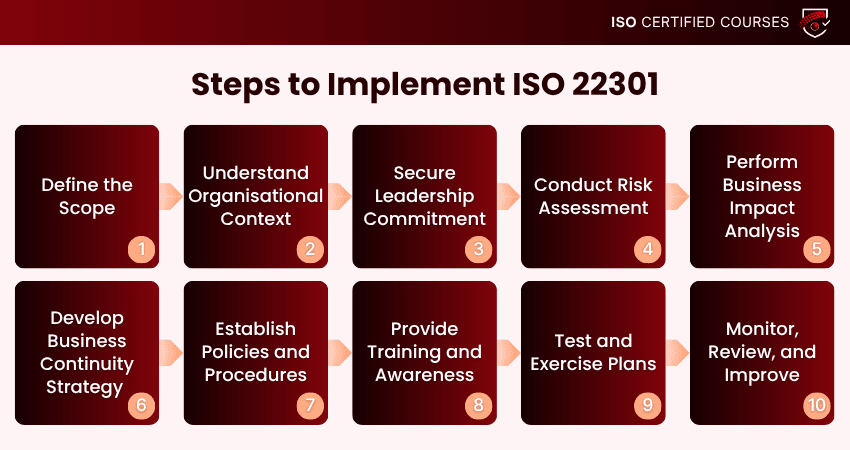
1) Define the Scope
Defining the scope involves identifying the boundaries of the BCMS, including key processes, services, and operational locations. It ensures clarity on what areas of the organisation are covered under the system. This step helps align organisational continuity objectives with organisational priorities.
2) Understand Organisational Context
Organisations must be aware of the internal and external factors that may affect operational performance. This includes identifying stakeholders, regulatory requirements, and potential risks. Understanding context ensures that the BCMS is relevant and aligned with business objectives.
3) Secure Leadership Commitment
Top management support is essential for successful implementation. Leaders must provide direction, allocate resources, and promote a culture of continuity. Their involvement ensures accountability and drives the effectiveness of the BCMS.
4) Conduct Risk Assessment
This step involves identifying potential threats that could disrupt operations. Organisations must evaluate the likelihood and impact of these risks. Risk assessment helps prioritise actions and develop appropriate mitigation strategies. This step should also include conducting a Business Impact Analysis (BIA).
5) Perform Business Impact Analysis
Business Impact Analysis helps determine critical activities and acceptable downtime for each function. It evaluates the operational, financial, and legal impact of disruptions. This information is essential for developing effective recovery strategies.
6) Develop Business Continuity Strategy
Based on risk assessment and BIA findings, organisations must define strategies to prevent and respond to disasters. This includes mitigation, response, and recovery plans. A well-defined strategy ensures continuity of critical operations.
7) Establish Policies and Procedures
Organisations need to document business continuity policies and roles clearly. This ensures consistency and clarity in managing disruptions. Proper documentation supports effective communication and implementation.
8) Provide Training and Awareness
Employees must be trained to understand their roles in business continuity. Awareness programmes ensure that staff can respond effectively during incidents. This improves preparedness and reduces response time during disruptions.
9) Test and Exercise Plans
Regular testing of continuity plans ensures their effectiveness and reliability. Organisations should conduct drills and simulations to identify and refine strategies and improve readiness for real-world scenarios.
10) Monitor, Review, and Improve
Continuous monitoring and evaluation are essential for maintaining an effective BCMS. Organisations must review performance, address gaps, and implement. This ensures the system remains relevant and effective over time.
Benefits of ISO 22301 for Business Continuity Standard
The wide range of ISO 22301 benefits help organisations prepare for disruptions, maintain operations, and remain resilient. It strengthens resilience while improving governance, risk management, and overall business performance.
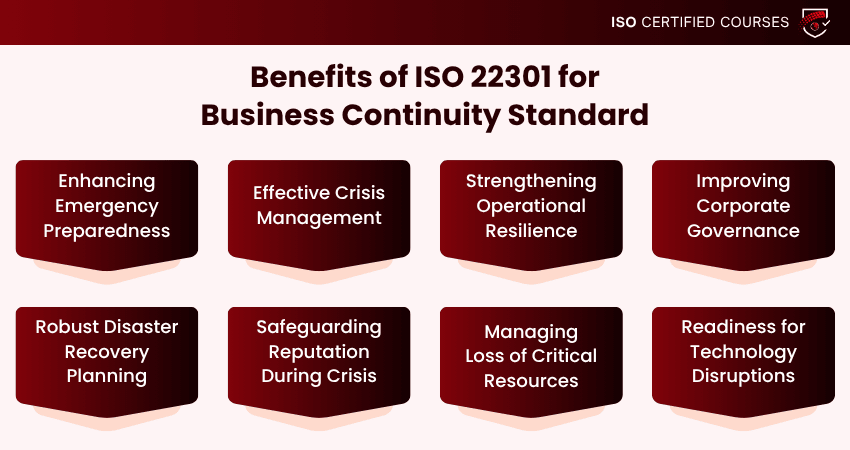
1) Enhancing Emergency Preparedness
ISO 22301 enables organisations to prepare effectively for unexpected disruptions to their critical business activities and potential risks. It supports proactive planning and ensures that appropriate response strategies are in place. This reduces uncertainty and helps organisations act quickly during emergencies.
2) Effective Crisis Management
The standard supports structured and timely crisis management by defining clear roles and responsibilities. It ensures organisations can respond to incidents in a coordinated and consistent manner. This helps minimise damage to operations, finances, and overall business operations.
3) Strengthening Operational Resilience
ISO 22301 strengthens operational resilience by ensuring organisations can continue essential functions during disruption and maintain stability even during major incidents or unexpected events. This reduces downtime and improves the organisation's ability to recover quickly.
4) Improving Corporate Governance
Implementing ISO 22301 supports better corporate governance by aligning business continuity with regulatory and organisational requirements. It demonstrates accountability and organisational structured risk management. This enhances transparency and strengthens overall management practices.
5) Robust Disaster Recovery Planning
The standard ensures organisations have effective disaster recovery plans in place after disruptions. It focuses on returning to normal operations as quickly as possible. This reduces the long-term impact of incidents and improves recovery efficiency.
6) Safeguarding Reputation During Crisis
ISO 22301 helps protect an organisation's reputation by demonstrating its ability to manage effectively. Certification shows stakeholders that proper systems and processes are in place. This builds trust and confidence among customers, partners, and regulators.
7) Managing Loss of Critical Resources
The standard prepares organisations to handle the sudden loss of critical resources, systems, or infrastructure. It ensures contingency plans are in place to maintain continuity. This reduces operational risks and supports uninterrupted service delivery.
8) Readiness for Technology Disruptions
ISO 22301 ensures organisations are prepared for technology failures such as system or data loss. It establishes measures to minimise disruption and recover systems quickly. This improves efficiency and protects business operations from digital risks.
Conclusion
ISO 22301 provides a structured approach to managing business continuity and ensuring organisational resilience during disruptions. It helps manage organisational risks, maintain critical operations, and respond to unexpected events. By implementing this standard, businesses can strengthen governance, improve preparedness, and build stakeholder trust. Overall, understanding what is ISO 22301 supports long-term stability and sustainable business performance.
Strengthen your business continuity skills and learn to manage disruptions effectively with our ISO 22301 Training – Join today!
Search Smarter
Quickly search through our blog content for what interests you
- Top ISO 9001 Internal Audit Questions and Answers in 2026
- ISO 27005 vs ISO 31000: How to Choose the Right Risk Framework
- Challenges of ISO 14001 and How to Overcome Them
- Top 14 Benefits of ISO 45001 Certification
- What are the ISO 27001 Requirements: A Complete 2026 Guide
- 12 Benefits of ISO 27001 Certification for Business
- ISO 27001 vs ISO 27002: Key Difference and Uses Cases
- ISO 17025 vs ISO 9001: Key Differences and Similarities
- ISO 45001 Requirements for Occupational Health & Safety
- ISO 9001, 14001, and 45001: Key Differences and Similarities
- ISO 27001 vs SOC 2: Understanding Key Differences
- ISO 17025 Requirements: Explained in Detail
- What is ISO 27001 Gap Analysis? A Complete Overview
- ISO 17025: An Overview of Laboratory Accreditation
- What is ISO 27001: An Overview of the Information Security Standard
- ISO 27001 Controls from Annex A: What Changed in ISO 27001:2022?
- What is ISO 50001: Meaning, Requirements & Clauses Explained
- Top 10 Benefits of ISO 50001: A Detailed Explanation
- What is a Quality Management System (QMS): A Comprehensive Overview
- ISO 22000: Food Safety Management System Explained
- What is the Statement of Applicability (SoA) in ISO/IEC 27001?
- What is ISO 31000? The Risk Management Standard Explained
- What Is ISO 13485? Understanding Its 8 Key Sections
- ISO 56000: A Comprehensive Guide to Innovation Management
- What is ISO 14064? Components, Execution, and Benefits Explained
- Carbon Footprint: Definition, Types, and How to Calculate It
- ISO 9001 vs ISO 9002: Key Differences You Should Know
- Carbon Accounting: Meaning, Benefits, and Challenges
- Ecological Footprint: Meaning, Importance, and Purpose
- Compliance Management System: Components and How to Implement
- What is Competency Management? Benefits, Tips and Best Practices
- ISO 9001 and 27001: Quality Management vs Information Security Management
- ISO 27001 Annex A Controls: Everything You Need to Know
- ISO 27001 Audit: A Complete Guide to the Audit Process
- ISO 9001 vs ISO 14001: Key Differences and Similarities
No match found
Frequently Asked Questions
Is ISO 22301 a Legal Requirement?
ISO 22301 is not a legal requirement, but it is highly recommended for organisations that want to improve resilience and meet industry standards. It may also support meeting regulatory or contractual requirements in certain sectors.
What are Business Continuity Risks?
Business continuity risks refer to potential events that can disrupt operations, such as natural disasters, cyberattacks, system failures, or supply chain issues. Identifying and managing these risks is essential for maintaining critical operations and reducing downtime.
What is the Difference Between ISO 22301 and 27001?
ISO 22301 focuses on business continuity and maintaining operations
during disruptions, while ISO 27001 focuses on information security and
protecting data from threats. Both standards complement each other and can be
implemented together for stronger organisational resilience and risk
management.