







ISO 9001 vs ISO 14001: Key Differences and Similarities
Compare ISO 9001 vs ISO 14001 to understand their key differences, similarities, and how each standard supports quality and Environmental Management. ISO 9001 focuses on Quality Management to ensure customer satisfaction, while ISO 14001 focuses on Environmental Management to reduce ecological impact and ensure regulatory compliance.

Delivering consistent quality and operating sustainably are two key priorities for modern organisations. That's where ISO 9001 and ISO 14001 come in. While ISO 9001 focuses on improving quality and customer satisfaction, ISO 14001 helps businesses minimise environmental impact and achieve sustainability goals.
So, which standard is right for your organisation? In this blog, we'll compare ISO 9001 vs ISO 14001, exploring their key differences, similarities, benefits, and how each supports long-term business success. So read on and make the right pick for lasting success!
Table of Contents
1) What is ISO 9001?
2) What is ISO 14001?
3) The Difference Between ISO 9001 and ISO 14001
4) Similarities Between ISO 9001 and ISO 14001
5) Can You Implement ISO 9001 and ISO 14001 Together?
6) Common Challenges of Implementing ISO 9001 and ISO 14001
7) Real-World Examples of ISO 9001 and ISO 14001 Implementation
8) Conclusion
What is ISO 9001?
ISO 9001 is an internationally recognised standard pertaining to Quality Management Systems (QMS) that helps organisations consistently deliver products and services that meet or even exceed customer and regulatory requirements. It focuses on improving processes, enhancing customer satisfaction, and driving continual improvement through a structured management approach.
Applicable to organisations of every industry and size, ISO 9001 promotes efficiency, reduces errors, and supports long-term business success by embedding quality into everyday operations.
What is ISO 14001?
ISO 14001 is an internationally recognised standard pertaining to Environmental Management Systems (EMS) that helps organisations manage their environmental responsibilities effectively. It provides a structured framework for reducing environmental impact, meeting legal and regulatory requirements, and supporting continual environmental improvement.
Suitable for organisations of every size and industry, ISO 14001 promotes sustainable practices, improves resource efficiency, reduces waste, and helps businesses demonstrate their commitment to environmental responsibility.
Difference Between ISO 9001 and ISO 14001
Below are the key differences between ISO 9001 and ISO 14001:
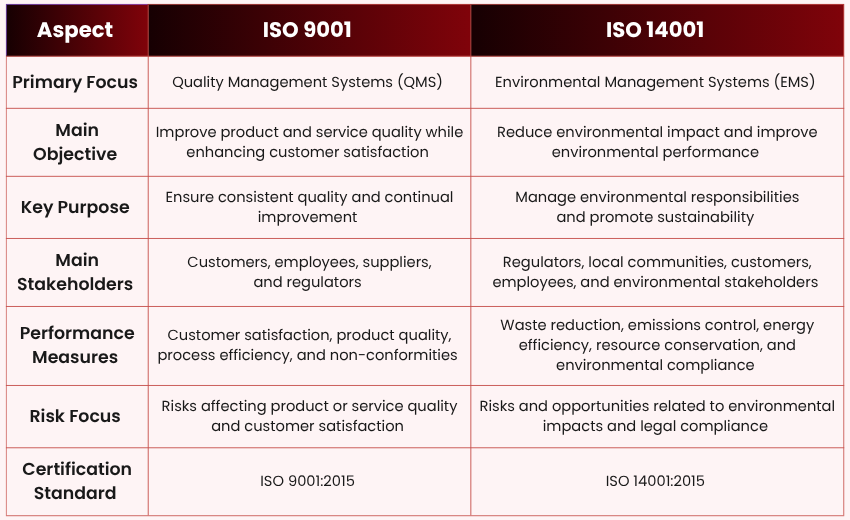
1) Primary Focus: ISO 9001 focuses on setting up a Quality Management System (QMS) to make sure services and products meet or exceed customer and legal requirements. ISO 14001 focuses on creating an Environmental Management System (EMS) to help organisations manage their environmental responsibilities and mediate their impact on the environment.
2) Main Objective: The main goal of ISO 9001 is to amplify ove the quality of products and services while increasing customer satisfaction through consistent processes and continuous improvement. The main goal of ISO 14001 is to improve environmental performance by reducing waste, preventing pollution, conserving resources, and following environmental laws.
3) Key Purpose: ISO 9001 helps organisations deliver consistent quality, increase efficiency, and build customer trust. ISO 14001 helps organisations identify and reduce the environmental impact of their activities while supporting sustainable business practices.
4) Main Stakeholders: ISO 9001 mainly focuses on customers, employees, suppliers, and regulatory authorities. ISO 14001 has a broader focus that includes environmental regulators, local communities, customers, employees, and anyone affected by the organisation's environmental performance.
5) Performance Measures: Success in ISO 9001 is measured through factors such as customer satisfaction, product quality, process efficiency, and fewer defects. For ISO 14001, performance is measured through environmental results such as reduced waste, lower emissions, improved energy efficiency, better resource use, and compliance with environmental regulations.
6) Risk Focus: ISO 9001 focuses on risks that could affect product quality, service delivery, and customer satisfaction. ISO 14001 focuses on environmental risks such as pollution, resource consumption, climate-related impacts, and legal compliance.
7) Certification Standard: ISO 9001 certification is based on the ISO 9001:2015 standard for Quality Management Systems. ISO 14001 certification is based on the ISO 14001:2015 standard for Environmental Management Systems.
Both ISO 9001 and ISO 14001 can be used by organisations of any size and in any industry. However, ISO 9001 is mainly used to improve Quality Management and consequently boost customer satisfaction, while ISO 14001 is used to improve Environmental Management and support sustainability goals.
Learn to identify opportunities and strengthen quality systems through effective internal audits. Sign up for our ISO 9001 Internal Auditor Training – Register now!
Similarities Between ISO 9001 and ISO 14001
Although ISO 9001 and ISO 14001 have different objectives, they share several core principles that make them compatible and easy to integrate into a single management system.
1) Common High-level Structure
Both standards follow the Annex SL high-level structure, making them easy to implement together. They share similar clauses, terminology, and documentation requirements. This consistency simplifies integration and reduces duplication across management systems.
2) Focus on Continual Improvement
ISO 9001 and ISO 14001 promote continual improvement rather than one-time compliance. Organisations are expected to monitor performance, identify opportunities for improvement, and take corrective actions. This helps maintain long-term effectiveness.
3) Leadership and Organisational Commitment
Strong leadership is a key requirement in both standards. Top management must establish policies, define objectives, and provide the resources needed for successful implementation. Leadership also drives a culture of accountability and improvement.
4) Risk-based Thinking
Both standards encourage organisations to identify risks and opportunities before they affect performance. This proactive approach helps prevent issues rather than simply reacting to them. It also supports informed decision-making.
5) Documented Information
Both standards require organisations to maintain documented information to support their management systems. Clear documentation improves consistency, traceability, and compliance. It also makes audits more efficient.
6) Internal Audits and Management Reviews
Regular internal audits are essential for evaluating how well the management system is performing. Management reviews help assess objectives, monitor progress, and identify areas for improvement. Together, they support continual compliance and better decision-making.
7) Employee Involvement and Awareness
Both ISO 9001 and ISO 14001 recognise the importance of employee participation. Staff should understand their roles, responsibilities, and the organisation's objectives. Well-trained employees contribute to stronger system performance.
8) Improved Organisational Performance
Implementing either standard helps organisations improve efficiency and establish consistent processes. Together, they strengthen operational performance, increase stakeholder confidence, and support sustainable business growth.
Build a greener future with our ISO 14001 Training and learn how to drive environmental excellence in every process, Sign up now!
Can ISO 9001 and ISO 14001 Be Implemented Together?
Yes, organisations can implement ISO 9001 and ISO 14001 together through an Integrated Management System (IMS). Since both standards follow the Annex SL high-level structure, they share common requirements such as leadership, risk-based thinking, documented information, internal audits, and continual improvement, making integration efficient and cost-effective.
Implementing both standards together helps organisations streamline processes, reduce duplication, improve operational efficiency, and simplify compliance. It also enables businesses to enhance product and service quality while strengthening environmental performance, delivering greater value to customers, stakeholders, and the organisation as a whole.
Common Challenges of Implementing ISO 9001 and ISO 14001
Implementing ISO 9001 and ISO 14001 often face practical challenges during adoption. Understanding these obstacles early helps ensure a smoother implementation and long-term success. The common challenges are mentioned below:
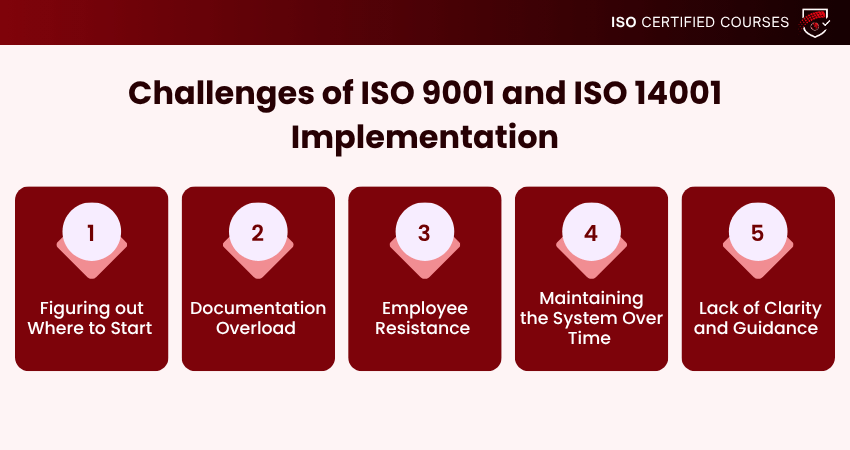
1) Figuring out Where to Start
Many organisations struggle to identify their current level of compliance and determine the steps needed for certification. Conducting a gap analysis and creating a structured implementation plan helps establish a clear starting point.
2) Documentation Overload
Both standards require documented processes, policies, and records, which can seem overwhelming at first. Keeping documentation clear, relevant, and well-organised makes the system easier to manage and maintain.
3) Employee Resistance
Employees may show hesitancy towards embracing new processes or view the standards as additional work. Providing training, communicating the benefits, and involving staff throughout implementation encourages greater engagement and acceptance.
4) Maintaining the System Over Time
Achieving certification is only the beginning, as both standards require continual improvement and regular reviews. Internal audits, management reviews, and ongoing monitoring help keep the management system effective and compliant.
5) Lack of Clarity and Guidance
Interpreting ISO requirements without sufficient expertise can lead to confusion and inconsistent implementation. Seeking guidance from experienced professionals, training providers, or consultants helps organisations apply the standards correctly and confidently.
Implement and improve Quality Management systems with confidence through our ISO 9001 Lead Implementer Training – Join now!
Real-world Examples of ISO 9001 and ISO 14001 Implementation
Organisations across various industries use ISO 9001 and ISO 14001 to improve operational performance, strengthen compliance, and build stakeholder confidence. While ISO 9001 focuses on quality and customer satisfaction, ISO 14001 helps organisations minimise environmental impact and support sustainable business practices.
1) Manufacturing: Companies use ISO 9001 to improve product quality and reduce defects, while ISO 14001 helps minimise waste, optimise resource use, and comply with environmental regulations.
2) Construction: Businesses implement ISO 9001 to ensure consistent project delivery and customer satisfaction, alongside ISO 14001 to manage environmental risks, reduce pollution, and improve site sustainability.
3) Healthcare: Healthcare providers apply ISO 9001 to standardise processes and enhance patient care, while ISO 14001 supports better waste management and environmental compliance.
4) Service Organisations: Service providers use ISO 9001 to improve service consistency and customer experience, while ISO 14001 helps reduce resource consumption and promote environmentally responsible operations.
5) Logistics and Transport: Organisations implement ISO 9001 to streamline operations and improve service reliability, whereas ISO 14001 supports initiatives to reduce emissions, manage fuel consumption, and improve environmental performance.
Conclusion
Choosing between ISO 9001 vs ISO 14001 depends on your organisation's goals, but both standards provide a strong foundation for continual improvement and long-term success. While ISO 9001 enhances quality and customer satisfaction, ISO 14001 strengthens environmental performance and sustainability. Many organisations achieve the greatest value by implementing both standards together, creating an integrated management system that improves efficiency, supports compliance and builds lasting trust with customers and stakeholders.
Achieve operational excellence with the best ISO 9001 Training - Join now!
Search Smarter
Quickly search through our blog content for what interests you
- Top ISO 9001 Internal Audit Questions and Answers in 2026
- ISO 27005 vs ISO 31000: How to Choose the Right Risk Framework
- Challenges of ISO 14001 and How to Overcome Them
- Top 14 Benefits of ISO 45001 Certification
- What are the ISO 27001 Requirements: A Complete 2026 Guide
- 12 Benefits of ISO 27001 Certification for Business
- ISO 27001 vs ISO 27002: Key Difference and Uses Cases
- ISO 17025 vs ISO 9001: Key Differences and Similarities
- ISO 45001 Requirements for Occupational Health & Safety
- ISO 9001, 14001, and 45001: Key Differences and Similarities
- ISO 27001 vs SOC 2: Understanding Key Differences
- ISO 17025 Requirements: Explained in Detail
- What is ISO 27001 Gap Analysis? A Complete Overview
- ISO 17025: An Overview of Laboratory Accreditation
- What is ISO 27001: An Overview of the Information Security Standard
- ISO 27001 Controls from Annex A: What Changed in ISO 27001:2022?
- What is ISO 50001: Meaning, Requirements & Clauses Explained
- Top 10 Benefits of ISO 50001: A Detailed Explanation
- What is a Quality Management System (QMS): A Comprehensive Overview
- ISO 22000: Food Safety Management System Explained
- What is the Statement of Applicability (SoA) in ISO/IEC 27001?
- What is ISO 31000? The Risk Management Standard Explained
- What Is ISO 13485? Understanding Its 8 Key Sections
- ISO 56000: A Comprehensive Guide to Innovation Management
- What is ISO 14064? Components, Execution, and Benefits Explained
- Carbon Footprint: Definition, Types, and How to Calculate It
- ISO 22301: Requirements, Benefits and How to Implement It?
- ISO 9001 vs ISO 9002: Key Differences You Should Know
- Carbon Accounting: Meaning, Benefits, and Challenges
- Ecological Footprint: Meaning, Importance, and Purpose
- Compliance Management System: Components and How to Implement
- What is Competency Management? Benefits, Tips and Best Practices
- ISO 9001 and 27001: Quality Management vs Information Security Management
- ISO 27001 Annex A Controls: Everything You Need to Know
- ISO 27001 Audit: A Complete Guide to the Audit Process
No match found
Frequently Asked Questions
Does ISO 14001 Focus on Product Quality?
No, ISO 14001 does not focus on product quality. It's the international standard for Environmental Management Systems (EMS). It helps organisations clamp down on their environmental impact, improve resource efficiency, minimise waste, and comply with environmental regulations through a structured management framework.
What are the Common Requirements of ISO 9001 And ISO 14001?
ISO 9001 and ISO 14001 share common requirements as both standards follow ISO's harmonised high-level structure. These requirements are:
a) Context of the organisation
b) Leadership and commitment
c) Risk-based planning
d) Support and resources
e) Operational control
f) Performance evaluation
g) Continual improvement
h) Documented information
What is the Difference Between Quality Risks and Environmental Risks in ISO standards?
Although both ISO 9001 and ISO 14001 require organisations to identify and manage risks, they focus on different areas. Quality risks affect an organisation's ability to consistently deliver great products or services that exceed customer and regulatory requirements. Environmental risks relate to an organisation's impact on the environment.