



ISO 9001 and 27001: Quality Management vs Information Security Management
ISO 9001 focuses on Quality Management and ISO 27001 focuses on Information Security Management; both improve business performance and operational efficiency. ISO 9001 improves process and service quality, whereas ISO 27001 protects sensitive data and reduces security risks. Together, they build trust and improve operational performance.

What matters more for a business today: delivering quality services or protecting customer data? The answer is both. Customers expect organisations to provide reliable products and services. They also expect businesses to protect sensitive information from security threats and data breaches. To meet these expectations, you might require ISO 9001 and ISO 27001.
These standards help you manage quality deliveries while protecting data and strengthening security practices. In this blog, we will discover what are ISO 9001 and 27001, their differences, similarities and benefits to understand how both standards support long-term business success. Let's dive in!
Understanding ISO 9001 and ISO 27001
ISO 9001 and ISO 27001 are two widely used international standards designed to improve organisational performance. Although both follow a similar management system structure, they focus on different areas of business operations. Understanding their purpose and objectives helps organisations implement the right standard for long-term business growth.
What is ISO 9001?
ISO 9001 is an internationally recognised standard for Quality Management Systems. It provides a structured framework that helps organisations consistently deliver products and services that meet customer and regulatory requirements. Organisations implementing ISO 9001 aim to improve operational efficiency, reduce errors and enhance customer satisfaction.
What is ISO 27001?
ISO 27001 is the leading international standard for Information Security Management Systems (ISMS). It helps organisations identify, manage and reduce information security risks. It focuses on protecting sensitive information, whether it is digital, physical, financial or intellectual property. It also aims to reduce the likelihood of data breaches, cyberattacks, and unauthorised access.
ISO 9001 vs ISO 27001: Core Differences
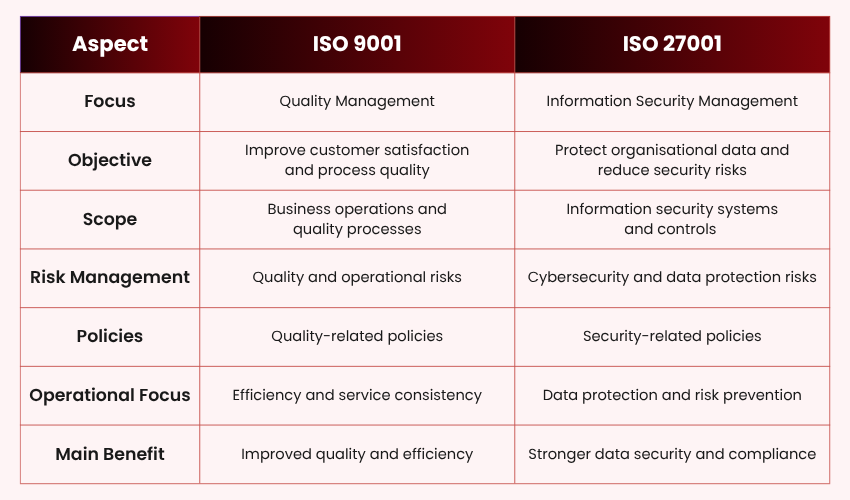
Although ISO 9001 vs 27001 follow a similar management system structure, their objectives and operational focus are different. Understanding these core differences helps organisations choose the right standard based on their business priorities and requirements. So, let’s check their core differences:
1) Scope
The biggest difference between ISO 9001 and ISO 27001 lies in their scope. ISO 9001 focuses on overall Quality Management across business processes. Its primary goal is to improve customer satisfaction by ensuring products and services consistently meet expectations.
On the other hand, ISO 27001 specifically addresses Information Security Management. It is designed to protect organisational data, manage information risks, and ensure the confidentiality, integrity, and availability of information assets.
2) Leadership Involvement
Both ISO 9001 and ISO 27001 standards require strong leadership involvement, but the focus differs. In ISO 9001, leadership ensures quality objectives align with business goals and customer expectations. Senior management needs to foster a quality culture and allocate resources for continual improvement.
In contrast, ISO 27001 requires leadership to establish information security objectives and support governance frameworks. This involves a more risk-focused approach, with closer oversight of security controls, compliance requirements, and threat management.
3) Policies
ISO 9001 requires organisations to create quality-related policies that support continuous improvement. It also allows you to design policies based on the business’s operational needs and quality objectives.
ISO 27001, however, requires organisations to develop security-specific policies. The documentation requirements in ISO 27001 are often focused more on security aspects and are technically detailed compared to ISO 9001.
4) Defined Controls
ISO 9001 does not prescribe specific operational controls. Instead, organisations determine processes and controls based on quality objectives. They may include controls like process monitoring, quality inspections, supplier evaluations and corrective action procedures.
But ISO 27001 includes a detailed set of security controls aimed at protecting information assets and reducing cybersecurity risks. These controls cover access management, encryption, network security, incident response and physical security.
5) Resource Management
ISO 9001 focuses on managing resources that improve quality and operational efficiency. This includes employee competence, infrastructure, equipment, and monitoring systems.
On the contrary, ISO 27001 places greater emphasis on resources that protect information assets. Organisations must ensure secure technologies, skilled personnel, cyber security awareness and incident response capabilities are in place.
6) Operational Focus
ISO 9001 primarily focuses on improving product quality, customer satisfaction and process consistency across the organisation. Businesses concentrate on streamlining workflows, improving service delivery and ensuring continuous improvement in operational performance.
ISO 27001, in contrast, focuses on protecting sensitive information and maintaining confidentiality, integrity and availability. It encourages organisations to implement proactive security measures and maintain ongoing monitoring of information systems.
Support quality compliance and continual improvement with
ISO 9001 Internal Auditor Training
– Register today!
Clause-based Comparison of ISO 9001 and ISO 27001
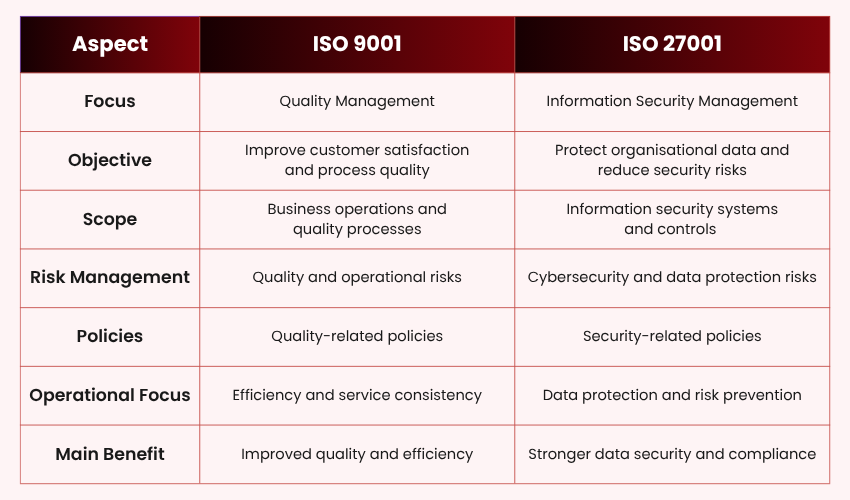
The purpose and implementation of ISO 9001 and ISO 27001 clauses differ significantly. Understanding the clause-based differences helps organisations identify how each standard supports its specific operational and compliance goals. Let's have the comparison:
Clause 4: Organisational Context
In ISO 9001, organisations identify internal and external factors affecting quality objectives and customer satisfaction. Organisations can define the scope of the Quality Management System (QMS) and establish processes that support quality objectives.
In ISO 27001, organisations identify factors affecting information security risks, compliance obligations and data protection requirements. The clause places greater emphasis on risk exposure and data protection requirements.
Clause 5: Leadership
The leadership responsibilities of ISO 9001 include:
1) Establishing quality policies
2) Supporting customer focus
3) Promoting continual improvement
4) Assigning quality responsibilities
The leadership responsibilities of ISO 27001 include:
1) Establishing information security policies
2) Supporting risk management
3) Allocating security resources
4) Ensuring accountability for information protection
Clause 6: Planning
In ISO 9001, planning focuses on identifying opportunities and risks that may affect product or service quality. Organisations establish measurable quality objectives and create action plans to improve operational performance and customer satisfaction.
In ISO 27001, planning revolves around information security risk assessment and treatment. Organisations identify security threats, evaluate vulnerabilities and implement controls to minimise risks. The planning process is more detailed because it addresses cyber threats, data breaches and regulatory obligations.
Clause 7: Support
Clause 7 in ISO 9001 focuses on providing resources, employee competence, communication and documented information necessary to maintain quality standards. Organisations ensure staff are properly trained and supported to achieve consistent operational outcomes.
ISO 27001 focuses on the resources required to maintain information security controls and awareness. This includes cybersecurity training, security communication, technical infrastructure, and documentation related to risk management and security procedures.
Clause 8: Operations
The operational requirements of ISO 9001 focus on:
1) Product and service delivery
2) Process control
3) Customer requirements
4) Supplier management
5) Quality Assurance (QA)
The operational requirements of ISO 27001 focus on:
1) Risk treatment implementation
2) Access control and backup processes
3) Incident response
4) Monitoring security activities
5) Managing security changes
Clause 9: Performance Evaluation
In ISO 9001, performance evaluation measures customer satisfaction, process effectiveness, product quality, and overall QMS performance. Internal audits, management reviews and performance metrics are used to identify areas for improvement.
In ISO 27001, performance evaluation focuses on monitoring the effectiveness of information security controls and risk management processes. Organisations assess security incidents, vulnerabilities, compliance performance, and audit results to ensure the ISMS remains effective against evolving threats.
Clause 10: Improvement
ISO 9001 focuses on continual improvement of quality processes, customer satisfaction and operational efficiency. Organisations identify nonconformities, implement corrective actions and improve business performance over time.
ISO 27001 focuses on improving the organisation’s information security posture through continual monitoring, incident response improvements, corrective actions and updated risk treatments. The objective is to strengthen security resilience and adapt to changing cybersecurity risks.
Align quality objectives with organisational goals effectively with ISO 9001 Lead Implementer Training – Sign up soon!
Similarities Between ISO 9001 and ISO 27001
Despite their differences, ISO 9001 vs ISO 27001 share several important similarities because both are based on management system principles. Here are the similarities between them:
1) Organisational Context
Both standards require organisations to understand internal and external issues affecting their management systems. Businesses must evaluate:
1) Organisational goals
2) Industry conditions
3) Stakeholder expectations
4) Regulatory requirements
2) Interested Parties
ISO 9001 and ISO 27001 both require organisations to identify their stakeholders and understand their expectations. People involved in implementing these standards may include:
1) Customers
2) Employees
3) Suppliers
4) Regulators
5) Investors
6) Business partners
3) Responsibility Allocation
Both ISO 9001 and ISO 27001 require organisations to clearly define responsibilities and authorities within the management system. Businesses must ensure employees understand their roles and contribute towards organisational objectives. Employees must understand:
1) Their responsibilities
2) Reporting structures
3) Compliance expectations
4) Escalation procedures
4) Competence, Awareness, Communication, and Documentation
Organisations must ensure that their employees are trained, informed and capable of performing their assigned responsibilities effectively. Key areas to focus on include:
1) Skill development and competency evaluation
2) Awareness of organisational policies and objectives
3) Clear communication across departments and teams
4) Controlled documentation and version management
5) Maintenance of accurate operational records
6) Accessibility of procedures and work instructions
5) Compliance Maintenance
ISO 9001 and ISO 27001 both require organisations to maintain ongoing compliance with legal, regulatory, and organisational requirements. Compliance activities often include:
1) Regulatory monitoring
2) Policy updates
3) Risk reviews
4) Process evaluations
5) Compliance reporting
6) Continual improvement activities
6) Internal Audits and Management Reviews
Both standards require organisations to conduct internal audits and management reviews to evaluate system effectiveness and identify improvement opportunities. Common activities include:
1) Performance reviews
2) Management meetings
3) Nonconformity tracking
4) Process evaluations
5) Improvement planning
7) Corrective Actions
Both ISO 9001 and ISO 27001 require organisations to take corrective actions when issues or nonconformities are identified. Businesses need to investigate root causes, implement solutions and prevent similar problems from recurring. Corrective action activities generally include:
1) Issue identification
2) Root cause analysis
3) Corrective action planning
4) Implementation of solutions
5) Performance monitoring
6) Preventive improvement measures
Benefits of Integrating ISO 9001 and ISO 27001
Now, let’s check the benefits that you will gain through integrating ISO 9001 and ISO 27001:
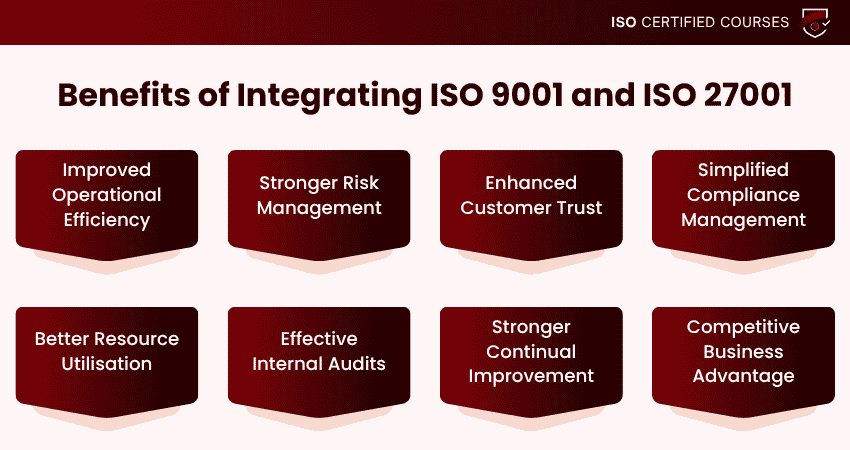
1) Improved Operational Efficiency: Integrating both standards helps organisations streamline processes, reduce duplication of work and manage operations through a unified management system.
2) Stronger Risk Management: Businesses can manage both quality-related and information security risks together, creating a more balanced and proactive approach to organisational risk control.
3) Enhanced Customer Trust: Combining Quality Management with information security shows commitment to both customer satisfaction and data protection, helping build stronger customer confidence.
4) Simplified Compliance Management: An integrated system makes it easier to manage legal, regulatory and contractual requirements by aligning documentation, audits and compliance activities.
5) Better Resource Utilisation: Organisations can optimise the use of employees, technology, training and management resources by handling multiple standards within a single framework.
6) Effective Internal Audits: Integrated audits reduce repetition and allow organisations to evaluate quality and security performance simultaneously, saving time and effort.
7) Stronger Continual Improvement: Both standards promote continual improvement and integration helps organisations improve operational performance, customer service and information security together.
8) Competitive Business Advantage: Holding both ISO 9001 and 27001 certifications strengthens market reputation and can improve opportunities for partnerships, contracts and customer acquisition.
Conclusion
Both ISO 9001 and ISO 27001 standards play an important role in helping organisations improve overall business performance. With consistent quality delivery of ISO 9001 and data protection and cybersecurity resilience of ISO 27001, businesses can have a balanced framework that supports long-term business growth. For businesses operating in a data-driven environment, integrating these standards creates a secure, reliable, and customer-focused organisation.
Understand how effective Quality Management Systems support business growth with ISO 9001 Foundation Training – Join now!
Search Smarter
Quickly search through our blog content for what interests you
- Top ISO 9001 Internal Audit Questions and Answers in 2026
- ISO 27005 vs ISO 31000: How to Choose the Right Risk Framework
- Challenges of ISO 14001 and How to Overcome Them
- Top 14 Benefits of ISO 45001 Certification
- What are the ISO 27001 Requirements: A Complete 2026 Guide
- 12 Benefits of ISO 27001 Certification for Business
- ISO 27001 vs ISO 27002: Key Difference and Uses Cases
- ISO 17025 vs ISO 9001: Key Differences and Similarities
- ISO 45001 Requirements for Occupational Health & Safety
- ISO 9001, 14001, and 45001: Key Differences and Similarities
- ISO 27001 vs SOC 2: Understanding Key Differences
- ISO 17025 Requirements: Explained in Detail
- What is ISO 27001 Gap Analysis? A Complete Overview
- ISO 17025: An Overview of Laboratory Accreditation
- What is ISO 27001: An Overview of the Information Security Standard
- ISO 27001 Controls from Annex A: What Changed in ISO 27001:2022?
- What is ISO 50001: Meaning, Requirements & Clauses Explained
- Top 10 Benefits of ISO 50001: A Detailed Explanation
- What is a Quality Management System (QMS): A Comprehensive Overview
- ISO 22000: Food Safety Management System Explained
- What is the Statement of Applicability (SoA) in ISO/IEC 27001?
- What is ISO 31000? The Risk Management Standard Explained
- What Is ISO 13485? Understanding Its 8 Key Sections
- ISO 56000: A Comprehensive Guide to Innovation Management
- What is ISO 14064? Components, Execution, and Benefits Explained
- Carbon Footprint: Definition, Types, and How to Calculate It
- ISO 22301: Requirements, Benefits and How to Implement It?
- ISO 9001 vs ISO 9002: Key Differences You Should Know
- Carbon Accounting: Meaning, Benefits, and Challenges
- Ecological Footprint: Meaning, Importance, and Purpose
- Compliance Management System: Components and How to Implement
- What is Competency Management? Benefits, Tips and Best Practices
- ISO 27001 Annex A Controls: Everything You Need to Know
- ISO 27001 Audit: A Complete Guide to the Audit Process
No match found
Frequently Asked Questions
Does ISO 9001 Focus on Information Security?
No. ISO 9001 primarily focuses on quality management, customer satisfaction, and process improvement. While organisations may include security-related processes within their quality systems, information security is not the primary objective of ISO 9001.
Can Small Businesses Adopt Both ISO 9001 and ISO 27001?
Yes. Both ISO 9001 and ISO 27001 can be implemented by small businesses. The standards are scalable and can be adapted to the size, complexity, and operational needs of the organisation. Many small businesses adopt both standards to improve credibility and strengthen operational practices.
Do You Need ISO 9001 Before Getting ISO 27001?
No. ISO 9001 certification is required for ISO 27001 certification. Organisations can implement ISO 27001 independently. However, businesses already using ISO 9001 may find it easier to integrate ISO 27001 because both standards share a similar structure and management system approach.