
























ISO 17025 Principles: Explained in Detail
ISO 17025 principles are the basic principles that ensure laboratories demonstrate competence, impartiality, and reliability in testing and calibration. These principles build trust in scientific results and support global recognition. They enable customers, regulators, and industries to rely on consistent and fair outcomes.


When you take a blood test, buy packaged food, or even check air quality, you expect the results to be correct. But how do you know the laboratory got it right? That’s where the ISO 17025 Principles come in, ensuring accuracy, fairness, and trust in every test result.
In this blog, we’ll explore what the ISO 17025 Standard is, the eight core ISO 17025 Principles, the main requirements labs must follow, and the benefits of ISO 17025 accreditation. By the end, you’ll understand why ISO 17025 is considered the global benchmark for testing and calibration laboratories.
Table of Contents
1) What is the ISO 17025 Standard?
2) The Eight Core Principles of ISO 17025
3) What are the Requirements for ISO 17025?
4) What are the Benefits of ISO 17025 Accreditation?
5) Conclusion
What is the ISO 17025 Standard?
ISO 17025 is an international standard developed by the International Organization for Standardization (ISO). It shows testing and calibration labs are skilled, fair, and consistent. It was created by ISO and the International Electrotechnical Commission (IEC). It sets clear rules for how labs should manage quality, use equipment, train staff, and follow proper methods.
When a laboratory follows these rules, it can get accredited. This means the laboratory is trusted, its results are reliable, and customers can believe in its work. It also allows the laboratory reports and results to be accepted not just locally, but all around the world.

The Eight Core Principles of ISO 17025
The heart of ISO 17025 lies in eight important principles. These principles ensure that every result from the laboratory can be trusted.
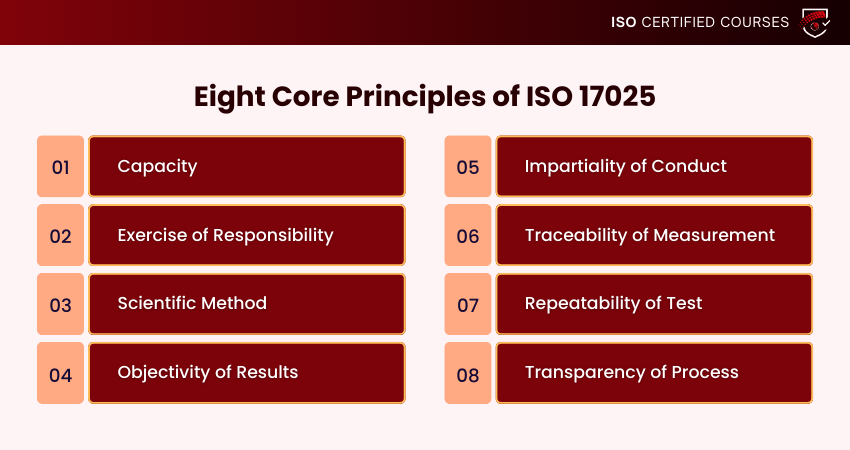
1) Capacity
A laboratory must have enough resources to do its work. Capacity means:
a) Enough skilled staff
b) Proper equipment and space
c) Correct materials for testing
For example, if a food laboratory accepts more samples than it can test, results may be delayed or rushed, causing mistakes.
2) Exercise of Responsibility
Every laboratory must take responsibility for its actions. This means:
a) Clear roles for staff
b) Accountability for results
c) Responsibility to clients and regulators
For example, if a mistake happens, the laboratory should not hide it. Instead, it should admit, correct, and learn from it. Responsibility builds trust with customers.
Gain expertise in auditing risk and elevate your Internal Audit role with our
ISO 17025 Internal Auditor Training
– Join now!
3) Scientific Method
A laboratory must use proper scientific methods. This includes:
a) Following tested and approved procedures
b) Using reliable tools and techniques
c) Checking methods with trials and validations
For example, if a water laboratory uses random methods, the test results may harm people. Using proper scientific methods keeps results safe and credible.
4) Objectivity of Results
Objectivity means results are based only on facts, not opinion. A lab should:
a) Avoid pressure from clients
b) Make decisions only with data
c) Keep personal bias out of reports
For example, if a company pays for testing, the laboratory should still report the real result, even if it is bad for the company. Objectivity protects fairness.
5) Impartiality of Conduct
A laboratory must act impartially at all times. This means:
a) No favouritism
b) No conflict of interest
c) Equal treatment for all clients
For example, if two companies send samples, both should get the same honest treatment. Impartiality keeps the lab’s reputation clean.
6) Traceability of Measurement
Traceability means every measurement can be linked back to a standard. This ensures results are consistent worldwide.
For example, if a laboratory measures sugar in juice, that measurement should connect to an international unit like grams or milligrams. This way, anyone in the world can understand and compare results.
7) Repeatability of Test
Results must be repeatable, which means:
a) If the same test is done again under the same conditions, the result should be the same.
b) Staff should follow standard methods to avoid random errors.
For example, if a medical laboratory tests blood sugar twice in the same sample, the results should not be wildly different.
8) Transparency of Process
Labs must be transparent in how they work. Transparency means:
a) Clear records of methods.
b) Open communication with clients.
c) Documentation of all steps.
For example, if a wrong medicine test result is found, clear records help locate the error.
Become a Lead Auditor: lead Risk Management audits confidently with our
ISO 17025 Lead Auditor Training
– Join now!
What are the Requirements for ISO 17025?
ISO 17025 Principles and requirements guide labs to stay competent, fair, and reliable in testing or calibration. Below is a simple explanation of the main requirements:
1) General Requirements
a) The laboratory must work in a fair and impartial way
b) It must handle customer information confidentially
c) It should avoid any conflict of interest in its work
d) All activities must follow legal and regulatory rules
2) Structural Requirements
a) The laboratory must have a clear organisational structure
b) Roles, responsibilities, and authority of staff should be well-defined
c) Management must ensure enough resources are available
d) Staff must know who they report to and who makes key decisions
3) Resource Requirements
a) Staff must be trained, qualified, and competent
b) Equipment and facilities must be suitable, safe, and well-maintained
c) Reference materials and standards must be correct and traceable
d) Supporting services must be reliable and managed
4) Process Requirements
a) Clear methods and procedures for testing and calibration must be in place
b) All measurements must be valid, accurate, and repeatable
c) Sampling, handling, transport, and storage of test items must be proper
d) Records of results should be complete and easy to trace
5) Management System Requirements
a) The laboratory must have a Quality Management system (like ISO 9001 style)
b) Usual internal audits and management reviews must be done
c) Non-conformities (mistakes or failures) must be recorded and corrected
d) Continuous improvement should always be encouraged
What are the Benefits of ISO 17025 Accreditation?
The Benefits of ISO 17025 Accreditation come from following the ISO 17025 Principles, helping labs gain trust, global recognition, and reliable quality results. These are the benefits:
1) Trust and Credibility: People can trust the lab’s results because they know the work is done properly.
2) International Recognition: Test reports are accepted in other countries, so there is no need to repeat the same test. This saves money and time.
3) Better Quality: Labs keep their test methods updated, so results are always correct and reliable.
4) Skilled Staff: Workers receive regular training, which helps them do their job better.
5) Fewer Mistakes: Clear rules and systems help the laboratory avoid errors.
6) Customer Confidence: Clients feel safe using the lab’s services, knowing the results can be trusted.
7) More Business: Accredited labs are often chosen for projects, giving them more contracts and opportunities.
For example, a construction company may prefer an accredited laboratory to test cement or steel because safety depends on accurate results.
Conclusion
The ISO 17025 Principles give laboratories a strong foundation to deliver accurate, fair, and trusted results. They ensure competence, improve quality, and build global recognition. For industries, businesses, and individuals, these principles mean safer products and reliable services. By following ISO 17025, labs not only prove their credibility but also strengthen confidence in science and everyday decisions.
Gain expertise in ISO 27005 to proactively identify, assess, and treat risks. Join our ISO 17025 Training now!
Search Smarter
Quickly search through our blog content for what interests you
- ISO 9001 Principles: Quality Management Principles Explained
- ISO 9000 vs ISO 9001: Choosing the Right Quality Standard
- Key Differences Between ISO 9001 and 22000: Explained
- ISO 9001 Requirements: Key Elements for Quality Management
- ISO 45001 Implementation: Benefits and Step-by-Step Guide
- 17 Key Elements of ISO 14001 Environmental Management System
- ISO 14001 Checklist: Key Requirements for ISO 14001
- ISO 45001 Objectives: Definition, Plans to Achieve and Examples
- Difference Between OHSAS 18001 and ISO 45001: Detailed Comparison
- ISO 14001 and ISO 50001: What are the Differences?
- What is ISO 27001:2022? Clauses and Requirements Explained
- What is an Integrated Management System (IMS) and its Components?
- ISO 13485 Benefits Explained: What Manufacturers Must Know
- ISO 20000 vs ISO 27001: A Complete Comparison Guide 2026
- ISO 13485 vs ISO 9001: A Complete Comparison and Usage Guide 2026
- ISO 27001 vs. ISO 22301: Key Differences & Similarities Explained
- ISO 26000: A Guide to Social Responsibility Standards
No match found
Frequently Asked Questions
No FAQs available for this blog.