



ISO 27001 vs. ISO 22301: Key Differences & Similarities Explained
ISO 27001 and ISO 22301 are international standards that help organisations manage risks and strengthen resilience. ISO 27001 focuses on protecting information through an Information Security Management System, while ISO 22301 ensures business continuity during disruptions. They help businesses safeguard data and maintain operations.

Imagine trying to run your business when your systems are down, your data is at risk and your team cannot continue their work. Situations like this are very common in today’s digital environment. Cyberattacks, system failures and other unexpected disruptions can stop your business operations. This is where ISO 27001 and ISO 22301 become important.
Businesses deserve these structured frameworks to protect their information and ensure smooth operations. In this blog, we will explore what these standards are, the differences and similarities of ISO 22301 vs ISO 27001 and how they help organisations build stronger security practices. Let's dive in!
Table of Contents
1) What is ISO 27001?
2) What is ISO 22301?
3) The Key Differences Between ISO 27001 and ISO 22301
4) The Key Similarities Between ISO 27001 and ISO 22301
5) How Combination of ISO 27001 and ISO 22301 Helps Your Organisation?
6) Conclusion
What is ISO 27001?
ISO 27001 is a globally recognised standard that provides a framework for establishing, implementing, maintaining and continuously improving an Information Security Management System (ISMS). It helps a diverse range of organisations protect sensitive information by following a risk-based approach.
ISO 27001 requires businesses to identify potential security risks, implement appropriate controls and regularly monitor their security practices. It helps strengthen data protection, reduce the chances of security breaches and build greater trust with customers as well as stakeholders.
What is ISO 22301?
ISO 22301 is another international standard that’s used for Business Continuity Management Systems (BCMS). It focuses on ensuring that organisations can continue operating during disruptive events like cyberattacks, natural disasters, supply chain failures or system outages.
The purpose of ISO 22301 is to help businesses prepare, respond and recover from disruptions in a structured manner. Instead of focusing only on preventing incidents, this standard makes sure that the most critical business operations can continue even when unexpected events arise.
The Key Differences Between ISO 27001 and ISO 22301
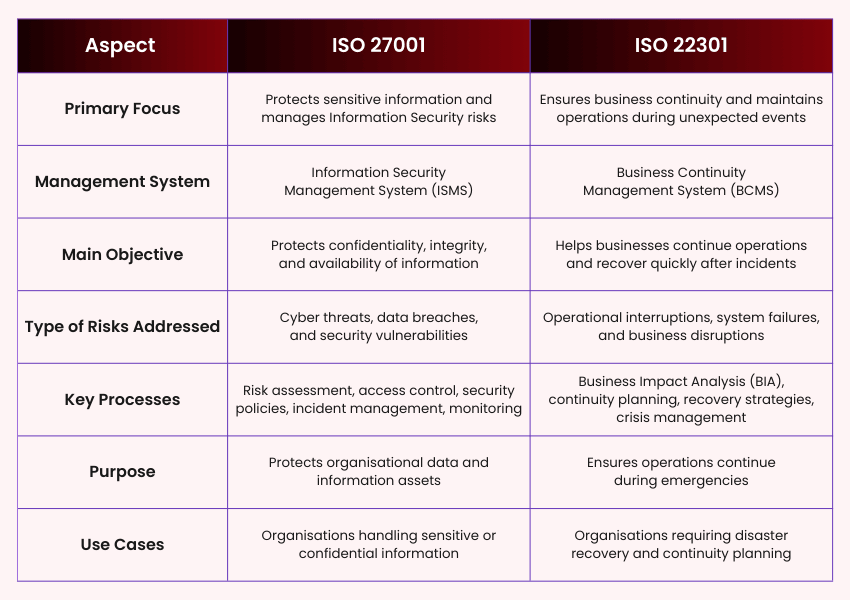
Although ISO 27001 and ISO 22301 share several structural similarities, they serve different organisational purposes. Understanding their differences helps organisations determine how each standard contributes to Risk Management and resilience. So, let's check the differences between ISO 27001 and ISO 22301 in detail:
1) Scope and Primary Focus
The most visible difference between ISO 27001 and ISO 22301 lies in their core objectives and scope. ISO 27001 focuses on protecting information assets from threats such as cyberattacks, data breaches, unauthorised access, and information leakage.
In contrast, ISO 22301 focuses on ensuring operational continuity during disruptions. Instead of protecting data specifically, it aims to ensure that business operations can work even during unexpected events.
2) Core Framework and Key Components
The foundation of ISO 27001 is the CIA triad, which is the three principles of Information Security: Confidentiality, Integrity, and Availability. Confidentiality ensures only authorised people can access information. Integrity ensures data remains accurate and is not changed without permission. Availability means authorised users can access information and systems whenever they need them.
However, ISO 22301 is centred around Business Impact Analysis (BIA). BIA helps organisations identify critical business processes and evaluate how disruptions could affect them. It helps develop recovery strategies and continuity plans to minimise downtime and maintain essential services during unexpected events.
3) Approach to Risk Management and Objectives
ISO 27001 assesses risks related to Information Security threats like malware attacks, insider threats, system vulnerabilities, and data breaches. Meanwhile, ISO 22301 evaluates risks related to business disruptions such as natural disasters, infrastructure failures, supply chain interruptions, or operational crises.
In a nutshell, ISO 27001 focuses on preventing and mitigating security threats, whereas ISO 22301 focuses on ensuring business continuity and recovery.
4) Impact on Certification
ISO 27001 certification shows that an organisation has implemented an effective ISMS and follows recognised Information Security controls. In the same way, ISO 22301 certification confirms that the organisation has implemented a structured BCMS capable of responding to incidents and maintaining operations.
Achieving these certifications enhances organisational credibility and builds trust with customers, partners, and stakeholders. It also improves regulatory compliance and strengthens a business’s reputation in competitive markets.
Strengthen your knowledge of operational resilience with
ISO 22301 Foundation Training
– Register today!
The Key Similarities Between ISO 27001 and ISO 22301
Despite their different purposes, ISO 27001 vs ISO 22301 share several structural and operational similarities. So, here are the aspects in which ISO 22301 and ISO 27001 are similar:
1) Conducting Internal Audits
Both standards require organisations to conduct regular internal audits to check the effectiveness of their management systems. This helps organisations identify gaps, assess compliance with policies, and ensure that controls are functioning as intended.
2) Control of Documents and Records
ISO 22301 and ISO 27001 both require organisations to maintain proper document control procedures. They require the policies, procedures, risk assessments, and audit reports to be documented, updated regularly, and accessible to authorised personnel.
3) Management Review Process
Another key similarity is the requirement for management reviews. Senior leadership needs to review the performance of the management system on a regular basis to ensure that it is aligned with organisational goals.
4) Awareness and Training
Employee training and awareness play a prominent role in both standards. Businesses have to ensure that employees understand their roles and contribute accordingly to the organisational success.
5) Corrective Measures and Continuous Improvement
Both ISO 22301 and ISO 27001 emphasise the importance of taking corrective measures and continuously improving the management system. When issues or security incidents arise, businesses investigate the root cause and implement corrective actions. Both standards follow the Plan-Do-Check-Act (PDCA) cycle for continuous improvement.
How Combination of ISO 27001 and ISO 22301 Helps Your Organisation?
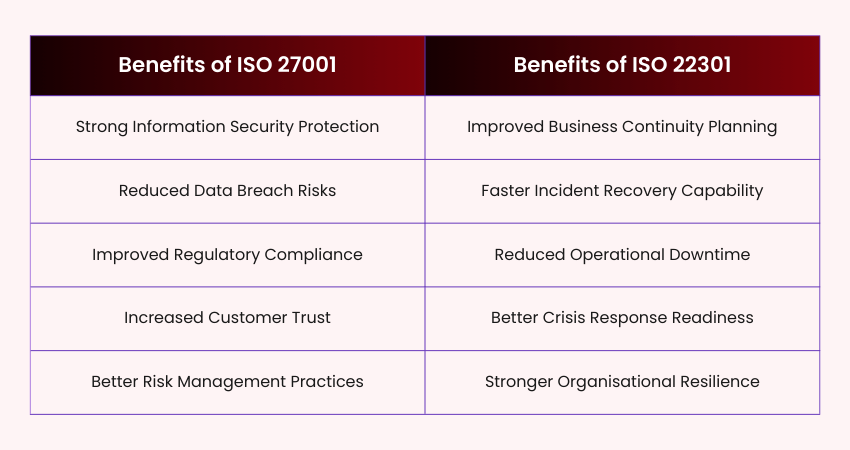
Implementing ISO 27001 and ISO 22301 together helps organisations build a stronger Risk Management framework. While ISO 27001 protects information assets from security threats, ISO 22301 ensures that business operations can continue without any disruptions. When they work together, they address both security and continuity holistically.
Organisations that adopt both standards benefit in several ways including:
1) Improved organisational resilience
2) Stronger protection of sensitive information
3) Reduced operational downtime and faster recovery from disruptions
4) Enhanced customer and stakeholder trust
5) Better compliance with regulatory requirements
Conclusion
ISO 27001 and ISO 22301 are two essential standards that help organisations manage risks and maintain operational stability. Although their primary objectives differ, both standards share similar management principles such as risk assessment and continuous improvement. Adopting both standards not only strengthens security and continuity practices but also helps build trust with customers, stakeholders, and regulatory bodies.
Understand how organisations protect sensitive information with
ISO 27001 Foundation Training
– Join now!
Search Smarter
Quickly search through our blog content for what interests you
- ISO 9001 Principles: Quality Management Principles Explained
- ISO 9000 vs ISO 9001: Choosing the Right Quality Standard
- Key Differences Between ISO 9001 and 22000: Explained
- ISO 9001 Requirements: Key Elements for Quality Management
- ISO 45001 Implementation: Benefits and Step-by-Step Guide
- 17 Key Elements of ISO 14001 Environmental Management System
- ISO 17025 Principles: Explained in Detail
- ISO 14001 Checklist: Key Requirements for ISO 14001
- ISO 45001 Objectives: Definition, Plans to Achieve and Examples
- Difference Between OHSAS 18001 and ISO 45001: Detailed Comparison
- ISO 14001 and ISO 50001: What are the Differences?
- What is ISO 27001:2022? Clauses and Requirements Explained
- What is an Integrated Management System (IMS) and its Components?
- ISO 13485 Benefits Explained: What Manufacturers Must Know
- ISO 20000 vs ISO 27001: A Complete Comparison Guide 2026
- ISO 13485 vs ISO 9001: A Complete Comparison and Usage Guide 2026
- ISO 26000: A Guide to Social Responsibility Standards
No match found
Frequently Asked Questions
No FAQs available for this blog.