
























ISO 14001 Checklist: Key Requirements for ISO 14001
The ISO 14001 Checklist helps organisations build and manage an effective Environmental Management System (EMS) with defined environmental policies. It covers key areas like leadership, planning, operations, performance evaluation and monitoring. It typically improves sustainability, tracks performance, and supports continual improvement.

Are you confident your organisation is meeting its environmental responsibilities or just hoping for the best? As sustainability expectations grow and regulations tighten, businesses need to go beyond good intentions. It is no longer enough to say you care about the environment. Now, you need to prove it with a structured, reliable system.
That’s where ISO 14001 comes in. This globally recognised standard provides a clear framework for building an Environmental Management System (EMS). A well-crafted checklist can help you understand where you need to improve. In this blog, we’ll walk you through everything you need to know to create and use an ISO 14001 Checklist for EMS success. Let’s get started!
Table of Contents
1) What is an ISO 14001 Checklist?
2) Why is the ISO 14001 Checklist Important?
3) What to Include in an ISO 14001 Checklist?
4) What are the Steps to Implement ISO 14001?
5) Conclusion
What is an ISO 14001 Checklist?
An ISO 14001 Checklist is a structured tool that helps organisations ensure they meet all the requirements of the ISO 14001 standard. ISO 14001 standard is an internationally recognised framework for creating and maintaining an EMS.
This checklist provides each clause of the standard into simple, manageable steps, making it easier for businesses to implement ISO 14001 effectively. By using it, you can monitor your environmental processes and identify areas for improvement.
Why is the ISO 14001 Checklist Important?
A well-designed ISO 14001 Checklist plays a crucial role in helping businesses implement, monitor and maintain their EMS. Here's how it is important for every business:
1) Clarity and Consistency: It simplifies complex ISO 14001 requirements, making them easier for teams to understand and apply uniformly across the organisation.
2) Audit Preparedness: It supports internal teams in preparing for external audits by helping them identify and address nonconformities before they escalate.
3) Evidence-based Compliance: Encourages proper documentation and record-keeping, ensuring that activities align with ISO standards.
4) Continuous Improvement: Serves as a recurring reference point for reviewing and enhancing environmental performance.
5) Risk Management:
Identifies potential environmental risks and ensures they’re being proactively managed through documented processes.
What to Include in an ISO 14001 Checklist?
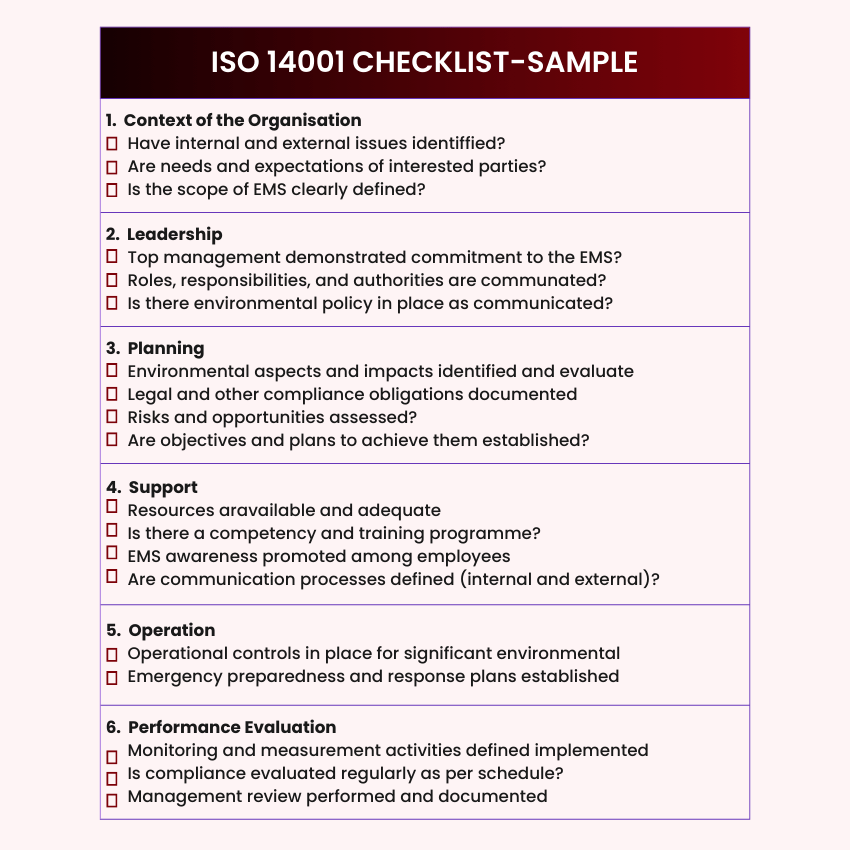
To be effective, the checklist should follow the structure of the ISO 14001 standard. Below are the essential clauses that need to be covered:
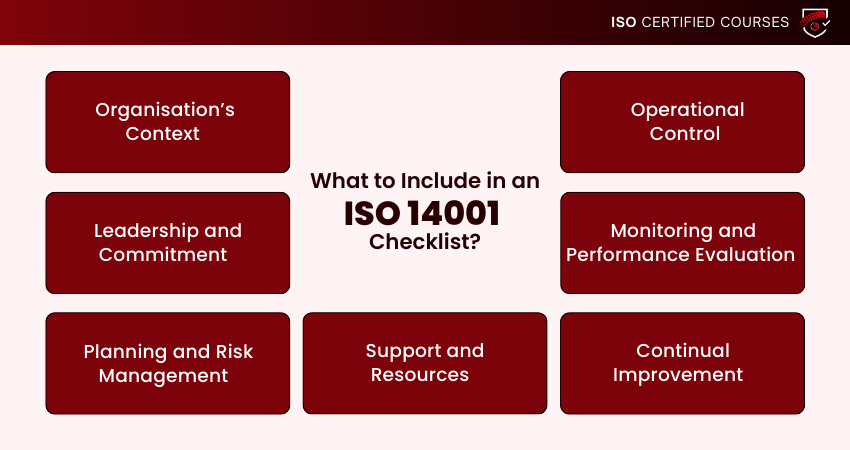
Clause 4: Understanding the Organisation’s Context
This clause establishes the foundation by assessing internal and external factors that affect your EMS. It ensures that your EMS is aligned with the realities of your organisation's environment
Identify Internal and External Issues:
1) Examine the legal, economic, social, technological, and regulatory aspects that could affect your environmental goals.
2) Internal factors include your organisation’s culture, structure, and available resources.
3) External factors include market trends, industry developments, and applicable environmental regulations.
Define the EMS Scope:
1) Clearly state your EMS's limitations and areas of application.
2) Think about your physical locations, products, services, and activities.
3) A focused scope ensures efforts are targeted and effective.
Become the driving force behind sustainable change with our
ISO 14001 Lead Implementer Training – Register today!
Clause 5: Leadership and Commitment
Leadership plays a prominent role in integrating the EMS into your organisation’s culture. Without strong leadership support, the EMS is unlikely to succeed.
Establish and Communicate the Environmental Policy:
1) Develop an environmental policy that promotes legal compliance, pollution prevention, and continual improvement.
2) Ensure the policy is communicated internally to all employees and available to the stakeholders.
3) Encourage environmental responsibility at all organisational levels.
Define Roles and Responsibilities:
1) Clearly define who is responsible for what within the EMS.
2) Ensure individuals have the authority to act on environmental matters.
3) Make all job functions and departments aware of their responsibilities.
Clause 6: Planning and Risk Management
This clause focuses on planning actions to address risks, opportunities, compliance obligations, and environmental objectives.
Conduct a Risk and Opportunity Assessment:
1) Identify environmental risks and opportunities linked to your activities, services, and products.
2) Consider legal obligations, environmental aspects, market demands, and technological changes.
3) Use this insight to shape your EMS and minimise negative outcomes while maximising opportunities.
Develop Action Plans:
1) Assign tasks, deadlines, and materials to achieve goals.
2) Regularly check on progress and revise plans as necessary.
3) Include ongoing, systematic improvement in your environmental planning.
Clause 7: Support and Resources
The success of your EMS depends on having the right support systems and resources in place. This includes everything from trained personnel to effective communication systems that enable the EMS to operate efficiently and improve over time.
Determine and Allocate Resources:
1) Identify the personnel, infrastructure, and budget needed to run your EMS.
2) Ensure resources are available and used effectively.
3) Performance and compliance are supported by appropriate allocation.
Build Competence and Awareness:
1) Provide training on the organisation’s environmental policy, objectives, and individual responsibilities.
2) Increase EMS awareness in every department.
3) Well-informed employees will be more engaged and effective.
Clause 8: Operational Control
Operational control ensures that activities with potential environmental impact are managed in a consistent, responsible way. It ensures that processes are controlled, sustainable, and aligned with EMS goals.
Identify Significant Operational Processes:
1) Look for activities that have an impact on the environment.
2) Focus control efforts on areas that are high-impact or high-risk.
3) Prioritise key processes to strengthen control.
Implement Controls and Procedures:
1) Apply engineering or administrative controls where needed.
2) Processes should be clearly documented and shared with employees.
3) Reliability and compliance are enhanced by consistent procedures.
Clause 9: Monitoring and Performance Evaluation
This clause ensures your EMS is working as intended through regular tracking, audits, and top-level reviews. It helps identify strengths and opportunities for improvement.
Create a Monitoring and Measurement Plan:
1) Decide which metrics you will monitor and how data will be collected.
2) Make sure the strategy fits your goals and legal requirements.
3) Decision-making and progress are supported by reliable monitoring.
Conduct Internal Audits:
1) Check if the EMS satisfies internal and ISO 14001 requirements.
2) Find any gaps or nonconformities, then record your findings.
3) Update processes and procedures based on audit results.
Strengthen your organisation’s environmental compliance with our
ISO 14001 Internal Auditor Training
– Join soon!
Clause 10: Continual Improvement
This clause focuses on enhancing your EMS over time by learning from performance data, feedback, and nonconformities. It ensures your system remains relevant, effective, and aligned with evolving environmental and organisational needs.
Analyse Data and Identify Improvement Areas:
1) To identify gaps, use trends, stakeholder feedback, and audit findings.
2) Understand the root causes of issues.
3) Make improvements where they will have the greatest effect.
Implement Corrective and Preventive Actions:
1) Fix problems at their source and prevent them from recurring.
2) Document actions clearly and assign responsibility.
3) A proactive approach can build a stronger EMS.
What are the Steps to Implement ISO 14001?
Here are the steps to implement ISO 14001:
1) Understand the Standard: Review ISO 14001 and focus on the Plan-Do-Check-Act (PDCA) cycle.
2) Secure Leadership Commitment: Ensure proper policy is set and resources are allocated.
3) Conduct a Gap Analysis: Compare current practices with ISO 14001 requirements to identify areas to improve.
4) Plan Your EMS: Set clear environmental goals and develop a good action plan with responsibilities.
5) Implement EMS Procedures: Integrate procedures into daily operations and align them with existing processes.
6) Train and Engage Staff: Provide training on EMS roles, responsibilities, and compliance to build awareness and competence.
7) Monitor and Audit: Track key indicators, perform internal audits, and assess EMS performance.
8) Take Corrective Action: Address non-conformities, implement improvements, and document actions taken.
Using the PDCA Cycle in ISO 14001:
The Plan-Do-Check-Act (PDCA) cycle is central to ISO 14001 and gives a practical way to structure your EMS plan. Here is what it means:
1) Plan: Set goals, identify risks, and prepare your EMS
2) Do: Include your procedures and collect data
3) Check: Monitor performance and conduct audits
4) Act: Correct issues, improve processes, and update the EMS
Repeating the PDCA cycle ensures continuous improvement and long-term success.
Conclusion
Implementing ISO 14001 is an ongoing journey of environmental responsibility and operational improvement. An ISO 14001 Checklist will act as a strategic asset for achieving environmental performance and compliance. As your business grows and environmental challenges shift, a well-maintained checklist ensures your EMS remains fit for purpose.
promote sustainable operations with our ISO 14001 Training – Explore now!
Search Smarter
Quickly search through our blog content for what interests you
- ISO 9001 Principles: Quality Management Principles Explained
- ISO 9000 vs ISO 9001: Choosing the Right Quality Standard
- Key Differences Between ISO 9001 and 22000: Explained
- ISO 9001 Requirements: Key Elements for Quality Management
- ISO 45001 Implementation: Benefits and Step-by-Step Guide
- 17 Key Elements of ISO 14001 Environmental Management System
- ISO 17025 Principles: Explained in Detail
- ISO 45001 Objectives: Definition, Plans to Achieve and Examples
- Difference Between OHSAS 18001 and ISO 45001: Detailed Comparison
- ISO 14001 and ISO 50001: What are the Differences?
- What is ISO 27001:2022? Clauses and Requirements Explained
- What is an Integrated Management System (IMS) and its Components?
- ISO 13485 Benefits Explained: What Manufacturers Must Know
- ISO 20000 vs ISO 27001: A Complete Comparison Guide 2026
- ISO 13485 vs ISO 9001: A Complete Comparison and Usage Guide 2026
- ISO 27001 vs. ISO 22301: Key Differences & Similarities Explained
- ISO 26000: A Guide to Social Responsibility Standards
No match found
Frequently Asked Questions
No FAQs available for this blog.